Vircurex Taxes: How to Import Your Historical Data & Generate Your Tax Report
Vircurex was one of the earliest Bitcoin exchanges, operating from 2011 until 2014 when it was forced to close after suffering security breaches that left it unable to honour user withdrawals. But closing does not erase your tax obligations — every trade you made on the platform remains a taxable event. CoinTracking accepts your Vircurex CSV export, calculates gains and losses across your full trading history, and generates a tax report ready for your accountant or tax authority.

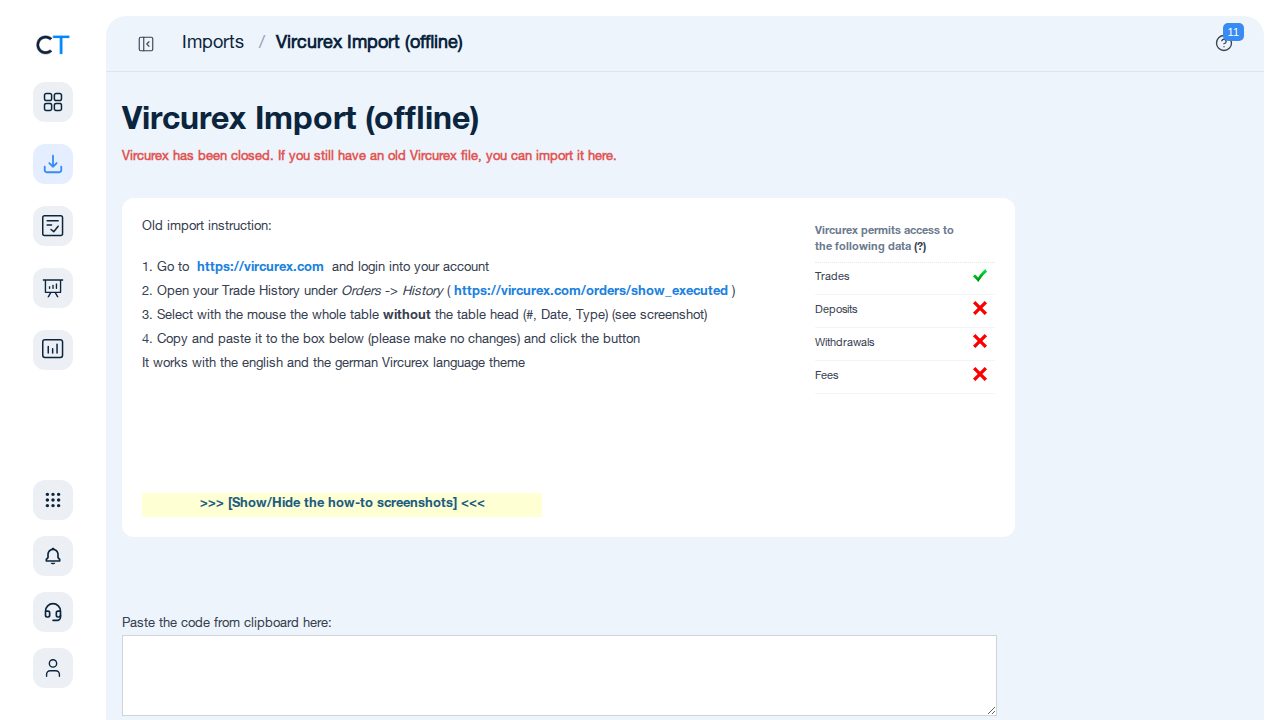
How to Import Your Vircurex Transactions into CoinTracking
Watch how to upload your Vircurex CSV export into CoinTracking and generate your complete crypto tax report — even for historical data from one of Bitcoin's earliest exchanges.
Start Your Free Vircurex Import- Every crypto trade, swap, and disposal on Vircurex is a taxable event in most jurisdictions. Capital gains tax obligations apply to historical transactions regardless of how long ago they occurred or whether the exchange still operates.
- CoinTracking imports Vircurex transactions via CSV export (manual upload). Upload your Vircurex trade history CSV file to import your full historical trading data.
- Transferring crypto between your own wallets or accounts is not a taxable event. Buying and holding crypto is not taxable until disposal.
- Vircurex closed in 2014. You can still import historical data via CSV. Your tax obligations for trades made on Vircurex remain in effect — all gains, losses, and income must be declared for the relevant tax years. CoinTracking supports CSV import for historical Vircurex data.
Vircurex and Your Crypto Tax Obligations
Vircurex was one of the pioneering cryptocurrency exchanges, launching in 2011 at a time when Bitcoin trading platforms were extremely rare. It allowed users to trade Bitcoin and a handful of early altcoins. The exchange was forced to close in 2014 after a series of security breaches left it unable to honour user withdrawals. Despite its long closure, the tax obligations arising from trades executed on the platform remain fully in force.
Vircurex operated without a clearly defined regulatory jurisdiction and was not an EU-regulated CASP, so EU DAC8 reporting requirements did not apply. You remain personally responsible for declaring all taxable events from your Vircurex trading history, regardless of how long ago those trades occurred.
CoinTracking supports Vircurex via CSV import:
- Vircurex CSV: upload your trade history CSV export for a full import of all your trades, deposits, and withdrawals
- All spot trades, Bitcoin and early altcoin disposals are supported
- Historical data from closed exchanges is fully compatible with CoinTracking\'s tax engine
- Generate back-tax reports for prior years if you have not yet declared your Vircurex activity
Crypto Tax Basics: What Vircurex Users Need to Know
Vircurex served early Bitcoin traders from around the world. With transactions potentially dating back to 2011, the tax treatment of these early-era trades requires careful handling. The core principles below apply broadly — but always verify the specifics with your local tax authority or a qualified tax advisor.
Every disposal is a taxable event
In most countries, selling, swapping, or otherwise disposing of cryptocurrency triggers capital gains tax. The gain or loss equals the difference between your proceeds and your cost basis (what you originally paid, including fees). This applies to each individual trade made on Vircurex — even those from over a decade ago. The very low Bitcoin prices in 2011–2014 mean that anyone who later sold those coins may have significant gains to report.
Obligations survive exchange closure
The closure of Vircurex in 2014 does not eliminate your tax obligations for trades made while the exchange was active. Tax authorities in most jurisdictions can assess back-taxes for unreported gains. If you have not yet declared your Vircurex trading history, you should consider filing retroactively using your historical CSV data. CoinTracking can generate tax reports for any prior year from your imported data.
Record-keeping with CSV exports
Since Vircurex has been closed since 2014, your CSV export file is the primary — and likely only — record of your trading history on the platform. Importing this data into CoinTracking converts it into a structured tax report with a full audit trail, formatted for your jurisdiction. CoinTracking uses historical price databases to fill in market prices for early-era trades where needed.
Vircurex Taxes by Country
Vircurex served traders worldwide in Bitcoin\'s early years. Crypto tax rules differ by market — below are the key rates, deadlines and filing rules for the countries where CoinTracking users most commonly report their Vircurex history.
 Germany
- Disposal tax: Personal income tax rate (up to 45%); gains are tax-free if held longer than 1 year (Haltefrist)
- Annual exemption: Gains up to €1,000/year are tax-free
- Business income: If trading is a business activity, profits are taxed as Gewerbeeinkünfte (trade income)
- Cost basis: FIFO per wallet
- Authority: Finanzamt
- Forms: Anlage SO, Anlage KAP
 United Kingdom
- Capital Gains Tax: 18% (basic rate) or 24% (higher rate) from October 2024
- Annual exempt amount: £3,000 (2024/25 onward)
- Trading income: If HMRC classifies activity as a trade, profits are subject to Income Tax at marginal rates
- Cost basis: Section 104 pool (HMRC rules)
- Authority: HMRC
- Forms: Self Assessment SA100, SA108
 United States
- Short-term gains: Taxed as ordinary income (up to 37%); applies to assets held 1 year or less
- Long-term gains: 0%, 15%, or 20% depending on income; applies to assets held more than 1 year
- Cost basis: Specific identification preferred; FIFO as default
- Authority: Internal Revenue Service (IRS)
- Forms: Schedule D, Form 8949
 Austria
- 27.5% capital gains tax: Since March 2022, crypto is taxed like shares — a flat 27.5% KESt applies to gains.
- Old coins grandfathered: Crypto acquired before 28 February 2021 is tax-free on disposal.
- Business income: Professional trading activity may be taxed as business income at progressive rates.
- Authority: Finanzamt Austria. Report via Einkommensteuererklärung (E1 / E1kv).
 Switzerland
- Capital gains: Generally tax-free for private investors; professional traders are taxed as self-employed income
- Wealth tax: Crypto holdings subject to wealth tax at cantonal rates based on year-end market value
- Business trading: High-frequency or leveraged trading may be classified as professional activity and taxed accordingly
- Authority: Cantonal tax authority (varies by canton)
 Spain
Spain
- Savings income (IRPF): 19% up to €6,000; 21% up to €50,000; 23% up to €200,000; 27% up to €300,000; 28% above
- Foreign crypto disclosure: Modelo 721 required if portfolio exceeds €50,000 abroad
- Business activity: Classified as rendimientos de actividades económicas if trading is a professional activity
- Authority: Agencia Tributaria (AEAT)
- Forms: Modelo 100 (IRPF), Modelo 721
 Poland
- Flat rate: 19% on all crypto gains (no holding period exemption)
- Loss carryforward: Up to 5 years
- Business income: Professional crypto trading may be taxed under business income rules
- Cost basis: FIFO
- Authority: Urząd Skarbowy
- Form: PIT-38
 Italy
Italy
- Flat rate: 26% on gains exceeding €2,000/year (from 2023)
- Foreign holdings disclosure: Quadro RW required if portfolio exceeds €15,000
- Business income: Corporate and professional traders taxed under IRES/IRPEF rules
- Authority: Agenzia delle Entrate
- Forms: Quadro RT (gains), Quadro RW (foreign holdings)
 France
- Flat 30% tax (PFU): Gains from crypto disposals are subject to the prélèvement forfaitaire unique (PFU) — 12.8% income tax + 17.2% social charges.
- No exemption for holding period: Unlike Germany, there is no tax-free threshold after 1 year.
- Professional traders: High-frequency trading may be classified as BNC (non-commercial income) at progressive rates.
- Authority: Direction générale des Finances publiques (DGFiP). Declare via Formulaire 2086.
Tax rules change frequently. This overview is for general information only and does not constitute tax advice. Consult a qualified advisor for your specific situation.
Are Vircurex Transactions Taxable?
In most jurisdictions, crypto is treated as an asset: disposing of it triggers capital gains tax. These rules apply to your historical Vircurex trading data — even for transactions that took place over a decade ago. Use this as a starting reference — exact rules vary by country.
Taxable Events
- Selling Bitcoin or altcoins for fiat
- Swapping or trading crypto for crypto
- Using crypto to pay for goods or services
- Referral rewards and bonuses received
Not Taxable
- Buying and holding crypto
- Transferring crypto between your own accounts
- Depositing fiat to Vircurex
- Receiving crypto as a personal gift
Tax treatment varies by country. CoinTracking applies the rules for your selected jurisdiction automatically.
How to Calculate Your Vircurex Taxes
Even if Vircurex closed back in 2014, you still need to account for every trade you made on the platform. Calculating cost basis, holding periods, and gains for early-era Bitcoin and altcoin transactions is especially challenging without automation — particularly when market prices from 2011–2014 must be retrieved from historical data sources.
CoinTracking imports your complete Vircurex trade history via CSV, applies your chosen cost-basis method (FIFO, LIFO, HIFO, and others), uses historical price databases to fill any market price gaps, and produces a jurisdiction-specific tax report. Historical data from prior tax years is fully supported — you can generate back-tax reports for any year covered by your Vircurex CSV file.
The result is a tax report — PDF or Excel — that your accountant or tax authority will accept, with a full audit trail for every transaction.
How to Import Vircurex into CoinTracking
Three steps to upload your Vircurex CSV and generate your tax report.
- 1
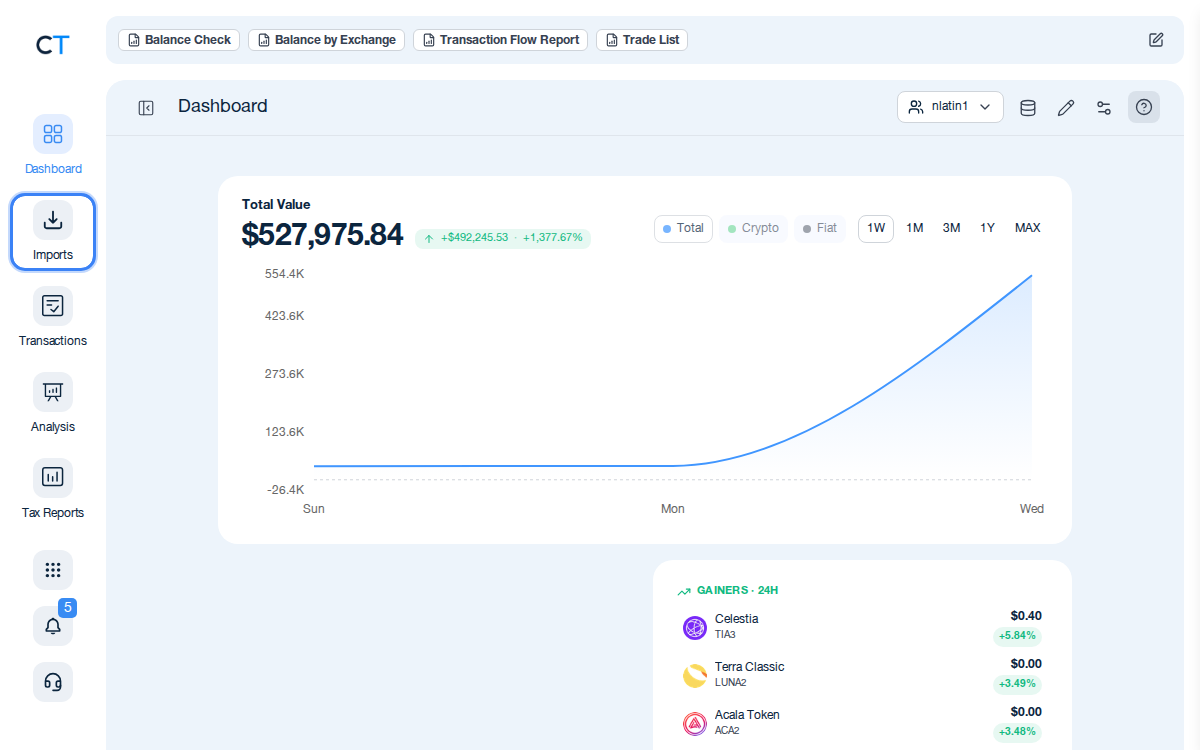
Log into CoinTracking and open Imports
After logging in, click the Import icon in the left navigation. This is where you connect all your exchanges, wallets and blockchains.
- 2
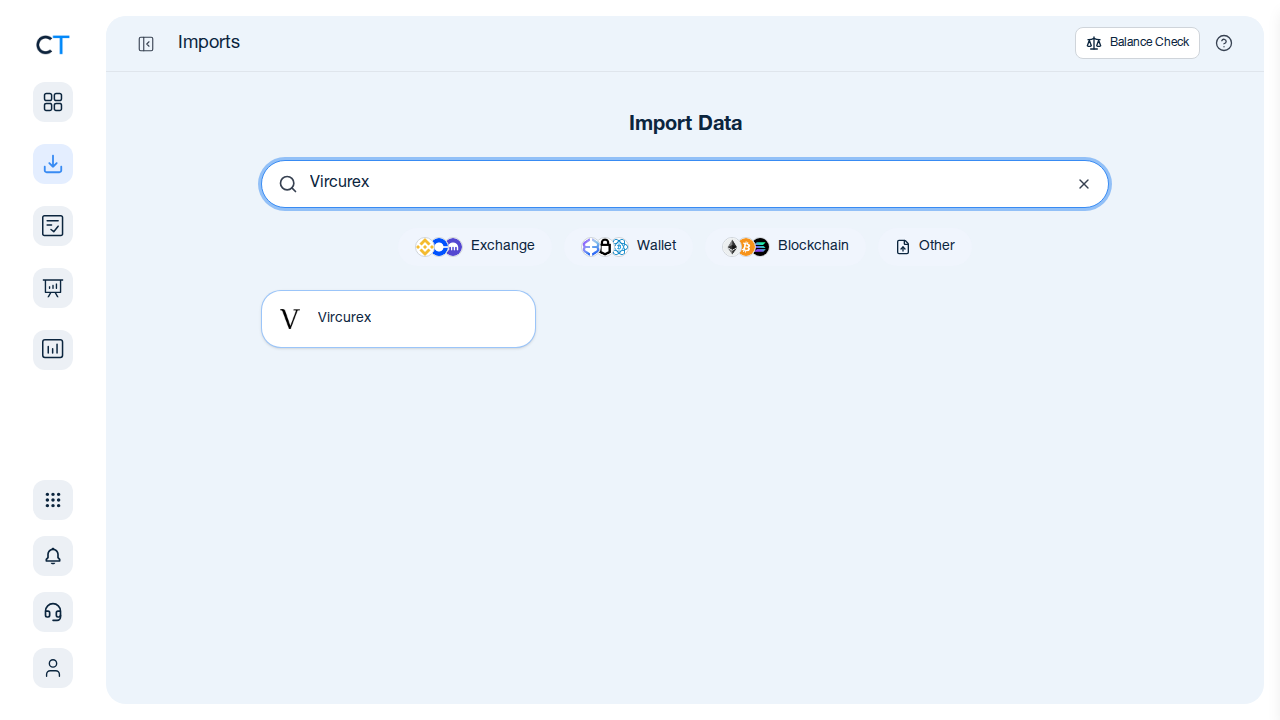
Search for Vircurex in the import list
Type "Vircurex" in the search field. CoinTracking will show the Vircurex import option — select it to proceed with your CSV upload.
- 3
Upload your Vircurex CSV file
Upload your Vircurex trade history CSV export. CoinTracking will import all your historical trades, deposits, and withdrawals automatically and calculate your tax position using historical price data.
"CoinTracking can handle just about any complex transaction you can throw at it and the automation is a real lifesaver. Of all the tax software tools we've reviewed, CoinTracking is the most detail-oriented and has more accuracy checks in place than the competition."

How to Create Your Vircurex
Tax Report with CoinTracking
Three steps from CSV upload to a tax report your accountant will accept.

Upload your Vircurex CSV
Download your Vircurex trade history CSV and upload it to CoinTracking via the Vircurex import. CoinTracking imports all historical Bitcoin and altcoin trades, deposits, and withdrawals automatically.

Review your transactions
Open Reports → Validate Transactions. CoinTracking flags missing cost basis entries, duplicate imports and price gaps so your final report is accurate — essential for early-era historical data from closed exchanges.

Generate and export your tax report
Select your country and tax year. CoinTracking generates a report formatted for your jurisdiction: PDF or Excel, ready to file or hand to your accountant.



No. Vircurex was one of the earliest Bitcoin exchanges, operating from 2011 to 2014 before closing after suffering serious security breaches. It did not generate a ready-to-file tax report. If you still have your old Vircurex CSV export, you can import it into CoinTracking. CoinTracking then calculates gains, losses, and income across your full trading history and generates a compliant tax report for your jurisdiction.
You can still import your historical Vircurex trading data into CoinTracking using a CSV file. If you exported your trade history from Vircurex before it closed, navigate to CoinTracking → Import Data → search for "Vircurex" and upload your CSV file. CoinTracking will parse all your historical trades, deposits, and withdrawals automatically. Given how long ago Vircurex closed, it is important to use any CSV files you may have saved, as the exchange's data is unlikely to be recoverable elsewhere.
Yes. Every sale, swap, or disposal of cryptocurrency through Vircurex is a taxable event in most jurisdictions, even for transactions that took place over a decade ago. Capital gains tax applies to the difference between your cost basis and the proceeds at the time of each trade. Tax authorities in most countries require you to declare gains from all years — including those from closed or defunct exchanges like Vircurex.
Yes. The closure of Vircurex in 2014 does not change your tax obligations for trades executed while the exchange was active. Tax authorities in most jurisdictions can assess back-taxes for unreported gains, often going back many years. If you traded Bitcoin or other cryptocurrencies on Vircurex and have not yet declared those transactions, you should do so retroactively — CoinTracking can process historical CSV data to generate back-tax reports for past years.
Vircurex operated without a clearly defined regulatory jurisdiction and was not an EU-regulated CASP, so EU DAC8 reporting rules did not apply. Given its early operation (2011–2014) and subsequent closure following security breaches, formal reporting to tax authorities may have been limited. Regardless, you remain personally responsible for declaring your crypto gains, losses, and income from your Vircurex activity in your annual tax return for all applicable years.
The correct cost-basis method depends on your jurisdiction. For trades that occurred as far back as 2011–2014, establishing the original purchase price can be challenging — CoinTracking uses historical price data to help fill gaps. In Germany, FIFO per wallet is the recognised method; in the UK, HMRC's Section 104 pooling rule applies. CoinTracking supports FIFO, LIFO, HIFO, and other methods — you can switch between them and instantly recalculate your Vircurex tax report.
Start Tracking Your Crypto Taxes Today
Experience why 2.2 million users trust CoinTracking — sign up today for a seven-day free trial!