
Bitcoin briefly traded below $80,000 in October 2026, according to market reports. Any coin you bought above that level carries an unrealized loss while the price stays lower. That loss counts on your tax return only after you sell. For a calendar-year taxpayer, the sale has to happen by December 31, 2026.
Our year-end crypto tax checklist lists every move to finish before then, and the guide to crypto tax-loss harvesting explains the basics. As of November 1, 2026, proposals to extend the wash-sale rule to crypto have been introduced in Congress, and none of them is law.
Key Takeaways
- The wash-sale rule is written for stock and securities: the IRS has issued no guidance applying it to crypto that is not a security.
- Pending bills would extend it to crypto: the House committee version would start with sales after September 14, 2026.
- Your choice of coins decides the result: the oldest coins sell first unless you record another choice.
- A net loss is deductible up to $3,000 a year: the rest carries forward to later years.
- Basis is only partly reported: brokers report gross proceeds for 2025 and basis only for certain 2026 transactions.
How Tax-Loss Harvesting Works When Bitcoin Falls
Tax-loss harvesting means selling coins for less than your cost basis to realize a capital loss. Your cost basis is what you paid for the coins. The IRS treats digital assets as property, so each sale can produce a gain or a loss.
A holding period of one year or less makes a result short-term, and a longer holding period makes it long-term. Each group is added up on its own first, and the two totals are then combined.
If your losses exceed your gains, the capital loss deduction lets you deduct up to $3,000 of the net loss against other income. The limit is $1,500 if you are married and file separately. The rest carries forward to later years until it is used up, and it stays short-term or long-term.
What the Wash-Sale Rule Says Today
Under the wash-sale rule, a loss on stock or securities is not deductible if you buy substantially identical stock or securities within 30 days before or after the sale.
What is a wash sale?
A wash sale is a loss sale combined with the purchase of a substantially identical asset within 30 days before or after the sale. Substantially identical means essentially the same asset; for stock, this depends on the facts and circumstances. For stock, the loss is not deductible at the time of the sale, but it is added to the cost of the new shares. A sale without such a purchase keeps the loss deductible right away.
Digital assets are not expressly within the scope of that rule, according to a September 2026 analysis by the Joint Committee on Taxation. As of November 1, 2026, the IRS has issued no regulations or guidance applying the rule to crypto that is not a security. The rule therefore does not expressly cover a sale of such crypto followed by a repurchase.
Outside the wash-sale rule, you report the loss as usual. The coins you buy back start with their repurchase price as cost basis and with a new holding period.
Pending Bills Would Extend the Wash-Sale Rule to Crypto
Three bills would apply the wash-sale rule to digital assets. The table shows each bill's latest step as of November 1, 2026, and the date after which sales and other dispositions would fall under the rule. Dates are as introduced, except H.R. 10357, which shows the committee version.
| Bill | Latest step | Would apply to dispositions |
|---|---|---|
| H.R. 10357 | Approved by House committee, 38-5 | After September 14, 2026 |
| S. 5616 | Referred to Senate Finance Committee | After enactment, not for coins acquired earlier |
| H.R. 9172 | Referred to House committee | After June 8, 2026 |
H.R. 10357, the Digital Asset Tax Certainty Act, cleared the House Ways and Means Committee 38 to 5 on September 16, 2026. The committee version keeps the start date of September 14, 2026, the day the bill was introduced.
The Senate bill is S. 5616, the Aligning Digital Assets with Principles of Taxation Act, or ADAPT Act. Senator Daines introduced it on September 30, 2026. As introduced, its wash-sale rule would apply to sales after the date of enactment, and not to coins you acquired before enactment. It would therefore start later than the House version and leave coins you already hold outside the rule.
An earlier House bill, H.R. 9172 of June 8, 2026, has not moved beyond referral to the Ways and Means Committee.
Three Ways to Handle Wash-Sale Risk Before December 31
Sell and Rebuy Right Away
This path relies on the wash-sale rule not expressly covering a sale of crypto that is not a security followed by a repurchase. If the House bill became law as approved by the committee, the rule would reach your sale. The loss would then be disallowed and added to the cost of the coins you bought back. You would recover it only when you sell those coins.
Sell and Wait 31 Days
The rule counts purchases from 30 days before to 30 days after the sale, so a repurchase on day 31 falls outside the window. Purchases you made in the 30 days before the sale count as well, so check your recent buys first. While you wait, the price can move, and that risk is yours.
Sell and Switch to a Different Asset
A different coin changes your market exposure. For crypto, the House bill would define substantially identical only for wrapped or tokenized versions of a coin. These are separate tokens that represent the coin. Under the bill, they would count as substantially identical if they are economically equivalent. Professional help with your crypto taxes can review a specific swap before you make it.
Not selling is a fourth option. An unrealized loss stays open, and you can sell in a later tax year.
Choose Which Coins You Sell
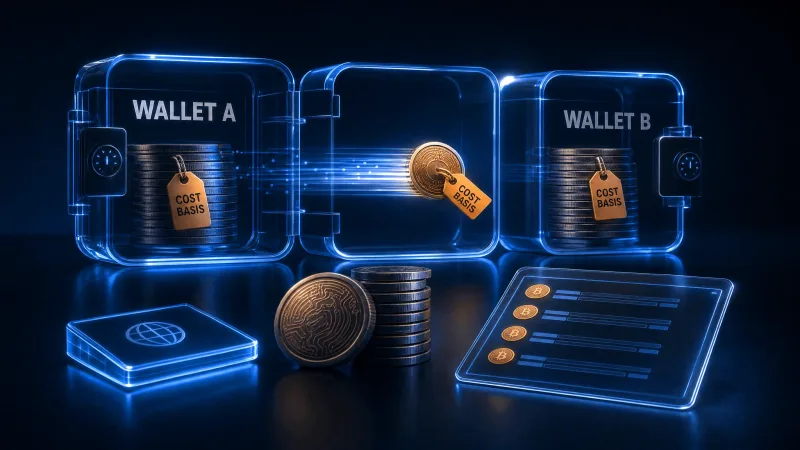
Which coins count as sold decides whether a sale realizes a loss or a gain. Since January 1, 2025, this choice applies to each wallet or account separately, under the final regulations.
For coins in your own wallet, you make a specific identification by recording the particular coins in your records no later than the date and time of the sale. An identifier such as the purchase date and time or the purchase price is enough.
At an exchange, you tell the exchange by the time of the sale which coins to sell. A standing instruction counts as well. For sales through December 31, 2026, you can also identify coins held at an exchange in your own records by the time of the sale, under IRS Notice 2026-20.
Without a recorded choice, the oldest coins in that wallet or account are treated as sold first.
The example uses assumed numbers and leaves fees out. You hold 1 BTC in one wallet, bought in two purchases called lots. You sell 0.5 BTC for $39,000. The first table shows the two lots.
| Lot | Bought | Cost basis |
|---|---|---|
| Lot 1, 0.5 BTC | 2023 | $15,000 |
| Lot 2, 0.5 BTC | March 2026 | $50,000 |
The second table shows the result of each choice.
| Choice | Lot sold | Result |
|---|---|---|
| Default, oldest first | Lot 1 | $24,000 gain, long-term |
| Specific identification | Lot 2 | $11,000 loss, short-term |
| Difference | Lot 1 against Lot 2 | $35,000 |
The default sells the older, cheaper coins and creates a gain. Because the identification has to exist at the time of the sale, you decide before you click sell.
Now assume you also have $4,000 of other short-term gains in 2026, enough other taxable income to use the full $3,000 deduction, and no other gains or losses. The table shows how the Lot 2 loss works out.
| Step | Amount |
|---|---|
| Loss on Lot 2 | $11,000 loss |
| Other short-term gains | $4,000 gain |
| Net capital loss | $7,000 loss |
| Deducted against other income | $3,000 |
| Carried forward to 2027 | $4,000 |
The harvest erases your gains, but only $3,000 of the net loss counts this year. Selling more coins at a loss would not raise this year's deduction, because the rest moves to later years.
See your unrealized losses before you sell
CoinTracking imports your transaction history from 400+ exchanges, wallets, and blockchains and calculates cost basis, holding period, and gain or loss. Plan a harvest from real records.
Report and Document the Loss
You report most sales on Form 8949, the form that lists each sale. You summarize the totals on Schedule D, including sales for which you received no Form 1099-DA. Short-term sales go in Part I and long-term sales in Part II. If a broker reported your basis and nothing needs adjusting, you may not need Form 8949.
Brokers report gross proceeds for sales made in 2025. From 2026, they must report basis only for coins you acquired after 2025 in their custodial account. That covers only coins still in that account when you sell. Basis for older coins is therefore generally missing, although a broker may report it voluntarily.
The form can also differ from your per-wallet records. Our guides on checking Form 1099-DA for errors and on reconstructing missing cost basis show how to close these gaps.
Record each harvest as it happens: the coins you chose, the date and time of the sale, the proceeds, and any repurchase.
Costs and Risks to Weigh Before You Sell
A harvest saves tax only on the part of the loss you can use this year. Fees and the price gap between your sale and your repurchase reduce that saving.
The coins you rebuy at a lower price carry a lower cost basis. A recovery in the price then produces a larger gain at your next sale.
The rebought coins start a new holding period on the day after you buy them. A sale after a holding period of one year or less produces a short-term result.
Federal law also contains an economic substance rule. Under it, a transaction counts only if it meaningfully changes your economic position and serves a substantial purpose apart from tax effects. For individuals, the rule applies to transactions connected with a business or with an activity done to produce income. Whether a sale and an immediate repurchase meets this test is a question for your tax professional.
Conclusion
As of November 1, 2026, the wash-sale rule does not expressly cover crypto that is not a security. You can therefore harvest a Bitcoin loss before December 31, 2026. Three choices matter most: the coins you sell, the timing of any repurchase, and your documentation.
Plan your year-end harvest on real records
CoinTracking has helped 2.2 million users track their crypto and calculate their taxes since 2012, with 400+ exchanges, wallets, and blockchains supported.
Disclaimer
The information provided in this article is intended for general informational purposes only and should not be construed as financial, tax, or legal advice. This article describes US federal income tax rules as of November 1, 2026, and the bills it mentions are proposals that are not law and may change. Readers are encouraged to conduct their own research and consult with a qualified tax professional about their specific situation before making decisions based on the information presented here. The author and publisher are not responsible for any losses or damages incurred as a result of using the information in this article.