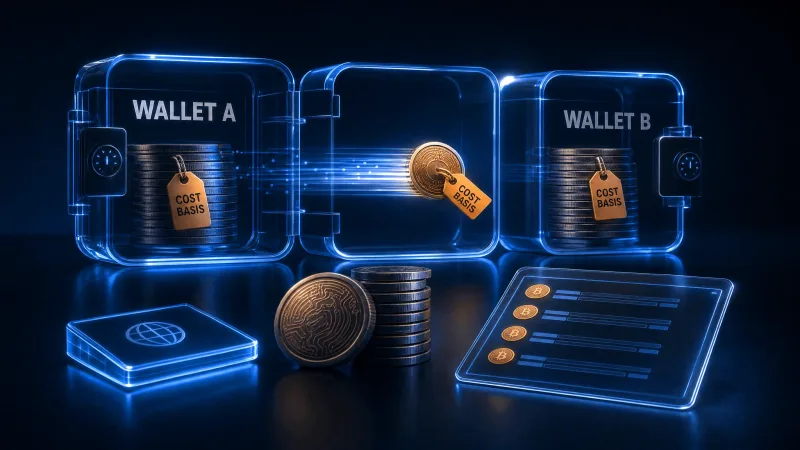

A stablecoin is a crypto asset that aims to keep a stable value by tracking a reference such as the US dollar or the euro. Swapping Bitcoin or Ether for one is a taxable sale or exchange in the United States. In Germany it is taxable if you held the coin for one year or less.
France does not tax the swap today, but an amendment to the 2027 budget bill would change that for swaps into MiCA e-money tokens from January 1, 2027. The amendment is a proposal, not law (as of October 21, 2026). The bill is in its first reading in the National Assembly.
Key Takeaways
- United States: A swap of crypto into a stablecoin is a taxable sale or exchange, even though no dollars reach your bank account.
- Germany: The swap counts as a sale, so the gain is taxable if you held the coin for one year or less.
- France today: A swap into a stablecoin without a cash payment on top is not taxed at the swap, because the tax is deferred.
- France from 2027: An amendment would tax gains on swaps into MiCA e-money tokens from January 1, 2027.
- Starting value: After a taxed swap, the stablecoin you receive starts at its value on the swap day.
Is Swapping Crypto for a Stablecoin Taxable? The Rules Side by Side
The three countries differ on whether the same swap is a taxable event.
| Country | Swap into a stablecoin | Condition |
|---|---|---|
| United States | Taxable sale or exchange | Capital gains or losses, short-term or long-term depending on how long you held the coin |
| Germany | Taxable sale | Taxable if held one year or less, unless your gains for the year stay below 1,000 euros (from tax year 2024) |
| France today | Tax deferred for swaps without a cash payment on top | The gain is taxed when you later sell the crypto for euros or spend it, not at the swap |
| France from January 1, 2027 | Would be taxable | Only for swaps into MiCA e-money tokens |
What is an e-money token?
MiCA is the EU regulation for crypto-assets. It defines an e-money token as a type of crypto-asset that aims to keep a stable value by referencing one official currency. The ESMA interim register of e-money token issuers lists white papers for USDC and EURC.
United States: A Swap Into a Stablecoin Is a Taxable Disposal
For US tax purposes, digital assets are property, and stablecoins are digital assets. Exchanging one digital asset for another that differs materially in kind or extent, such as Bitcoin for a stablecoin, is a disposal. A disposal means a sale or exchange. You recognize a capital gain or loss on it.
The stablecoin you receive counts at its fair market value (its market price on the day of the swap), reduced by transaction costs. Your gain or loss is that amount minus your adjusted basis in the coin you give up. Adjusted basis is generally what you paid for the coin. The stablecoin you receive takes a basis equal to its fair market value when you received it.
The holding period decides the type of result. A coin held for one year or less produces a short-term result, and a coin held longer produces a long-term result.
The IRS says that you must report digital asset transactions. This applies whether or not they result in a taxable gain or loss. For stablecoins held as capital assets, you recognize the gain or loss even if your broker does not report the transaction. Our guide to crypto trading taxes in the US explains how to report these trades.
Germany: A Swap Counts as a Sale Within the Holding Period
In a letter on crypto assets dated March 6, 2025, the Federal Ministry of Finance says that swapping crypto assets for other crypto assets counts as a sale. A stablecoin is a crypto asset, so a swap into one is a sale of the coin you give up.
The gain is taxable if the time between buying and selling the coin is one year or less. After more than one year, the gain is not taxable. Since the 2024 tax year, gains from all private sales in a calendar year also stay tax-free if they total less than 1,000 euros.
Your proceeds are the market price of the stablecoin at the time of the swap. A daily rate is accepted if you use the same method consistently. The market price of the coin you gave up, plus any acquisition costs you paid, becomes the cost of the stablecoin. A swap also restarts the clock, because the holding period for the crypto you receive begins with the swap.
A separate draft bill from the Ministry of Finance, dated September 30, 2026, would change the rules for newly acquired coins. According to the draft, gains on coins such as Bitcoin and Ether acquired after December 31, 2026 would be taxed regardless of the holding period. For older holdings, the current rules would continue.
E-money tokens under MiCA would be excluded from this new regime. According to the draft's explanatory text, this exclusion covers only a few of the tokens commonly called stablecoins.
Keep a clean record of every swap
With 400+ exchanges, wallets, and blockchains supported, CoinTracking imports your transaction history and calculates your gains and losses.
France Today: A Swap Between Crypto Assets Is Deferred
France taxes your gain when you convert crypto into a fiat currency such as the euro. It applies the flat tax, known as the PFU.
A swap of one crypto asset for another without a cash payment on top is treated differently. France calls this a tax deferral, known as sursis d'imposition. The tax authority's guidance for the crypto tax form leaves such swaps out of the calculation of your gain. A swap with a cash payment on top is taxable.
A swap into a stablecoin without a cash payment on top therefore does not trigger tax in France today. The gain stays in your portfolio, and the tax is due when you later dispose of the crypto. That happens, for example, when you sell it for euros or spend it on goods or services. France also works out that gain from the value of your whole crypto portfolio at the time of the sale, and not coin by coin.
France's PLF 2027 Amendment: What Would Change From January 1, 2027
Deputies tabled an amendment to the 2027 budget bill to end the deferral for swaps into stablecoins. The finance committee adopted it as amendment I-CF1826 on October 7, 2026. The Assembly adopted the same text as amendment I-3898 in the public session on October 16, 2026.
The amendment belongs to the first part of the bill, which covers revenue. The vote on that first part as a whole is scheduled for November 3, 2026. The Assembly's official schedule moved it from October 20. The vote on the full bill is scheduled for November 17, 2026, and the Senate is to take up the bill afterwards.
The amendment would remove the deferral when you receive an e-money token in a swap. It would apply to swaps made from January 1, 2027, so swaps before that date would not be affected. According to the amendment's explanatory note, the aim is to apply the flat tax to these swaps as it already applies to sales into euros.
Reports differ on whether USDT would be affected. One report says the legal definition of an e-money token decides, so USDT could fall inside. According to another report, USDT would in principle stay untaxed. The amendment text names no token.
What a Swap Does to Your Cost Basis: A Worked Example
The example uses assumed numbers, assumes a taxed swap, and leaves fees out. Your cost basis, the price used to calculate your gain, is the 10,000 euros you paid for one coin.
| Step | Cost basis (euros) | Value (euros) | Gain (euros) |
|---|---|---|---|
| 1. Swap the coin into a stablecoin | 10,000 | 15,000 | 5,000 |
| 2. Sell the stablecoin for euros | 15,000 | 15,000 | 0 |
| Gain taxed over both steps | 5,000 |
The stablecoin's cost basis is its value on the swap day, so a later sale at that value adds a gain of 0. The swap moves the tax date and does not remove the gain, because selling the coin directly for euros would produce the same 5,000 euros. In France today, the swap itself is deferred, so the 5,000 euros would be taxed only at a later disposal, for example a sale for euros.
You should keep the date, the market value and your original cost for every swap. If you have many swaps across exchanges and wallets, you can also get professional help with your crypto taxes.
Conclusion
A swap into a stablecoin is a taxable disposal in the United States, taxable in Germany within the one-year holding period, and deferred in France today. The proposed French amendment would end that deferral for swaps into e-money tokens from January 1, 2027.
Know your gains before you swap
2.2 million users trust CoinTracking to track their crypto and calculate their taxes, with 400+ exchanges, wallets, and blockchains supported.
Disclaimer
The information provided in this article is intended for general informational purposes only and should not be construed as financial, tax, or legal advice. This article describes tax rules and proposals in the United States, Germany, and France as of October 21, 2026, and rules, draft laws, and procedures are subject to change. Readers are encouraged to conduct their own research and consult with a qualified tax professional about their specific situation before making decisions based on the information presented here. The author and publisher are not responsible for any losses or damages incurred as a result of using the information in this article.