

You go to sell a coin you bought years ago, and the number staring back at you is a blank cost-basis field. Maybe the exchange you originally used shut down. Maybe your Coinbase account only shows the coin arriving from an external wallet, with nothing about what you paid for it in the first place. Maybe the CSV export you finally tracked down is missing prices for half your trades. Whatever the cause, missing cost basis turns a normal sale into a tax problem, because without it, the full sale price can end up looking like pure profit.
The good news is that a missing number in one export doesn't mean the underlying history is gone. This guide covers what actually counts as missing cost basis, how to track it down on Coinbase specifically, and what to do when no single record has the full picture, including how importing what you do have into CoinTracking reconciles the rest.
Key Takeaways
- Missing cost basis is common, not rare: lost exchange history, closed accounts, and unsupported CSV exports all create the same gap, and the fix is largely the same in every case.
- Coinbase doesn't always know your cost basis: if you transferred crypto in from elsewhere, its Gain/Loss report marks that basis "not available" and estimates from $0 until you correct it.
- A $0 assumed cost basis makes the entire sale taxable: that's the fallback once nothing else can be substantiated, so reconstructing your real basis is usually worth the effort.
- Partial records are enough to start: blockchain explorers, bank statements, and old exchange emails can corroborate a purchase date and price even without the original export.
- CoinTracking reconciles what you import: bring in whatever records you do have from over 400 exchanges, wallets, and blockchains, and apply one consistent cost-basis method across all of them.
What Counts as Missing Cost Basis?
Cost basis is what you originally paid to acquire a crypto asset, including any fees. It's the number your sale proceeds get compared against to calculate a gain or loss. "Missing" cost basis covers a few distinct situations that all lead to the same blank field on your tax report.
The most common cause is a coin that arrived in an account from somewhere else. If you moved crypto from an exchange or a personal wallet into another platform, that platform usually has no way of knowing what you originally paid, only when the coin showed up.
The second cause is a closed or inactive account: an exchange you haven't logged into in years, a platform that no longer operates in your country, or a service that has shut down entirely.
The third is an incomplete export, a CSV or PDF statement that lists trades but leaves out the price, the fee, or the transaction type needed to calculate basis correctly.
None of these situations are unusual. Anyone who has held crypto across more than one exchange or wallet for several years has a reasonable chance of hitting at least one of them.
How to Find Your Cost Basis on Coinbase
If Coinbase is where the gap shows up, the platform's own tax tools are the first place to check before assuming the number is gone for good.
Start With the Gain/Loss Report
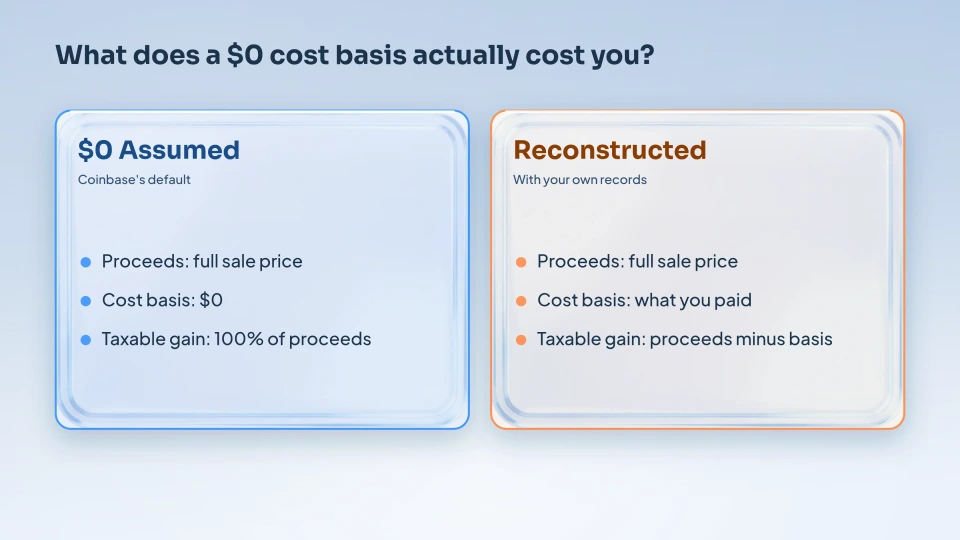
Coinbase's Gain/Loss report, available through Coinbase Taxes, lists every transaction that resulted in a capital gain or loss and calculates it by subtracting cost basis from proceeds. According to Coinbase's own explanation of how this works, when it doesn't have enough information to calculate a real cost basis, it labels that transaction "Cost-basis source: not available" and estimates the gain or loss using an assumed cost basis of $0, treating the date the crypto arrived in your account as the acquisition date. Coinbase also assumes you didn't receive that crypto as a gift or as payment for goods or services; if either of those assumptions is wrong, the estimate in your report will be wrong too.
Any transaction flagged this way is exactly the kind of gap this guide is about. The fix isn't to accept the $0 estimate, it's to track down what you actually paid and correct the figure before you file.
Pull the Raw Transaction Report
Coinbase also offers a raw transaction report, a downloadable CSV that lists every transaction along with whatever cost-basis data is on file, without calculating gains or losses for you. It's built for exactly this kind of manual reconciliation: you, or software like CoinTracking, can cross-reference it against records from wherever the coin actually came from. Coinbase's tax center also lets you choose which accounting method, FIFO, LIFO, or HIFO, it applies when it does have full information for a transaction.
Understand What Coinbase Will and Won't Report Going Forward
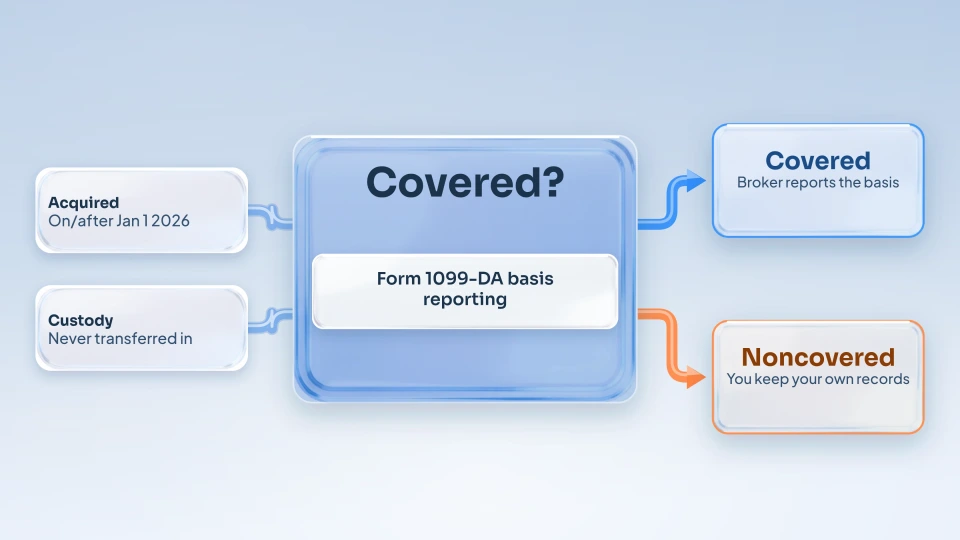
Starting with the 2026 tax year, Coinbase and other brokers are required to report cost basis on Form 1099-DA, but only for what the IRS classifies as a "covered security": a digital asset acquired on or after January 1, 2026 through a broker that has held it in custody continuously since. Any crypto transferred into Coinbase from elsewhere is automatically treated as a noncovered asset by the broker receiving it, meaning Coinbase has no obligation to supply its cost basis at all. Our guide to Form 1099-DA covers the covered-versus-noncovered distinction in more depth. In practice, this means anyone holding coins they moved onto Coinbase from another platform shouldn't expect Coinbase itself to ever fill in that gap. You'll need your own records instead.
Stop chasing cost basis across a dozen exports
CoinTracking imports your transaction history from over 400 exchanges, wallets, and blockchains, then matches deposits and withdrawals against each other so gaps like this are easier to spot.
What If I Don't Know My Crypto Cost Basis At All?
Sometimes the gap isn't one missing field, it's the whole history. The exchange you bought from no longer exists, you never kept a copy of the confirmation, and no current platform has any record of the original purchase. This is a realistic situation, and it has a smaller set of options than a partial gap does.
The first option is to accept a $0 cost basis and pay tax on the entire sale proceeds. Coinbase's own guidance describes this outcome for unmatched transfers: it assumes $0 basis for any crypto it can't trace. Without your own records to counter that number, there's nothing else to substantiate a different basis at filing time either. This is always available as a fallback, but it's rarely the right answer, since it usually means paying tax on money that was never actually a gain.
The second option, and the one worth trying first, is reconstruction: piecing together enough corroborating evidence, even without the original exchange statement, to support a reasonable basis figure. The next section walks through how that actually works in practice. The third option, for genuinely unresolvable cases or larger amounts, is bringing in a tax professional who can weigh the evidence you have and document the position you take.
Step-by-Step: Reconstructing Cost Basis From Partial Exchange Records
Most missing cost-basis situations fall somewhere between "fully documented" and "completely unknown." Here's how to work through one.
- Collect every export you still have access to, even partial or old ones. A statement from three years ago that only covers half your trading history is still worth pulling, since it may cover the exact purchase you're missing.
- Try an API or read-only exchange connection before assuming manual work is the only way. A direct, automated import can sometimes surface a more complete transaction history than what's visible in a manual CSV or PDF export, particularly on older accounts. It's worth setting up an automatic import from the exchange or wallet before you commit to reconstructing everything by hand.
- Check a blockchain explorer for on-chain history. If the coin ever moved through your own wallet, a public explorer shows the exact timestamp and amount of that transfer. Our guide to using Etherscan walks through exactly how to look up a wallet or transaction on Ethereum, and the same approach applies to explorers for other chains.
- Match that timestamp to a historical price. Once you know the date a coin was acquired, a historical price reference for that date and time gives you the dollar value needed to calculate cost basis, even without the original purchase receipt.
- Look for corroborating paper trails. A bank or card statement showing the fiat withdrawal that funded the original purchase, or an old confirmation email from the exchange, can support the date and amount even when the exchange itself is gone.
- Import what you've gathered and let it reconcile. Bringing your available records, exchange exports, wallet history, and manually added entries, into CoinTracking lets the software match deposits against withdrawals across every account you've used, so it can flag exactly which transactions are still missing a basis instead of you tracking that manually.
None of these steps require perfect records. They require enough independent evidence pointing at the same date and amount that a reasonable basis figure holds up.
Bring your records together in one place
Once you've gathered what you can from old exports, wallets, and statements, CoinTracking reconciles it across every exchange and blockchain you've used and calculates your gains from there.
When to Use a Reasonable-Basis Method (and When Not To)
For U.S. tax purposes, the IRS treats digital assets as property, not currency, and requires taxpayers to keep sufficient records to support the positions taken on their returns. Generally, the basis of a digital asset is what you paid in U.S. dollars to acquire it, including fees and commissions, according to the IRS's own FAQ on virtual currency transactions.
That same FAQ sets out the two accepted approaches when you're calculating which units were sold. If you don't specifically identify which units you disposed of, the default is FIFO: the units are treated as sold in the chronological order you acquired them, starting with the oldest. If you want to use specific identification instead, you have to document the exact unit involved. This means recording its unique digital identifier, or keeping per-account records of its acquisition date, basis, and fair market value. You also have to make that identification at or before the time of sale, not work it out afterward when you're filing.
This is the key distinction a reasonable-basis approach has to respect: reconstructing a lost number from real evidence is not the same as picking a number that produces the outcome you want. A reasonable basis means applying FIFO or a documented specific identification to the best verifiable evidence available, a blockchain timestamp, a bank record, a historical price, and keeping a record of how you arrived at it. It doesn't mean estimating a round number with no supporting evidence at all.
There's also a narrower situation worth knowing about if you tracked cost basis across multiple wallets as one combined pool before 2025. A one-time IRS safe harbor let these taxpayers reallocate their unused basis into specific wallets. They could use either a specific-unit method or a global allocation method, as long as they did it by January 1, 2025. That window has closed, so if it applies to your situation and you're not sure whether you made that allocation correctly, it's worth having a tax professional review it rather than guessing now.
When not to use a reasonable-basis method: if the exact figure is still available, whether from an export you haven't checked yet, an on-chain record, or a statement sitting in an old email, pull that instead of estimating. Reconstruction is for genuine gaps, not a shortcut around records you can still recover with a bit more digging.
Conclusion
Missing cost basis is fixable far more often than it looks at first glance. Doing nothing about it is the option that reliably costs the most at tax time. That holds whether the gap is a single flagged Coinbase transfer or an entire exchange that no longer exists.
Reconcile your full crypto history in one place
CoinTracking has helped over 2.2 million users track their crypto and calculate their taxes since 2012, importing from more than 400 exchanges, wallets, and blockchains.
Disclaimer
The information provided in this article is intended for general informational purposes only and should not be construed as financial, tax, or legal advice. Exchange policies, available reports, and specific tax treatment of crypto transactions change over time and depend on your jurisdiction and individual circumstances. Readers are encouraged to conduct their own research and consult with a qualified tax professional before making decisions based on the information presented here. The author and publisher are not responsible for any losses or damages incurred as a result of using the information in this article.