

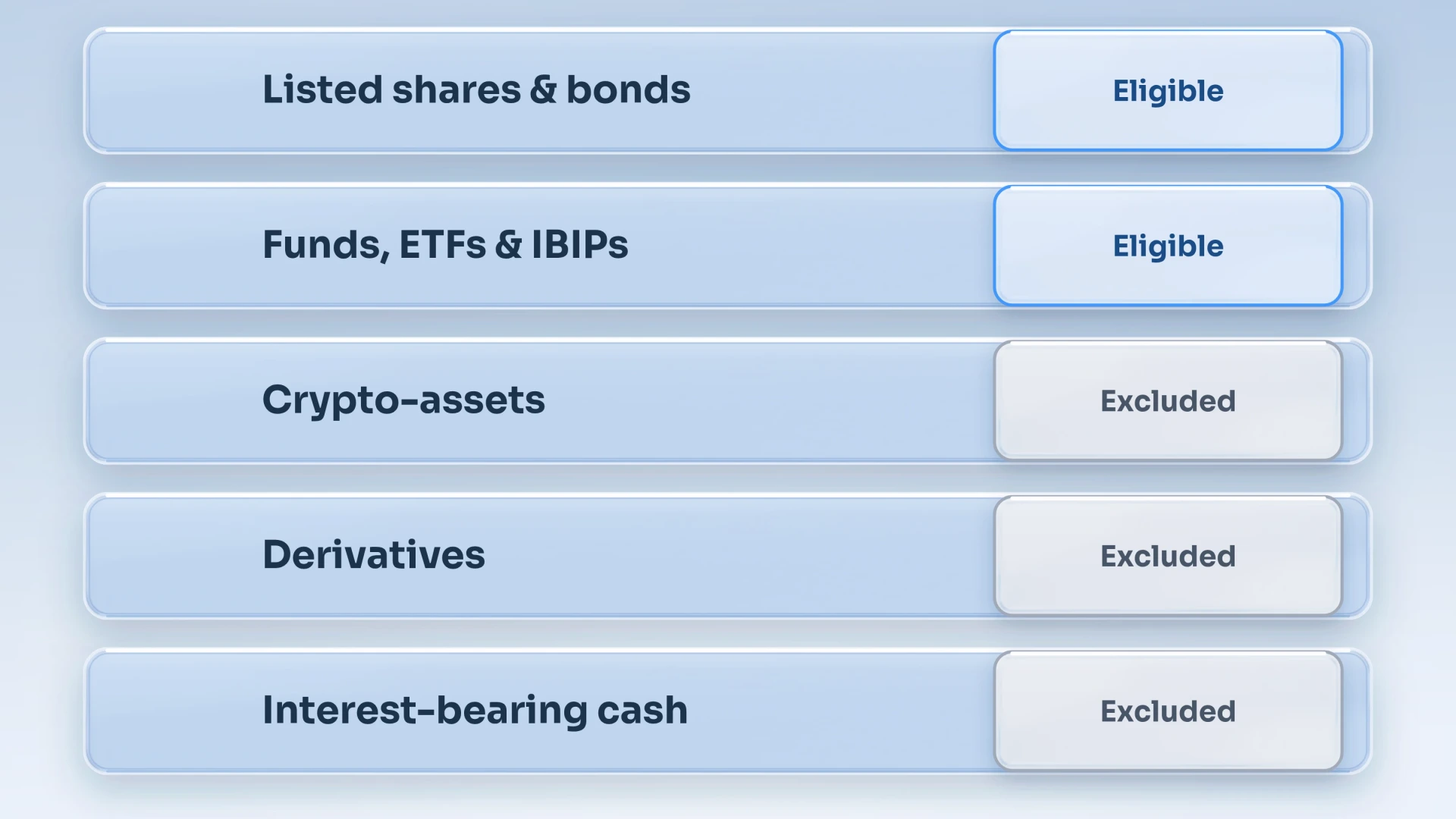
Ireland's government has decided which assets qualify for its new tax-advantaged savings scheme, and crypto is not one of them. The Department of Finance's Roadmap for the Taxation of Retail Investment, published in late August 2026, confirms an Investment Account that will let Irish savers put money into listed shares, bonds, and retail-suitable funds with favorable tax treatment starting in 2027. Crypto-assets, along with derivatives and interest-bearing cash, are explicitly excluded from that account.
This did not happen in isolation. A year earlier, the European Commission recommended that every EU member state take the same approach to these accounts, and Ireland is the first to turn that recommendation into a concrete national scheme. Nothing here changes how crypto itself is taxed in Ireland or held anywhere in the EU. It only decides what can go inside one new savings product.
Key Takeaways
- Ireland's new Investment Account excludes crypto: the Department of Finance's Roadmap for the Taxation of Retail Investment, published in August 2026, confirms a scheme opening in 2027 that leaves out crypto-assets, derivatives, and interest-bearing cash.
- The EU recommended this approach EU-wide first: the European Commission's September 2025 recommendation on Savings and Investment Accounts explicitly suggests member states exclude crypto-assets and high-risk derivatives from similar tax-advantaged products.
- This is not a crypto ban: the exclusion applies to one specific savings wrapper, not to owning, buying, or trading crypto in Ireland or the wider EU.
- Nothing changes for existing crypto holdings: buying and holding crypto through MiCA-authorized providers stays fully permitted, and Ireland's standard capital gains tax regime for crypto is unaffected.
- Key numbers are still pending: the tax-free threshold, flat rate, and contribution cap for the new account are due with Budget 2027 on October 6, 2026.
What Is Ireland's New Investment Account?
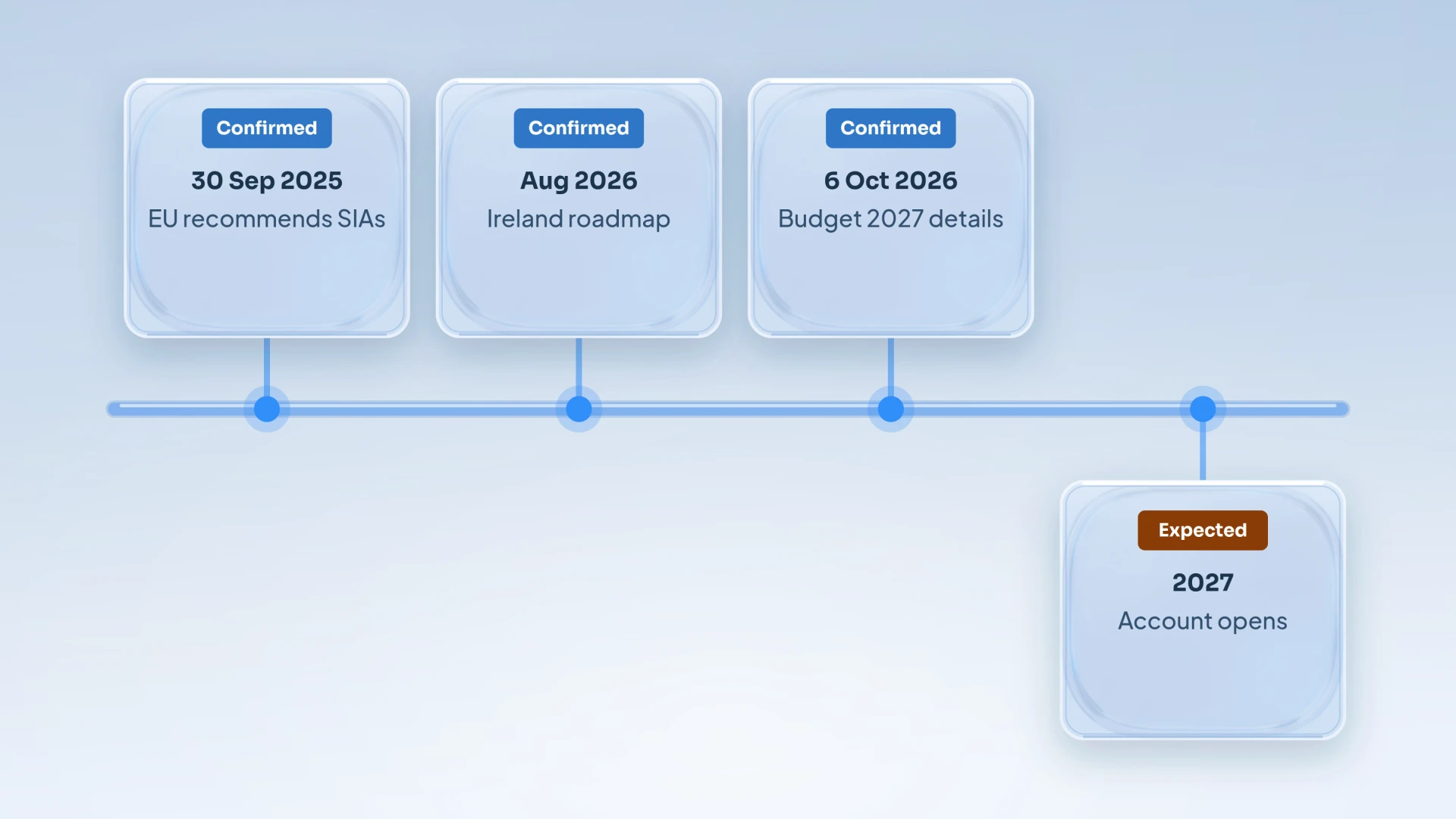
Ireland's Department of Finance, under Tánaiste and Minister for Finance Simon Harris and Minister of State Robert Troy, published the Roadmap for the Taxation of Retail Investment at the end of August 2026. It sets out plans for a new Investment Account. The scheme targets roughly €175 billion in household deposits, according to Central Bank of Ireland data reported in mid-2026. The roadmap frames this money as earning savers very little in today's low-deposit-rate environment.
The account is designed to make investing more attractive than parking cash. Eligible assets described in the roadmap include listed shares, listed bonds, financial instruments traded on regulated markets, retail-suitable funds and ETFs, and Insurance-Based Investment Products (IBIPs). Crypto-assets, derivatives, and interest-bearing cash are all explicitly excluded from that list.
Several practical details are still open. The roadmap confirms the account is planned to open to Irish tax-resident holders of a PPSN who are 18 or older, with one account per person, from 2027. The specific tax-free threshold, the flat tax rate that would apply above it, and any annual contribution cap are due to be set out with Budget 2027 on October 6, 2026, so the numbers that matter most for actually using the account are not public yet.
Track your crypto regardless of which wrappers it qualifies for
Ireland's new Investment Account won't hold crypto, but your existing crypto holdings still need accurate records under today's tax rules. CoinTracking imports transactions from over 400 exchanges, wallets, and blockchains and calculates your gains automatically.
Why Crypto, Derivatives, and Cash Got Left Out
The Department of Finance's own stated rationale is straightforward: crypto-assets and derivatives are, in the roadmap's words, highly complex and risky. A tax-advantaged savings account aimed at ordinary households investing their bank deposits is built around instruments regulators consider well understood and comparatively stable, such as listed shares and bonds. Crypto's price swings and derivatives' leverage sit outside that profile.
Interest-bearing cash was excluded for a different reason. The whole point of the new account is to nudge savers out of low-yielding deposits and into investment products, so allowing cash itself to sit inside the wrapper would work against that goal from the start.
Irish media reports on the roadmap describe the crypto exclusion as consistent with the government's broader caution around retail exposure to volatile digital assets, even as it continues to support crypto's regulated trading and custody under MiCA. That caution is about eligibility for one savings product. It says nothing about crypto's legal status in Ireland, which remains unchanged.
The EU-Wide Picture: A September 2025 Commission Recommendation
Ireland's account did not emerge from nowhere. On September 30, 2025, the European Commission published a recommendation, part of its Savings and Investments Union package, encouraging member states to set up or enhance national Savings and Investment Accounts with favorable tax treatment. The recommendation explicitly suggests excluding crypto-assets, aside from any that already qualify as regulated financial instruments, along with high-risk and complex derivatives, from the assets eligible for these accounts.
A recommendation is not a law. Under EU rules, a Commission recommendation carries no binding force, so no member state is legally required to adopt it, and each country remains free to design its own account however it chooses. The Commission also published a supporting staff working document alongside its official recommendation, laying out its reasoning for steering household savings toward listed markets rather than cash or higher-risk assets.
Ireland is the first EU country to turn that recommendation into a concrete national scheme with a published roadmap and a stated 2027 launch. It arrives alongside other EU-wide crypto tax measures already moving forward, such as DAC8's new exchange reporting requirements, which shows the EU tightening its crypto tax framework from more than one direction at once. Whether Ireland's approach makes it an outlier or the first of many is still an open question, one this article comes back to below.
What This Actually Changes (and Doesn't) for EU Crypto Holders
The most important thing to understand about both the Irish scheme and the EU recommendation behind it is what they do not touch. Buying, holding, and trading crypto through MiCA-authorized providers remains completely unaffected in Ireland and across the EU. No rule proposed here restricts access to exchanges, wallets, or custody services.
Ireland's existing tax treatment of crypto is also unchanged. Revenue.ie, Ireland's tax authority, confirms there are no special tax rules for cryptocurrencies, meaning the same standard capital gains tax rate that applies to shares and most other assets, currently 33% in Ireland, also applies to crypto. Nothing in the new roadmap alters that rate or how it is calculated.
What actually changes is narrower than the headlines suggest: crypto simply cannot be wrapped inside this one new tax-advantaged product. Every other way of owning or transacting in crypto, and every other tax rule that already applies to it, stays exactly as it was before the roadmap was published.
Standard capital gains rules still apply to every crypto disposal
Ireland's 33% capital gains tax on crypto hasn't changed, and neither has the record-keeping it requires. CoinTracking calculates your gains and losses automatically so nothing gets missed at tax time.
Will Other EU Countries Follow?
The Commission's recommendation applies EU-wide, but recommendations are, by design, optional. Ireland moving first with a published roadmap and a 2027 target date puts real pressure on other governments to show what they plan to do with their own retail investment taxation, without obligating any of them to copy Ireland's exact approach.
Whether other member states adopt a similar crypto exclusion, design a broader account that includes crypto, or decline to introduce a comparable scheme at all remains genuinely open. The Savings and Investments Union package is a recent, multi-year initiative, and national follow-through on non-binding EU recommendations varies significantly across the bloc. Crypto holders elsewhere in the EU should expect this picture to develop over the coming months rather than resolve quickly.
What Crypto Holders Should Do Now
None of this changes what you actually owe on crypto today, in Ireland or anywhere else in the EU. Whether or not a future tax-advantaged wrapper ever includes crypto, every disposal you make right now still needs to be tracked against the tax rules that already apply.
That makes accurate records more useful than speculation about which accounts crypto might eventually qualify for. Taxable events like selling, trading, or spending crypto still require a cost basis and a calculated gain or loss, regardless of what happens with Ireland's account or the EU's wider recommendation.
Conclusion
Ireland's new Investment Account closes crypto out of one specific tax-advantaged product, not out of the crypto market itself. What's still open is the account's precise numbers, due with Budget 2027, and whether other EU member states follow Ireland's lead.
Keep your crypto records accurate, no matter which wrapper it sits outside of
CoinTracking has calculated crypto gains and losses for 2.2 million users since 2012, across more than 400 exchanges, wallets, and blockchains, independent of how tax-advantaged savings rules evolve.
Disclaimer
The information provided in this article is intended for general informational purposes only and should not be construed as financial, tax, or legal advice. This article reflects the regulatory and policy situation as of September 7, 2026, which may change without notice, particularly regarding Ireland's Budget 2027 announcement on October 6, 2026. For guidance on your individual tax situation, consult a qualified tax advisor or accountant. The author and publisher are not responsible for any losses or damages incurred as a result of using the information in this article.