

If you trade or hold crypto in the UK, the odds that HMRC has already flagged your account for review are higher than they have ever been. In tax year 2025/26, HMRC sent 81,172 warning letters, emails and text messages to UK taxpayers, according to a Freedom of Information request submitted to the tax authority. That is nearly three times the 27,714 letters sent just two tax years earlier, in 2023/24.
This guide explains what the data actually shows, what causes HMRC to send one of these letters in the first place, and what to do if one lands on your doorstep. It also covers why the letters sent so far are only the beginning, with a much larger UK data-sharing framework for crypto still to come.
Key Takeaways
- HMRC sent 81,172 crypto tax warning letters in tax year 2025/26, up from 64,982 in 2024/25 and 27,714 in 2023/24, a rise of roughly 25% year on year and nearly triple the 2023/24 total.
- The letters are nudge letters, not investigations, sent to prompt a taxpayer to review a return HMRC believes may be missing or inaccurate, based on data it already holds.
- Most letters are triggered by data HMRC already has access to, including information shared by UK crypto exchanges, rather than by any new detection technology.
- A far larger reporting framework is still coming, with UK crypto platforms having started collecting data on 1 January 2026 to report to HMRC under the UK's Crypto-Asset Reporting Framework, with the first reports due by 31 May 2027.
- Accurate, exchange-by-exchange records are the best defense, whether you're trying to avoid a letter altogether or need to respond to one you've already received.
HMRC's Crypto Tax Warning Letters Are Surging: The Numbers
The figures come from a Freedom of Information request to HMRC, first reported in industry coverage in August 2026 and corroborated across multiple independent outlets. They show a clear three-year trend rather than a single-year spike.
- Tax year 2023/24: 27,714 crypto tax letters sent.
- Tax year 2024/25: 64,982 letters sent, an increase of roughly 134% on the year before.
- Tax year 2025/26: 81,172 letters sent, up roughly 25% on 2024/25 and nearly triple the 2023/24 figure.
UK tax years run from 6 April to 5 April, so tax year 2025/26 refers to the twelve months to 5 April 2026, not the calendar year. That distinction matters here because the letter count has climbed every single year measured, without HMRC yet having access to the far broader international data-sharing framework described later in this guide. The current volume reflects what HMRC can already do with existing tools, not the ceiling of what is coming.
These are commonly referred to as nudge letters or One to Many letters, a format HMRC uses across several tax areas, not just crypto, when it wants to prompt a large group of taxpayers to review a specific issue without opening individual investigations into each one. Receiving one is not the same as being formally investigated, though ignoring it can eventually lead to one.
Know exactly what your crypto activity looks like to HMRC
CoinTracking imports your transactions from over 400 exchanges and wallets, so you can see your full trading history the same way HMRC's data increasingly can.
What Triggers an HMRC Crypto Tax Warning Letter?
Crypto nudge letters are not random. HMRC generates them by comparing data it already holds against what a taxpayer has actually declared, then writing to the accounts where the two don't line up. Three sources of data typically drive that comparison.
Exchange-Reported Data Mismatches
UK-based crypto exchanges and other financial institutions can be required to share account and transaction information with HMRC. When the activity on file for an account doesn't match what appears on that person's Self Assessment return, or when no return has been filed at all despite recorded trading activity, that gap is exactly the kind of signal a nudge letter is built to flag.
This is also why gaps in your own records can create a mismatch even when you haven't done anything wrong. A transfer that looks unexplained because it moved between two of your own wallets, or a disposal calculated with the wrong cost basis, can produce numbers that don't reconcile with what HMRC's systems expect to see.
Transfers and Activity HMRC Can Already See
Crypto is not as anonymous from a tax authority's perspective as it can feel day to day. On-chain activity is public by design, and once a wallet address is linked to a UK exchange account through know-your-customer checks, HMRC's data-matching can follow the transactions that flow through it. Large or frequent transfers between an exchange and an external wallet are a common pattern these systems are built to flag for a closer look.
Patterns From Earlier Disclosure Campaigns
HMRC has run crypto-focused nudge letter campaigns for several years, and the accounts flagged in an earlier round often inform who gets contacted in a later one. Someone who received a letter in a previous tax year and made a partial correction, or who appeared in an earlier data-sharing batch without responding, is a reasonable candidate for a follow-up letter as HMRC's data coverage keeps expanding.
The UK's Crypto-Asset Reporting Framework: What's Coming in 2027
The letters sent so far were generated using data-sharing arrangements and detection methods HMRC already had in place. A much larger framework is still being phased in, and it will give HMRC significantly more visibility once it is fully operational.
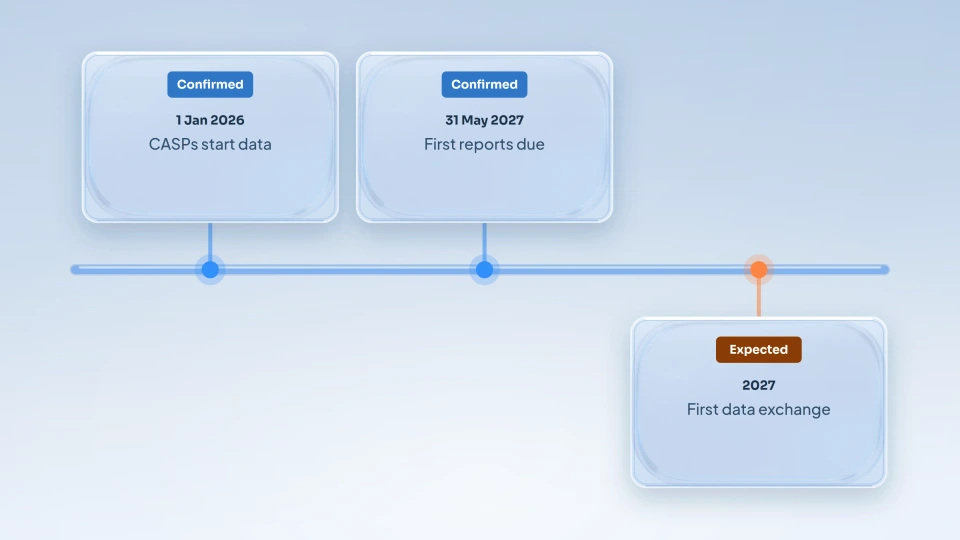
The Crypto-Asset Reporting Framework (CARF) is an international standard, developed by the OECD, for the automatic exchange of crypto transaction data between tax authorities. The UK is implementing CARF directly as a non-EU jurisdiction. It did this through the Reporting Cryptoasset Service Providers (Due Diligence and Reporting Requirements) Regulations 2025, which came into force on 1 January 2026. From that date, UK-based crypto exchanges, custodians, and other reporting service providers began collecting identity and transaction data on their users.
The first reports under this framework are due to HMRC by 31 May 2027, covering transactions carried out in 2026. According to HMRC's own published guidance, the UK expects to carry out its first international exchange of this data with other participating tax authorities in 2027.
That timeline is the reason the current wave of letters is worth treating as an early signal rather than the full picture. HMRC generated 81,172 letters in 2025/26 using data it could already access, before CARF's automatic reporting has even started flowing in. UK exchanges will begin submitting standardized reports in 2027, and that data will then be exchanged internationally with other participating countries. HMRC's ability to match declared income against actual activity is set to expand well beyond what triggered this year's letters. Getting your records in order now, ahead of that reporting starting, is a meaningfully easier position to be in than catching up once it has.
Get ahead of CARF before the first reports go in
CoinTracking reconciles your trading history across every exchange and wallet you use, so your records already match what platforms will start reporting to HMRC under CARF.
What to Do If You Receive an HMRC Crypto Tax Letter
A nudge letter is a request to review your position, not a verdict. How you respond matters more than the fact that you received one at all.
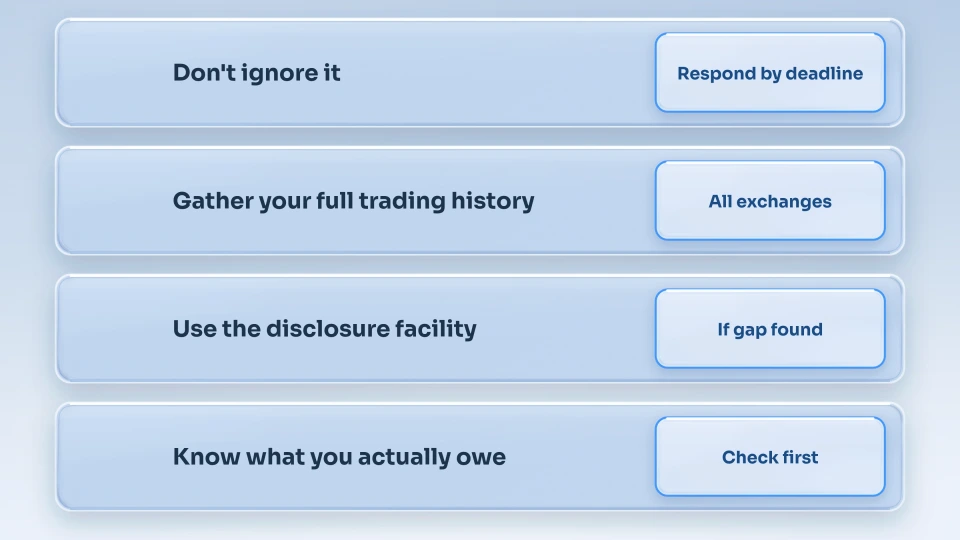
Don't ignore it. Nudge letters typically give a deadline to respond or file a correction. Letting that deadline pass is one of the more common ways to escalate a routine review into a formal enquiry, which carries a wider range of potential penalties.
Gather your full trading history before you reply. Pull together records from every exchange and wallet you've used, not just the one HMRC's letter references, since an accurate response usually depends on your complete activity for the years in question. Our guide on what happens if you don't report crypto to HMRC walks through the range of outcomes, from a straightforward correction to formal penalties, depending on how a case is handled.
Use HMRC's disclosure facility if you find a genuine gap. If reviewing your records shows you do owe additional tax, HMRC's own voluntary disclosure service for unpaid crypto tax lets you correct the position directly. Coming forward through that route, rather than waiting for a follow-up letter or an enquiry, is generally treated more favorably.
Understand what you actually owe before you file. Not every transaction is taxable, and knowing which ones are is the first step to an accurate correction. Our full guide to UK crypto taxes covers current capital gains and income tax treatment in detail, and our breakdown of the UK's tax-free allowance explains how much of your gain, if any, falls outside the tax net in the first place.
How to Avoid Getting Flagged in the First Place
The clearest way to stay out of HMRC's nudge letter pipeline is to make sure your own numbers already match what the data behind that pipeline shows. That comes down to consistent, complete record-keeping across every platform you use, not any single defensive move.
Reconstructing that picture by hand across several exchanges and wallets, especially with older accounts or ones you no longer actively use, is exactly where manual tracking tends to break down. Missed transfers, duplicated trades, and an inconsistent cost-basis method are the kinds of gaps that create the mismatches a nudge letter is designed to catch. CoinTracking's Crypto Portfolio Tracker imports your transaction history from over 400 exchanges, wallets, and blockchains, and reconciles it into a single accurate record, so the figures you'd report line up with the figures a UK exchange would report about you.
That same complete record is also what you want on hand if HMRC does reach out. You won't need to reconstruct months or years of activity from scratch under a response deadline. You already have a documented trading history you can review, correct if needed, and use to answer HMRC's letter with confidence.
Conclusion
HMRC's crypto tax warning letters have nearly tripled over three tax years, and that increase happened before the UK's Crypto-Asset Reporting Framework has even started exchanging data internationally. The practical takeaway is straightforward: keep accurate, exchange-by-exchange records now, respond to any letter you do receive rather than ignoring it, and use HMRC's disclosure facility if a genuine gap turns up. Doing that today is a far easier position than trying to reconstruct years of activity once CARF's reporting is fully in effect.
Get your crypto records ready for HMRC
CoinTracking has tracked crypto portfolios and calculated taxes for over 2.2 million users since 2012, across more than 400 exchanges, wallets, and blockchains.
Disclaimer
The information provided in this article is intended for general informational purposes only and should not be construed as financial, tax, or legal advice. HMRC's guidance and reporting requirements may change over time, and specific tax treatment of crypto transactions depends on your individual circumstances. Readers are encouraged to conduct their own research and consult with a qualified tax professional before making decisions based on the information presented here. The author and publisher are not responsible for any losses or damages incurred as a result of using the information in this article.