
A pattern keeps showing up among crypto users: someone bridges ETH to BTC through a cross-chain swap, a bridge, or a DEX aggregator instead of a KYC'd centralized exchange, and only afterward realizes there's no exchange statement, no clear cost basis trail, and no single record of what actually happened. If that's you, or you're about to do the same thing, here's what's actually taxable at each step, and how to rebuild a defensible record from data the blockchain already has.
The mechanics matter here because "bridging" quietly bundles two different actions together: converting ETH into a different asset, and moving an asset across chains without converting it. Current U.S. guidance treats those two actions very differently, and neither one disappears just because the platform you used didn't ask for your ID.
Key Takeaways
- A cross-chain swap and a same-asset bridge are taxed differently: swapping ETH for BTC disposes of a different asset and is very likely a taxable event, while wrapping or bridging the same asset across chains is a genuinely unsettled question under current guidance.
- The IRS has not issued specific guidance on wrapping or bridging: Treasury's own 2024 broker-reporting notice explicitly declines to say how these transactions are treated for tax purposes while it studies the question further.
- No-KYC routes skip the exchange statement, not the tax obligation: Form 1040 requires you to report digital asset activity whether or not a platform sends you a 1099-DA.
- A single bridge trip can span two chains and several disposal events: aggregator routing through an intermediate asset or chain can create more taxable events than a one-step swap.
- CoinTracking rebuilds the record from your wallet addresses: multi-chain import and transfer matching turn scattered on-chain data into one exportable history.
Is Bridging ETH to BTC a Taxable Event?
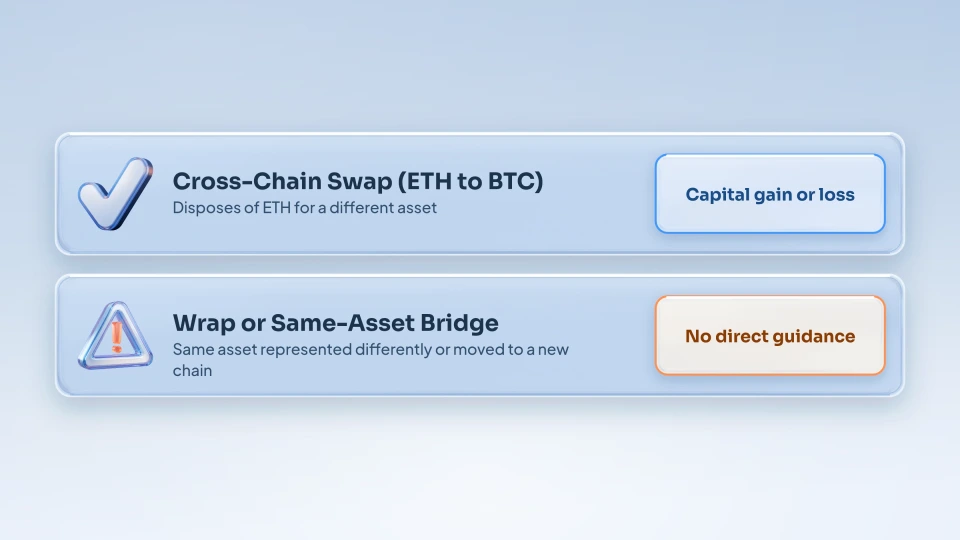
The honest answer depends on which part of the trip you're asking about. "Bridging ETH to BTC" usually bundles two different things into one sentence: a swap from one asset into a completely different one, and a wrap or bridge that moves the same asset across chains. The tax treatment of those two steps isn't the same, and mixing them up is where a lot of the confusion comes from.
A cross-chain swap: ETH for BTC
If your route ends with you holding BTC in exchange for ETH, whether through a DEX aggregator, a swap-based bridge, or a liquidity pool, you disposed of ETH and acquired a different asset. For U.S. tax purposes, digital assets are treated as property, not currency. The IRS's current FAQ on digital asset transactions is direct on this point.
Exchanging a digital asset for a materially different one, for example trading ETH for BTC, triggers a capital gain or loss. That gain or loss equals the fair market value of what you received minus your adjusted basis in what you gave up. That makes an ETH-to-BTC swap a taxable event regardless of which route you used to execute it or whether the platform ran identity checks.
A same-asset wrap or bridge: the unsettled part
Many routes don't swap assets at all in the first step. They wrap ETH into a representation like WETH, or move the same token to a different chain through a mint-and-burn bridge, before a separate step converts it to BTC. Whether that wrapping or bridging step is itself a disposal is a genuinely open question, and the IRS has not issued guidance that speaks directly to it.
When Treasury and the IRS built the 2024 broker reporting rules for digital assets, they carved wrapping and unwrapping out of the analysis entirely. Notice 2024-57 lists wrapping and unwrapping transactions among several types that "require further study." The notice adds that this description carries no substantive tax analysis and creates no inference about how wrapping should actually be taxed.
In the absence of direct guidance, our own guide to wrapping crypto takes the cautious position. It treats wrapping a token as a crypto-to-crypto trade in the same taxable category as the ETH-to-BTC swap above. Treat that as the safer assumption for your own filing unless a tax professional advises otherwise based on your specific facts. This is a different question from moving the same asset between two wallets you control, which current guidance does address directly and treats as a non-event; our guide on whether wallet-to-wallet transfers are taxable covers that distinction in more depth.
Why No-KYC Bridges Leave You Without a Paper Trail
A no-KYC route is attractive precisely because nobody asks for your identity before you swap. That same design is what leaves you without the one thing a centralized exchange would have handed you automatically: a statement.
No exchange-issued form, no aggregated history
The 2024 final regulations created Form 1099-DA reporting, and they apply to brokers. That means centralized trading platforms, payment processors, and hosted-wallet providers that take custody of your assets or execute trades on your behalf. A non-custodial DEX aggregator or bridge interface that only routes a transaction your own wallet signs generally falls outside that definition, so it never files anything with the IRS or sends you a year-end summary.
That "generally" carries some recent history. Treasury separately finalized a broader rule in December 2024 that would have classified non-custodial DeFi trading front-ends as brokers too. Congress repealed that rule under the Congressional Review Act in April 2025, before any reporting obligation under it ever took effect. That is why the narrower, custodial-only broker definition governs today.
That doesn't remove your own obligation to report the activity. The instructions to Form 1040 are explicit that you must answer the digital asset question and report gain or loss whether or not you received a Form 1099-DA. A no-KYC bridge only skips the paperwork; the underlying requirement to report stays in place.
Wallet-to-wallet logs across two chains, not one ledger
A centralized exchange keeps one internal ledger that already matches your buy to your sell. A bridge route leaves you with the opposite: a transaction hash on the Ethereum side, a separate transaction on the Bitcoin side, and a smart contract or validator log connecting the two. Nothing aggregates it for you, and nothing labels which hash belongs to which trade unless you write that down yourself.
Multi-hop routes multiply the number of taxable events
A DEX aggregator rarely fills your swap in a single step. It often routes ETH through an intermediate asset or an intermediate chain before it lands as BTC, and each hop is its own transaction with its own timestamp and fair market value. That can mean several potential disposal events packed into what felt like one click, each one needing its own record.
Skip the manual reconstruction
CoinTracking imports directly from your wallet addresses, no KYC'd exchange account required, and timestamps every transaction the moment it lands in your history.
What Records You Actually Need to Reconstruct This
Once you accept that a no-KYC bridge won't hand you a finished record, the question becomes what to actually go collect. Five pieces of information turn a scattered set of blockchain events into something you could hand to a tax professional or attach to a return.
- Transaction hashes on both chains: the Ethereum-side hash for the outgoing leg and the Bitcoin-side transaction ID for the incoming leg, plus anything in between if the route passed through an intermediate chain.
- A timestamp for each leg: block timestamps are public and permanent, which makes them more reliable than your own memory of when a multi-step route actually finished.
- Fair market value in USD at each hop: gain or loss is calculated against the value at the moment of each disposal, not the value when you started the route or when you happened to check the price later.
- Cost basis carried forward from your original ETH: the basis in the ETH you originally acquired doesn't disappear, it carries into whatever calculation applies at the swap or wrap step.
- Every fee paid along the way: gas on each chain and any aggregator or bridge fee, which generally adjust your basis or proceeds rather than standing on their own as a separate deduction.
This isn't a hypothetical list. It sits close to the same kind of open classification question CoinTracking has flagged elsewhere in DeFi, where a single automated step, like an Aave deposit that mints an aToken, can get treated differently depending on which software or which practitioner is looking at it. Bridging carries the same risk: get the classification wrong at one hop, and the error compounds through every step that follows.
Step-by-Step: Rebuilding Your Bridging History From the Blockchain
If you already completed a bridge and are reconstructing the record after the fact, the blockchain itself is still the most reliable source you have. This is the order that actually works.
Step 1: Find your ETH-side transaction
Start with your wallet's own history or a block explorer. Our guide to how to use Etherscan walks through pasting a wallet address or transaction hash into the search bar to pull the exact sender, receiver, amount, and timestamp straight from the chain.
Step 2: Match it to the BTC-side receipt
Most bridges and aggregators publish their own transaction explorer or status page where you can look up the same route by hash and see the corresponding Bitcoin-side transaction it produced. Save that confirmation page, since some interfaces don't keep a searchable history past a certain window.
Step 3: Timestamp and price each leg correctly
Pull the fair market value in USD for the exact block timestamp of each leg, not an end-of-day or average price, since gain or loss is calculated against the value at the moment each disposal actually happened.
Step 4: Document the exact route and protocol used
Write down which aggregator or bridge you used, which liquidity pools or intermediate assets the route touched, and the contract addresses involved. If the classification of a step is ever questioned, being able to show exactly what happened, not just the end result, is what supports your position.
Let the blockchain data import itself
CoinTracking matches your transfers and bridge transactions automatically across chains, turning scattered wallet activity into one exportable record.
Chain-of-Custody Habits to Keep This Clean Going Forward
Reconstructing a bridge trip after the fact works, but it's slower and less reliable than capturing the record at the moment it happens. A few habits make the next one much easier to document.
- Save transaction hashes immediately, not months later when a bridge interface's own history may have aged out or a wallet's transaction list has grown too long to scroll through.
- Screenshot or export the bridge's confirmation page at the time of the transaction, since interfaces change and some don't preserve old confirmation pages at all.
- Track wallet addresses across every chain you use continuously, rather than trying to remember which address received what months after the fact.
How CoinTracking Helps You Document No-KYC Bridge Transactions
None of the reconstruction work above goes away once you're using software, but the amount of it you do by hand does. CoinTracking imports directly from wallet addresses across 400+ supported exchanges, which covers both the Ethereum side of a bridge trip and the Bitcoin side, without needing either leg to come from a KYC'd account.
Transfers and bridge transactions get matched against each other automatically where the data allows it, rather than sitting as two disconnected entries you have to tie together by hand. Every import carries its own timestamp and cost basis, and the full history exports into an audit trail you can hand to a tax professional.
That matters beyond the tax question, too. Bridges are complex infrastructure with real security risks of their own; our coverage of the 2026 wave of DeFi bridge hacks covers what happens on the rarer occasions when a bridge itself gets exploited, and a clean transaction history is exactly what protects you if that ever happens to a route you used.
Conclusion
Skipping KYC skips a form, not a filing requirement. The record-keeping burden that a centralized exchange would have carried for you simply lands on your own shoulders instead, and the blockchain itself is a good enough witness if you take the time to read it.
Turn scattered blockchain data into one clean record
CoinTracking has tracked crypto portfolios and calculated taxes for over 2.2 million users since 2012, across 400+ exchanges supported, no KYC required to import your own wallet history.
Disclaimer
The information provided in this article is intended for general informational purposes only and should not be construed as financial, tax, or legal advice. The tax treatment of wrapping, bridging, and cross-chain transactions in particular is an evolving area where the IRS has not issued guidance directly on point, and specific tax treatment depends on your jurisdiction and individual circumstances. Readers are encouraged to conduct their own research and consult with a qualified tax professional before making decisions based on the information presented here. The author and publisher are not responsible for any losses or damages incurred as a result of using the information in this article.