
Buying your first bitcoin is the easy part. It only truly becomes yours, rather than an entry in an exchange's internal ledger, once you move it into a Bitcoin wallet you control. That single step trips up more beginners than almost anything else in crypto, largely because "wallet" is a misleading name for what the tool does.
This guide explains what a Bitcoin wallet is, how the public keys, private keys, and seed phrases behind it work, and how to choose between the different types before you move your first coin.
Key Takeaways
- A Bitcoin wallet manages keys, not coins: it generates and stores the private keys that prove ownership and creates the public keys and addresses used to receive bitcoin, while the coins themselves stay on the blockchain.
- Your seed phrase backs up your entire wallet: a single 12-to-24-word recovery phrase can regenerate every key and address your wallet has ever created.
- Hot and cold describe internet exposure, not quality: a hot wallet stays connected for convenience, while a cold wallet keeps its keys offline for maximum security.
- Custodial and non-custodial decide who holds the keys: an exchange account is typically custodial, while a wallet you set up yourself is non-custodial and puts you in full control.
- CoinTracking tracks wallet activity for taxes: once bitcoin moves into your own wallet, its full transaction history still needs to be tracked and reconciled alongside your exchange activity.
What Is a Bitcoin Wallet? (Quick Definition)
A Bitcoin wallet is software, or a physical device, that generates and stores the private keys needed to spend bitcoin, while also creating the public keys and addresses used to receive it. Bitcoin's developer documentation describes a wallet program as one that creates public keys to receive funds and uses the matching private keys to spend them, with the wallet file itself storing those private keys along with related transaction data.
The bitcoin you own isn't stored inside the wallet. It exists only as an entry on the Bitcoin blockchain, a public ledger anyone can verify, and our guide to what Bitcoin is covers how that ledger works in more depth. Your wallet holds the cryptographic keys that prove ownership of that entry and authorize you to move it. If you lose those keys, you lose access to the bitcoin itself. The coins never leave the blockchain, but without the keys you can no longer reach them.
How Does a Bitcoin Wallet Work?
Every Bitcoin wallet runs on the same core mechanism: a mathematically linked pair of keys, plus a shareable address generated from them.
Private key: a randomly generated, 256-bit number that only you should ever see, governed by the secp256k1 elliptic curve standard, the same cryptography used to sign every Bitcoin transaction. Whoever holds a private key can spend the bitcoin associated with it, which is why it functions as the ultimate proof of ownership.
Public key: derived from the private key using that same elliptic curve function. It can be shared safely, since reversing that calculation to recover the private key isn't feasible with current computing power.
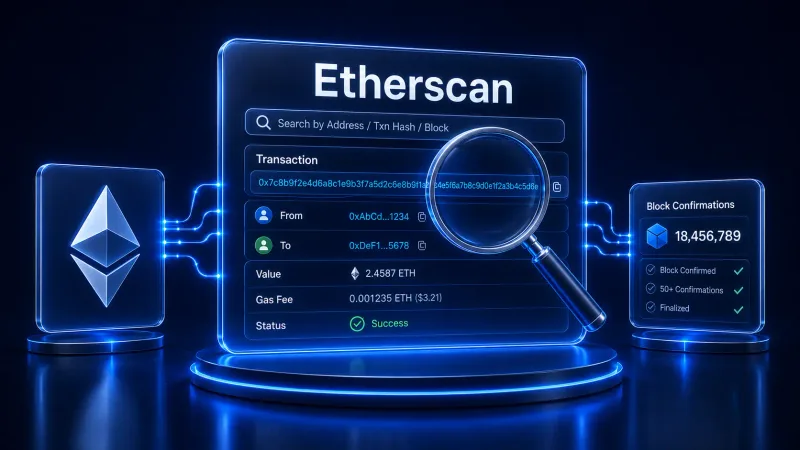
Wallet address: the string of characters you hand out to receive bitcoin. It's a hashed value formatted into a shareable identifier, currently the most common way users exchange payment information. An address is a hashed, shortened stand-in for the public key, and a good wallet generates a new one for every transaction to limit how much of your activity can be linked together on the public ledger. You can look up any address's balance and full transaction history on a public block explorer at any time.
When you send a payment, your wallet uses the private key to sign the transaction, which provides cryptographic proof that it came from the key's owner while also preventing anyone from altering it afterward. That signed transaction is then broadcast to the network and typically receives its first confirmation within about 10 to 60 minutes, once miners include it in a block.
Seed phrase: most modern wallets don't make you record raw keys at all. Instead, they give you a human-readable backup called a seed phrase, or recovery phrase, made up of 12 to 24 common words. Behind the scenes, this list of words follows a standard called BIP-39, which is just a set of rules for turning random data into those words and back again. What matters for you is simpler: that one phrase can regenerate every private key, public key, and address your wallet will ever use, including ones you haven't created yet. So instead of backing up each key separately, you write down this single phrase once, store it safely, and your entire wallet can be restored from it later.
One wallet is simple. A dozen wallets and exchanges isn't.
CoinTracking imports your transaction history from over 400 exchanges and wallets automatically, so you don't have to reconstruct every transfer by hand.
Types of Bitcoin Wallets
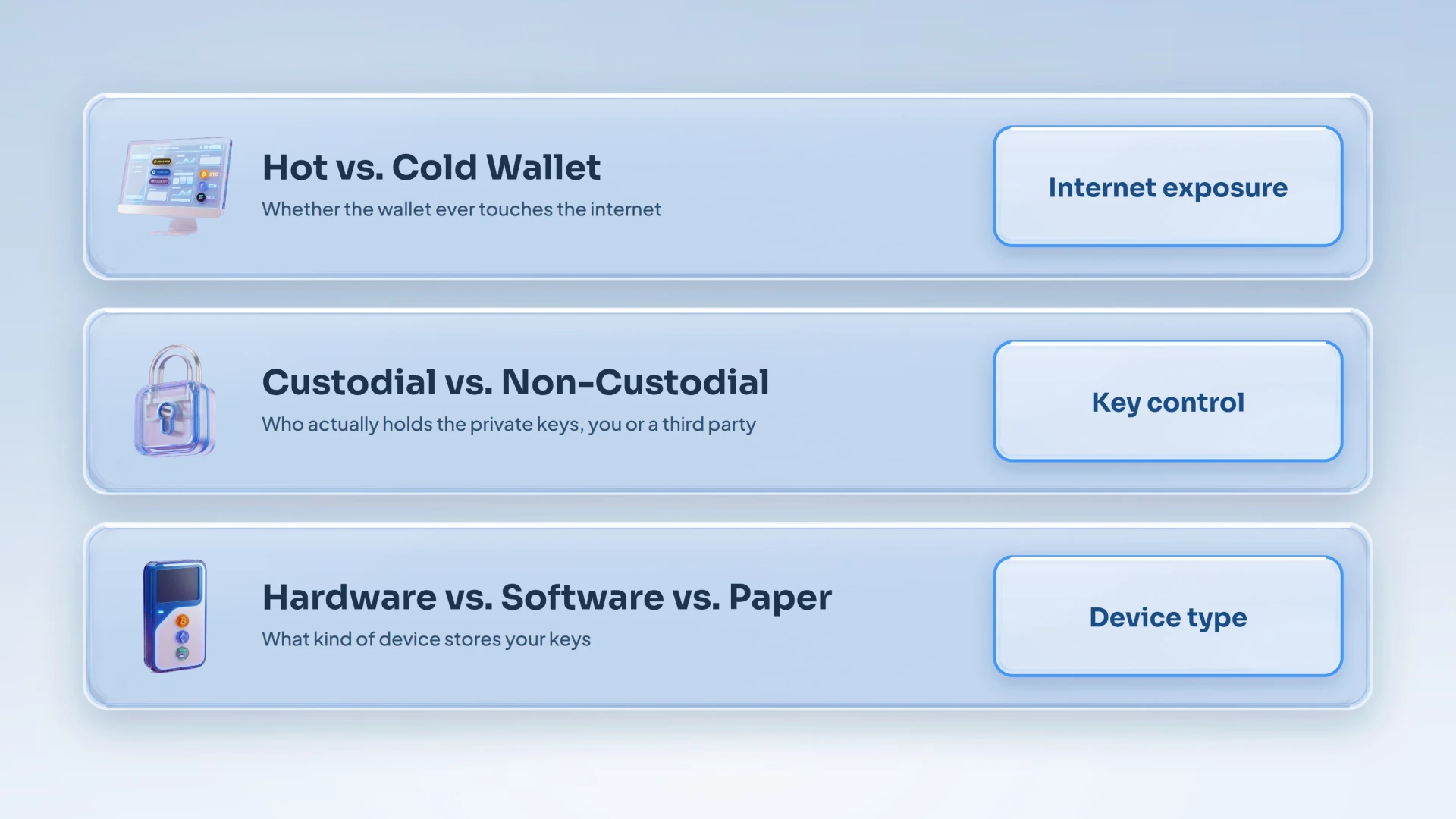
Every Bitcoin wallet falls somewhere on three overlapping spectrums: how connected it is to the internet, who holds the keys, and what kind of device it runs on.
Hot Wallets vs. Cold Wallets
The most basic split is whether a wallet ever touches the internet. A hot wallet runs on a connected device, a phone, browser, or desktop app, which makes it convenient for frequent transactions but also exposes its keys to online attack vectors. A cold wallet, often called cold storage, keeps its private keys on a device that never connects to any network, which removes that internet-based attack surface almost entirely and is generally considered the higher-security option for savings.
Custodial vs. Non-Custodial Wallets
This distinction is about who actually holds the private keys. A non-custodial wallet gives you sole control over your keys, meaning no third party can freeze or take away your funds, since only you can authorize a transaction. A custodial wallet, most commonly the wallet built into a crypto exchange account, flips that arrangement: the exchange holds the private keys on your behalf, and you access your balance through its interface rather than signing transactions with your own keys.
Custodial setups trade some control for convenience, since the provider handles backups and key security for you. Non-custodial setups put full responsibility, and full control, in your own hands. Neither option is inherently better for every situation; it depends on how much bitcoin you're holding and how comfortable you are managing your own keys.
Hardware Wallets vs. Software Wallets
Software wallets are applications, desktop programs, mobile apps, or browser extensions, that store keys on a general-purpose device. Some desktop wallets can even operate as a full node. This means they verify the blockchain independently instead of trusting a third party's data, giving users more direct control over their funds.
Hardware wallets are dedicated physical devices that keep private keys isolated from any internet-connected computer. They are one of the more secure storage methods available, and the recommended option for holding larger amounts of bitcoin long term. They combine the security of cold storage with an interface simple enough for regular use. That combination is why many experienced holders switch to one once a balance grows beyond what feels comfortable in a hot wallet.
Paper wallets are a related, older approach: a private key and address printed or written on physical paper, generated offline and never entered into an internet-connected device again afterward. Because the key exists only on that physical object, protecting a paper wallet means protecting a physical document, closer to safeguarding cash than securing a device or an app.
Is a Bitcoin Wallet Safe?
A Bitcoin wallet is only as safe as the practices behind it. A handful of habits account for most of the difference between a secure setup and a costly mistake.
Back up your seed phrase: a wallet backup protects you against device failure and simple human error. Most modern wallets are hierarchical deterministic wallets. This means one recovery phrase can recreate every key the wallet will ever use. That single phrase is worth protecting as carefully as the funds it controls. Store it offline, on paper or a metal backup plate, never as a photo or a note in a cloud account.
Encrypt your device: setting a password on your wallet or your phone adds a layer of protection for anyone who tries to withdraw funds without authorization. A lost password with no working seed-phrase backup, however, can lock you out just as permanently as a lost key.
Consider multi-signature setups for larger balances: a multi-signature wallet requires more than one independent approval before funds can move, which prevents a thief from draining an account by compromising a single device or key.
Ultimately, protecting a Bitcoin wallet is the user's own responsibility. Unlike a bank account, there's no customer service line that can reverse a mistaken transfer or reissue a lost private key, which is exactly why the habits above matter more here than they would for a traditional financial account.
How to Create a Bitcoin Wallet
Setting one up is more straightforward than the security discussion above might suggest. The process looks similar whether you're installing a software wallet or unboxing a hardware device.
- Choose a wallet type based on how much bitcoin you plan to hold and how often you expect to transact, using the categories covered above as a starting point.
- Install the software or set up the device, following the wallet provider's official instructions and downloading apps only from official sources.
- Let the wallet generate your keys and seed phrase. A properly designed wallet creates this randomly on your own device; you should never be asked to type an existing seed phrase into a website or receive one that someone else generated for you.
- Write down your seed phrase immediately and store it somewhere offline and secure before you fund the wallet with anything.
- Generate a receiving address from within the wallet whenever you're ready to move bitcoin into it.
Your wallet doesn't calculate your taxes
Once bitcoin moves into your own wallet, CoinTracking can still track its full history and calculate your gains, losses, and holding periods automatically.
Bitcoin Wallet vs. Crypto Exchange Account
Beginners often treat the balance shown in an exchange app the same way they'd treat a wallet balance, but the two aren't the same thing. An exchange account is typically a custodial wallet: the private keys stay in the exchange's custody, and the balance you see is the exchange's own internal record of what it owes you, rather than bitcoin controlled by keys only you hold. Moving that bitcoin to a wallet you set up yourself is what puts it under your own control.
Do You Owe Tax When You Move Bitcoin Into Your Own Wallet?
Moving bitcoin from an exchange into a wallet you own and control is generally not a taxable event in the US, though the network fee paid to make the transfer can itself trigger a small taxable disposal; our guide on whether wallet-to-wallet transfers are taxable covers this in detail.
What doesn't change is that the activity now lives in two separate places, your exchange's records and your wallet's on-chain history, and keeping both reconciled matters once tax season arrives. That's the exact gap dedicated software like CoinTracking is built to close, by importing activity across both exchanges and self-custody wallets automatically.
Choosing the Right Bitcoin Wallet for You
Brand recognition and interface polish are the wrong starting point. Start with how much bitcoin you're actually holding, because that number should drive the decision more than anything else. A small amount you're still learning with belongs in a reputable mobile or desktop wallet, something you can install in minutes and use without friction while you get comfortable sending and receiving. A balance you'd genuinely be upset to lose belongs in cold storage, ideally a hardware wallet, even if that means a slightly less convenient setup for everyday use.
From there, a few practical questions narrow the field further. Does the wallet let you independently verify the blockchain instead of trusting a third party's data, or does it quietly depend on the provider's own servers? Does it generate a new address for every transaction, or does it reuse the same one and leak more of your activity than it needs to? And if your phone is lost or your hardware device breaks tomorrow, does the recovery process actually work, or have you never tested it?
Our Trust Wallet vs. MetaMask comparison walks through how two of the most widely used software wallets stack up on exactly these points, if you're deciding between that type. As your holdings grow, moving some or all of your bitcoin to a hardware wallet is the more common next step, for the security reasons covered earlier in this guide.
Conclusion
A Bitcoin wallet is fundamentally a keychain, not a container: it generates and protects the keys that prove your bitcoin is yours and lets you move it, while the coins themselves live permanently on the blockchain. Whether you start with a custodial exchange balance, a software wallet, or a hardware device from day one, the core decision comes down to how much control and responsibility you want over your own keys. Once bitcoin is sitting in a wallet you control, keeping a clear record of its activity becomes part of managing it properly, including for tax purposes.
From your first wallet to a finished tax report
CoinTracking has tracked crypto portfolios and calculated taxes for over 2.2 million users since 2012, across more than 400 exchanges and wallets.
Disclaimer
The information provided in this article is intended for general informational purposes only and should not be construed as financial, tax, or legal advice. Wallet software and security best practices change over time, and specific tax treatment of crypto transactions depends on your jurisdiction and individual circumstances. Readers are encouraged to conduct their own research and consult with a qualified professional before making decisions based on the information presented here. The author and publisher are not responsible for any losses or damages incurred as a result of using the information in this article.