Two separate warnings about Bitcoin's long-term security surfaced within weeks of each other in mid-2026, and they point at the same underlying weakness from different directions. In a televised interview, Scott Crowder, IBM's Vice President of Quantum Adoption and Business Development, discussed a future in which nation-state actors use quantum computers to breach financial systems and digital assets, with several outlets summarizing his remarks as placing that risk in the early 2030s. Weeks before that interview aired, Binance founder Changpeng Zhao, widely known as CZ, floated a proposal to eventually freeze more than a million dormant Bitcoin if their owners never move them to safer addresses.
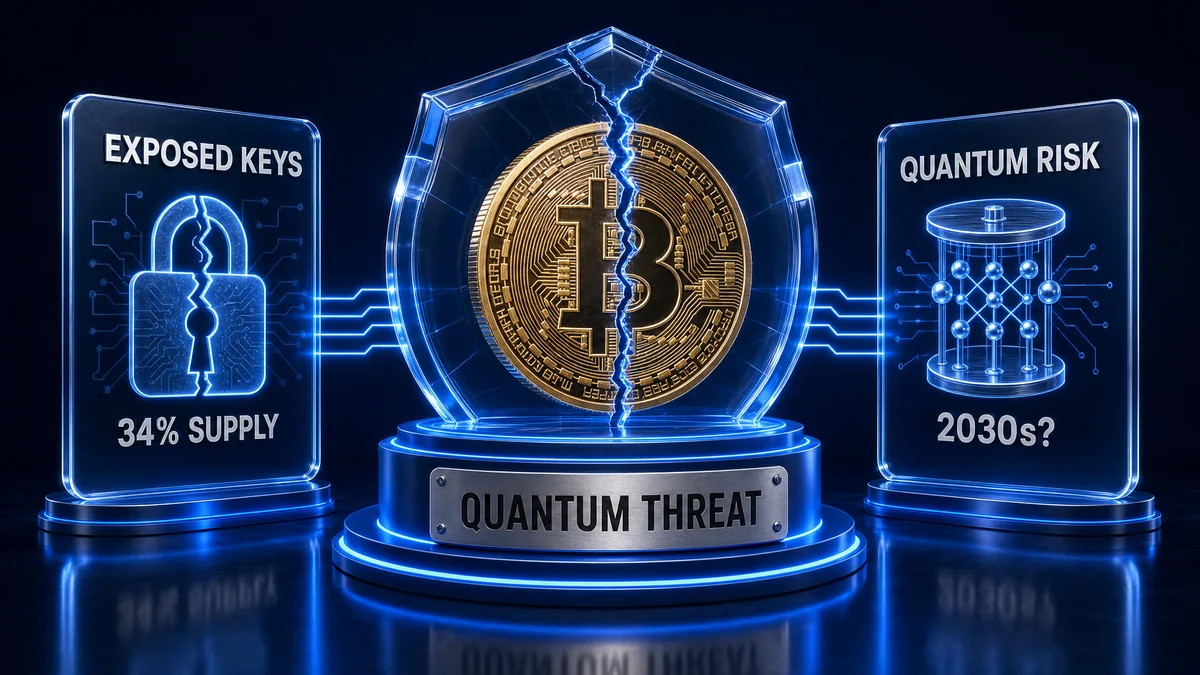
The two stories share one number. More than 34% of all Bitcoin in circulation sits in addresses with a public key already exposed on the blockchain, according to a formal Bitcoin developer proposal submitted in April 2026. That exposure, not the mere existence of a Bitcoin address, is the specific condition a quantum computer would need to attack a wallet. This guide separates what's confirmed from what's speculative, explains how the underlying attack would actually work, walks through how to check whether your own coins sit in an exposed address, and covers what a hypothetical future loss would mean for your taxes.
Key Takeaways
- Two separate stories point at the same vulnerability, with IBM's Scott Crowder placing a quantum threat to Bitcoin in the early 2030s in a televised interview while CZ proposed freezing dormant coins with exposed public keys around the same time.
- Over 34% of all Bitcoin has an exposed public key on-chain, according to Bitcoin developer proposal BIP-361, which is the specific condition a quantum computer would need to exploit a wallet.
- The early-2030s timeline is one expert's estimate, not a consensus, since independent estimates range from a 50% probability by 2032 to a multi-decade horizon, and some researchers argue today's risk is overstated.
- Modern SegWit addresses that have never sent a transaction are not exposed, but Taproot is an exception: it places a public key on-chain the moment it receives funds, so checking your own address type is the most useful thing you can do today.
- CoinTracking keeps a permanent record of every wallet and transaction you import, which matters if you ever need to prove what you held before a future security event, quantum-related or otherwise.
Two Warnings, One Underlying Vulnerability
Crowder's televised remarks and CZ's freeze proposal read like two unrelated news items at first. One is a corporate quantum-computing executive talking about long-term financial-system risk, and the other is a Bitcoin exchange founder floating a governance idea on a podcast. What connects them is the same technical fact: a meaningful share of Bitcoin's supply already has its cryptographic public key sitting in the open on the blockchain, and that is the one condition a quantum computer would need before it could even attempt to derive a private key and drain a wallet.
Neither story means Bitcoin is at risk today. Both are about a future capability that doesn't exist yet, layered onto a present-day fact about how exposed a portion of the existing supply already is. Keeping those two pieces separate, the "not yet possible" part and the "already measurable" part, is the difference between useful information and panic.
What CZ's Freeze Proposal Actually Says
CZ raised the idea in a podcast appearance with Galaxy Digital's Alex Thorn about a month before the debate broke into wider coverage, and framed it as a question for the Bitcoin community to debate rather than a plan he could put into motion himself. According to industry reporting, the proposal works in two stages. First, Bitcoin would need a network-wide upgrade to quantum-resistant cryptography. After that upgrade, holders of old, exposed addresses would get a migration window of roughly six to twelve months to move their coins to newly protected addresses. Addresses still untouched once that window closes could then be blocked from spending through a protocol fork, pending the community's agreement to do so.
The proposal would technically apply to any exposed address, but the debate has centered on Bitcoin's largest known holder: wallets linked to Satoshi Nakamoto, estimated to hold around 1.1 million BTC from Bitcoin's earliest years, when exposing a public key on-chain was unavoidable. CZ explained his reasoning this way: "If we don't do anything with it, then we're basically giving it to somebody who's going to hack it."
The reaction split along familiar lines. Crypto investor Michael Terpin argued the idea "begins a slippery slope of creating permission in a permissionless system relative to personal property," and questioned whether Bitcoin's decentralized governance could even reach consensus on it, noting that "it took years just to implement SegWit." Bitcoin developer Jameson Lopp rejected the idea that CZ had made a formal proposal at all, calling the remarks musing on the threat rather than a plan. Lopp's own BIP-361 proposal, covered later in this guide, applies the same kind of freeze mechanism network-wide to every exposed address, not just Satoshi's, on a longer five-year timeline instead of CZ's six-to-twelve-month window. Bitwise CIO Matt Hougan said he preferred a different idea floated by researcher Nic Carter: placing Satoshi's coins in a legal trust rather than freezing them outright.
What IBM's Quantum VP Said, and Why the Timeline Is Disputed
Crowder's comments focused on the broader picture of quantum computing risk to financial systems, framing a scenario in which rogue nation-state actors gain enough quantum capability to threaten digital assets. Reporting on the interview attached an "early 2030s" timeframe to that scenario. Nothing about Crowder's role makes him an unreliable source on quantum hardware roadmaps; IBM is one of the leading builders of quantum computers. But a single executive's estimate is not the same thing as an agreed timeline, and the published research on this question disagrees by years.
BIP-361 itself cites a McKinsey estimate placing a cryptographically relevant quantum computer as early as 2027 to 2030, at the aggressive end of the range. Ethereum Foundation researcher Justin Drake, a co-author on the Google paper, initially put the odds at 10% by 2032. On June 2, 2026, he revised that estimate upward, citing continued progress in the field, to 50% by 2032 and 10% by 2030, a framing that now treats the early-2030s window as closer to a coin flip than a long shot.
Blockstream CEO Adam Back pushed back harder in earlier reporting, saying "quantum computing still has a lot to prove" and describing today's machines as "essentially lab experiments," even while agreeing Bitcoin should prepare through optional upgrades now. Separate reporting citing CoinShares research argued the near-term threat is smaller than headlines suggest.
Treat the "early 2030s" framing the way you would treat any single expert's forecast on a question this unsettled: plausible, worth tracking, and not something to base an urgent decision on today.
Know exactly what's in every wallet you hold
CoinTracking imports your full transaction history from over 400 exchanges and wallets, so you always have a timestamped record of your holdings, address by address, no matter what happens with quantum computing or anything else.
How a Quantum Attack on Bitcoin Would Actually Work
Bitcoin's signature scheme, ECDSA, relies on a mathematical relationship between a private key and a public key that is computationally impractical to reverse with classical computers. A sufficiently powerful quantum computer running Shor's algorithm could reverse that relationship, deriving a private key from a known public key and then spending the coins it controls. The catch, and the reason this isn't an immediate risk to every Bitcoin holder, is that the public key has to already be visible on the blockchain for that attack to have a target.
Whether your public key is visible depends on your address type and history. Legacy Pay-to-Public-Key (P2PK) addresses from Bitcoin's earliest years expose the public key permanently by design. Pay-to-Public-Key-Hash (P2PKH) addresses, the common "1..." addresses, and Pay-to-Script-Hash (P2SH) "3..." addresses only reveal the underlying public key at the moment you spend from them, meaning an address that has only ever received funds keeps its key hidden. Modern SegWit (bc1q) addresses work the same way: unspent, they don't expose a public key at all. Taproot is the exception. A Taproot output places a public key directly on-chain the moment you receive funds, whether or not you ever spend from it.
Hardware progress is also part of why this conversation intensified in 2026. Bitcoin's own BIP-361 proposal points to Google security research showing quantum factoring algorithms "improving up to 20X," which lowers the theoretical hardware bar for breaking classical encryption schemes like the one protecting Bitcoin. Separately, other reporting on a Google whitepaper published March 30, 2026, found that cracking Bitcoin's elliptic-curve cryptography could take fewer than 500,000 qubits. Even at that reduced figure, it's several orders of magnitude beyond what today's largest quantum systems have demonstrated.
Is Your Bitcoin in an Exposed Address? How to Check
You can get a reasonable read on your own exposure without any special tools. Start with the address prefix. Addresses beginning with 1 are legacy P2PKH, addresses beginning with 3 are P2SH, and both fall into the exposed category once you've ever spent from them. Addresses beginning with bc1q are native SegWit and keep their public key hidden as long as you've only received funds and never sent from it. Addresses beginning with bc1p are Taproot, which places a public key on-chain as soon as it receives funds, regardless of whether you've ever spent from it. A blockchain explorer lets you confirm directly whether a given address has ever sent a transaction, rather than guessing from memory.
From there, a few habits close most of the practical gap:
- Avoid reusing the same receiving address more than once. A new address for every incoming payment keeps your public key unexposed until you actually spend.
- If you're holding coins long-term in an old legacy address that has already sent a transaction at some point, consider moving those funds to a fresh, modern address as routine wallet hygiene, not out of urgency.
- Watch for BIP-360, Bitcoin's proposed quantum-resistant address format, discussed below. Once it's live, migrating exposed balances to it becomes the direct fix rather than a workaround.
If you're due for a wallet refresh anyway, setting up a new wallet is a natural moment to start these habits from scratch rather than carrying old address hygiene forward.
Bitcoin's Answer: BIP-360 and BIP-361
Bitcoin developers are already working on a formal response with a similar end result: coins that never migrate become permanently unspendable. BIP-361, formally titled "Post Quantum Migration and Legacy Signature Sunset," was submitted to Bitcoin's improvement-proposal repository on April 14, 2026 by developer Jameson Lopp and five co-authors. It proposes a phased path: give the network time to migrate to the quantum-resistant address format introduced separately in BIP-360, then eventually sunset support for the legacy signature schemes that expose public keys in the first place. You can read the full proposal for the technical detail behind the 34% exposure figure cited throughout this article.
None of this is activated yet, and that's the real bottleneck. Bitcoin has no central authority that can push a change like this through on a deadline. Any upgrade needs broad agreement across miners, node operators, and the wider community, the same kind of coordination that took years to reach on far smaller changes like SegWit. That slow, deliberate process is a feature of Bitcoin's design, not a bug, but it also means a technical fix arriving before a real quantum threat materializes isn't guaranteed just because a proposal exists.
Your records should outlast any single security scare
CoinTracking calculates your cost basis and keeps a full transaction history for every wallet you import, so you have documentation ready if you're ever asked to prove what you held and when.
If a Quantum Exploit Ever Happened, What Would It Mean for Your Taxes?
No wallet has been drained by a quantum attack, and nothing in this article should be read as a prediction that one is imminent. But the same question raised by the 2026 wave of DeFi bridge hacks, whether stolen or hacked cryptocurrency creates a deductible loss, would apply the same way here if an exposed wallet were ever drained. In the United States, a theft is not itself a taxable event for the victim, and whether the loss becomes deductible depends on the same distinction that applied to those DeFi incidents: whether the crypto was held for personal use or for investment and trading, and what you can prove about it.
That's the part worth acting on now rather than after the fact. A cost basis and transaction history you can produce on demand, the same kind of documentation behind a Source of Funds report, is what turns a hypothetical future loss into something you can substantiate to a tax authority or an accountant, regardless of how any specific quantum scenario plays out or how a tax professional ultimately classifies it for your situation.
How CoinTracking Helps You Keep Track of What You Hold
Whatever happens with the CZ freeze debate, IBM's timeline, or Bitcoin's eventual quantum-resistant upgrade, one thing doesn't change: your own records are what protect you, not the exchange's or the network's. CoinTracking imports transaction history from more than 400 exchanges and wallets and has tracked crypto portfolios and calculated tax reports for 2.2 million users since 2012.
That matters here in a specific way. If you ever move coins to a new address as a precaution, whether that's routine wallet hygiene today or a migration to a future quantum-resistant format, CoinTracking keeps the full chain of custody intact in your records instead of treating it as a break in your history.
Conclusion
Nobody, including IBM, can tell you the exact year a quantum computer becomes a real threat to Bitcoin, and treating any single forecast as settled fact would be a mistake. What you can act on today doesn't depend on that debate being resolved: know your address type, stop reusing addresses, and keep records that hold up regardless of how the CZ freeze proposal or Bitcoin's own quantum-resistant upgrade eventually play out.
Keep a complete record, whatever the future holds
CoinTracking has tracked crypto portfolios and calculated tax reports for 2.2 million users since 2012, across more than 400 exchanges and wallets, so your history is ready no matter what security story comes next.
Disclaimer
The information provided in this article is intended for general informational purposes only and should not be construed as financial, tax, or legal advice. The quantum-computing timelines, statistics, and proposals described here reflect public reporting and developer proposals as of August 3, 2026, remain subject to significant expert disagreement, and may change without notice. Readers are encouraged to verify current details directly with the sources cited and consult a qualified tax professional about their specific situation before making decisions based on the information presented here. The author and publisher are not responsible for any losses or damages incurred as a result of using the information in this article.