

December 31 doesn't care whether you have reconciled every exchange, chosen a cost-basis method, or actually reviewed which trades left you with a loss this year. Once the calendar turns, the moves that could have lowered your 2026 crypto tax bill are gone. You can't harvest a loss retroactively, elect a cost-basis method for a position you already closed, or backdate a charitable donation.
Crypto adds a layer most other assets don't have. A single investor might hold positions across a dozen exchanges, wallets, and DeFi protocols, each with its own transaction history that needs to be pulled together before any year-end move actually makes sense. This checklist walks through the specific actions worth taking before December 31, in roughly the order they need attention.
Key Takeaways
- December 31 is the hard cutoff: crypto sales, cost-basis elections, and charitable gifts all have to settle by then, since nothing completed in January counts for the 2026 tax year.
- Tax-loss harvesting with an immediate buyback is still legal in 2026: crypto has no wash-sale rule today, though a bill in Congress could change that in a future year.
- Wallet-by-wallet cost basis is now the default: since Revenue Procedure 2024-28, the IRS tracks cost basis per wallet and account rather than pooled across your whole portfolio.
- Donating appreciated crypto beats selling first: give it directly to a qualified charity and you can deduct the fair market value while skipping the capital gains tax a sale would trigger.
- The 2026 annual gift tax exclusion is $19,000 per recipient: gift up to that amount in crypto without filing a gift tax return or touching your lifetime exemption.
Lock In Tax-Loss Harvesting Before the Wash Sale Rule Changes
Tax-loss harvesting means selling an asset at a loss to offset gains elsewhere in your portfolio, then optionally buying back into the same position. For a full walkthrough of the mechanics, including how losses offset gains and carry forward to future years, see our guide to crypto tax-loss harvesting. What matters for a year-end checklist is timing: any loss you want counted against your 2026 gains has to be realized, meaning the sale has to settle, by December 31.
Crypto currently sits outside the wash-sale rule that applies to stocks and securities. That rule normally disallows a loss if you buy back a substantially identical position within 30 days, but the IRS treats digital assets as property rather than as stock or securities, so the rule doesn't apply to crypto trades today. In practice, you can sell a losing position, realize the loss for your 2026 return, and buy back into the same coin right away, without waiting out the 30-day window a stock investor would face. Our full breakdown of how this works, and where it could change, is in our crypto wash-sale rule guide.
That gap isn't guaranteed to last. H.R. 9172, the Applying Existing Tax Anti-Abuse Rules to Digital Assets Act, was introduced in the House on June 8, 2026. It was referred to the Committee on Ways and Means the same day. The bill would extend the wash-sale rule to digital assets, closing the exact gap described above.
As of this article's publish date, it hasn't been voted on in committee or on the House floor, and it isn't law. The push has drawn bipartisan interest, notable given how divided Congress usually is on crypto tax policy. Reporting attention isn't the same as passage, though. Treat the current wash-sale gap as available for the 2026 tax year, and don't assume it will still be there in 2027.
Reconcile Every Exchange, Wallet, and DeFi Transaction
Every other item on this checklist depends on a complete, accurate transaction history. Tax-loss harvesting only works if you actually know which positions show a loss, and a cost-basis election is close to meaningless if half your trades are missing from the picture. Before you make any year-end move, pull a full history from every exchange, wallet, and DeFi protocol you touched in 2026, and check it against what you remember trading.
The gaps that most often trip up crypto investors are predictable: an exchange that shut down mid-year, an old wallet you stopped checking, a DeFi position where the platform's own history is incomplete, or staking and airdrop income that never generated a formal statement. Missing even one of these can throw off your entire cost-basis calculation, since it means your reported gains are being measured against an incomplete picture of what you actually paid.
Every wallet, one cost basis
CoinTracking lets you track wallet-by-wallet cost basis to match the IRS's current account-by-account rules, with 400+ exchanges, wallets, and blockchains supported.
Confirm Your Cost-Basis Method Before Your Last Trade
Once your transaction history is complete, you need an accounting method to determine which specific units you sold and at what cost. The IRS's default is First In First Out (FIFO) when you haven't identified specific units, but you can elect Specific Identification instead, and within it investors commonly apply conventions such as LIFO (Last In First Out) or HIFO (Highest In First Out) to choose which units to sell. The timing matters either way: to use anything other than the default method, you need to identify which units you are selling at the time of each transaction, not months later when you sit down to file.
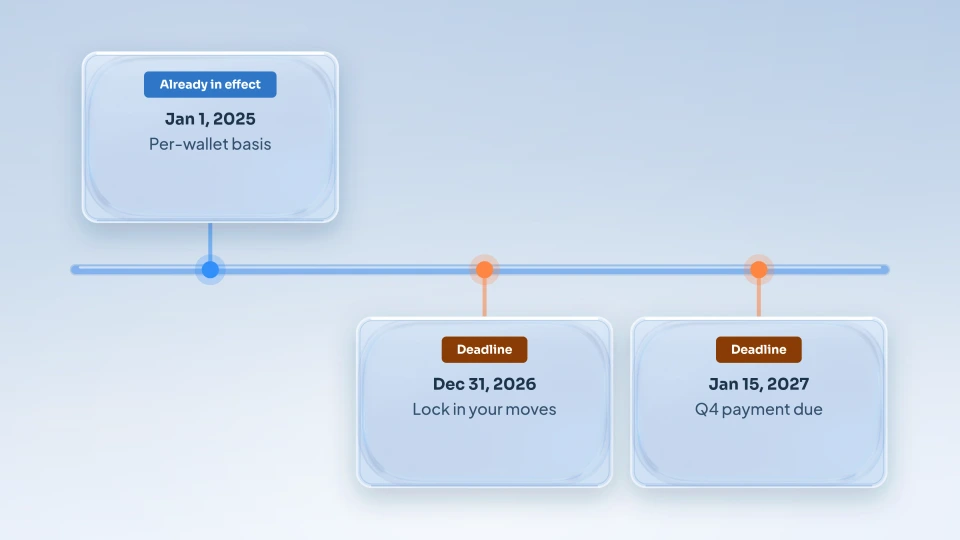
There is a second layer that changed recently. Under Revenue Procedure 2024-28, the IRS requires cost basis to be tracked wallet by wallet and account by account. Pooling cost basis across your entire portfolio is no longer allowed for dispositions on or after January 1, 2025. That means the cost basis assigned to a coin in one wallet can't be borrowed from a different wallet's records. Each wallet or account now carries its own basis going forward.
If you haven't already set a method for each wallet you are still trading in, do it before your next trade closes out the year. The election applies to future sales only and can't be applied retroactively to a position you have already closed. HIFO tends to minimize the gain reported today by disposing of your most expensive units first, though it can leave a smaller loss to harvest later, so weigh it against FIFO or Specific Identification based on your own holdings before you decide.
Donate Appreciated Crypto Instead of Selling First
If you are planning to donate to a qualified charity before year-end anyway, giving appreciated crypto directly is usually more tax-efficient than selling it and donating the cash. Under IRS Publication 526, donating property you have held for more than a year generally lets you deduct its fair market value, while skipping the capital gains tax you would otherwise owe on the appreciation if you sold it first. Sell the same coin and donate the proceeds instead, and you trigger a taxable gain before the charity ever sees the money.
Our full guide on how crypto donations lower your taxes covers deduction limits, the paperwork a larger gift requires, and how to actually make the donation through a platform that accepts crypto directly. If you already know you want to give before December 31, that guide is worth reading in full before you send anything.
One planning move worth considering alongside the donation itself is bunching charitable gifts. The 2026 standard deduction is $16,100 for single filers and $32,200 for married couples filing jointly. If your itemized deductions normally fall short of that amount, you can combine several years of planned giving into one tax year. Adding an appreciated crypto donation to that bunched year can push your itemized total high enough to make itemizing worth it.
Gift Crypto Using the Annual Exclusion
Gifting crypto to family or friends before year-end is a separate move from donating to charity, and it comes with its own limit. For 2026, the IRS annual gift tax exclusion is $19,000 per recipient, unchanged from 2025. You can give that amount, in crypto or anything else, to as many different people as you want without filing a gift tax return or touching your lifetime estate and gift tax exemption.
Gifting crypto isn't a taxable event for the giver, so gifting it directly avoids the capital gains tax a sale would trigger, similar to the donation strategy above. The tax bill on the appreciation doesn't disappear, though. The recipient inherits your original cost basis and holding period, so it moves to whoever receives the gift when they eventually sell. If you are gifting to someone in a much lower tax bracket, such as an adult child, that shift can still meaningfully reduce the total tax paid on the position.
Like every other item on this list, the gift has to actually settle, meaning the transfer completes on-chain or on the platform you are using, before December 31 to count for the 2026 tax year.
Track every gift and donation alongside your trades
CoinTracking logs gifts, donations, and transfers next to your taxable trades, so your records stay complete no matter how you moved your crypto this year.
Reconcile Form 1099-DA and Line Up Your Q4 Estimated Payment
2026 is the first full tax year exchanges are sending Form 1099-DA, the IRS's dedicated broker-reporting form for digital assets. Our complete guide to Form 1099-DA covers the full phase-in timeline, but the year-end action is straightforward: as statements arrive, check each one against your own transaction records rather than assuming the broker's numbers are complete. The forms already sent for the 2025 tax year report gross proceeds only, without cost basis. A missing or incorrect basis figure on those forms is expected, not a sign something is wrong with your account. Cost-basis reporting is only starting to phase in for 2026 transactions on covered assets, with those forms due to arrive in early 2027. Specific identification and backup withholding still fall under transition relief through Notice 2026-20 and Notice 2025-33.
If your 2026 trading produced gains large enough that your withholding won't cover the tax owed, this is also the point to check whether you need a Q4 estimated tax payment, due January 15, 2027. Underpaying throughout the year can trigger a penalty even if you pay the full balance when you file, so a rough estimate of your 2026 gains before year-end gives you time to send a payment rather than discover the shortfall in April.
Final Checklist: Confirm Everything Is Imported Before You File
Every strategy above only works if it is built on a complete picture of your 2026 activity. Before December 31, confirm that every exchange, wallet, and DeFi protocol you used this year is fully imported into whatever crypto tax calculator or spreadsheet you use, and that the transaction count roughly matches what you remember trading.
Keep your own records regardless of what any exchange sends you. Cost-basis documentation for coins bought years ago, especially on exchanges that have since shut down or changed ownership, gets harder to reconstruct the longer you wait, and a 1099-DA statement won't fill that gap for you. CoinTracking has supported 400+ exchanges, wallets, and blockchains since 2012, and 2.2 million users rely on it to keep this kind of record straight across every platform they use.
Conclusion
The clearest verdict for 2026 is that crypto's year-end tax moves reward investors who act before December 31, not after. Tax-loss harvesting, cost-basis elections, donations, and gifting all share the same constraint: the transaction has to settle before the calendar turns, and none of them work without a complete, reconciled transaction history behind them.
Get your 2026 crypto taxes ready before December 31
CoinTracking has helped 2.2 million users track crypto portfolios and calculate taxes since 2012, with 400+ exchanges, wallets, and blockchains supported.
Disclaimer
The information provided in this article is intended for general informational purposes only and should not be construed as financial, tax, or legal advice. Year-end crypto tax strategies, including tax-loss harvesting, cost-basis elections, and gifting, are subject to ongoing IRS guidance and pending legislation such as H.R. 9172, and specific tax treatment depends on your individual circumstances. Readers are encouraged to conduct their own research and consult with a qualified tax professional before making decisions based on the information presented here. The author and publisher are not responsible for any losses or damages incurred as a result of using the information in this article.