
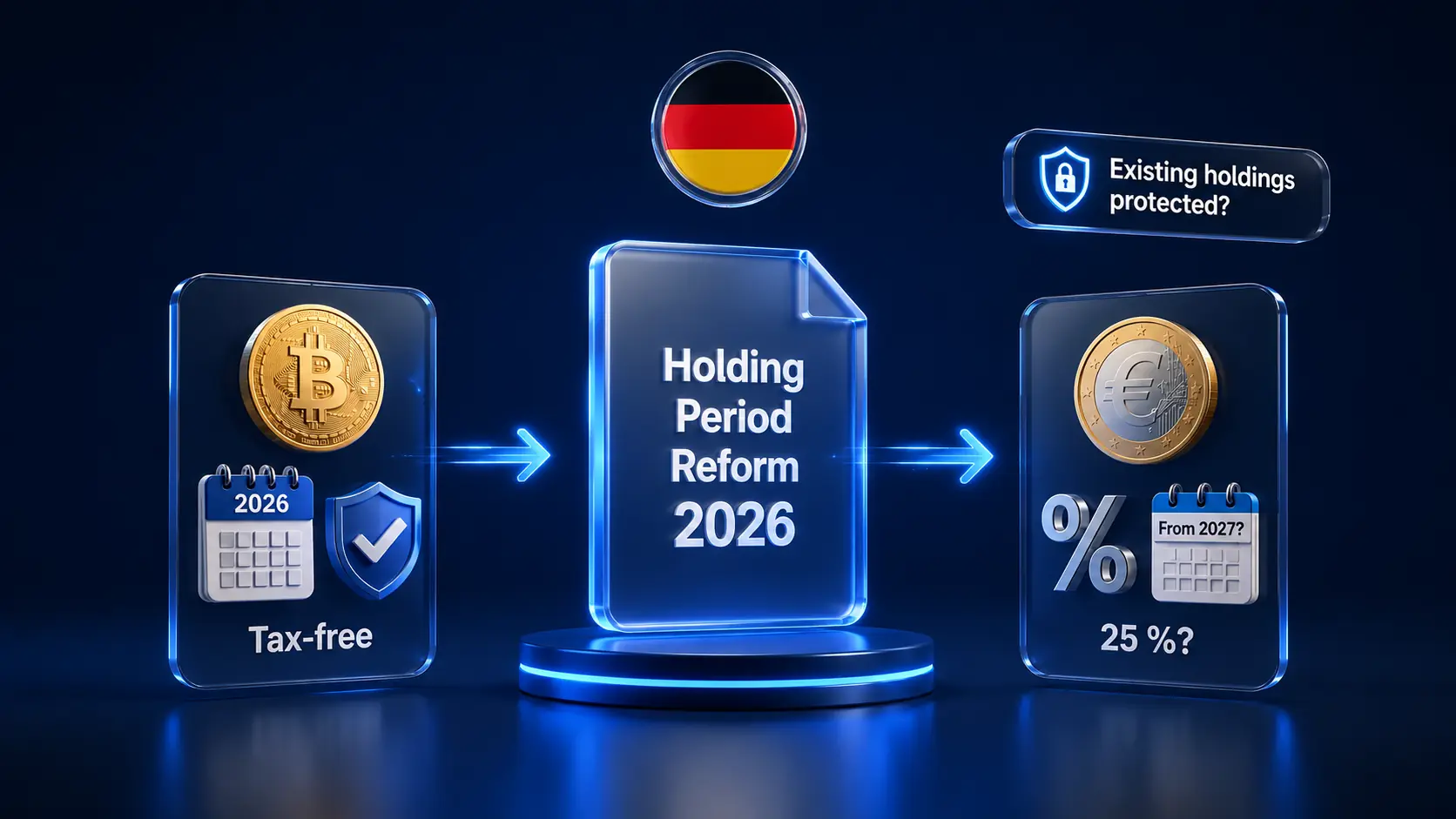
Anyone who invests in cryptocurrencies in Germany knows the rule: hold Bitcoin or Ethereum for more than a year, and the gain on sale is tax-free. This rule has existed for decades in German income tax law. For crypto assets, it has been firmly anchored through case law and administrative practice. But now it is coming under political pressure: for the first time, the crypto holding-period reform is seriously on the federal policy agenda in 2026. In spring 2026, Federal Finance Minister Lars Klingbeil announced a redesign of crypto taxation.
What this actually means, which scenarios are realistic, and what investors should do now: this article gives you the current overview. For a comprehensive introduction to the applicable rules, see our Crypto Tax Germany 2026 guide.
Key Takeaways at a Glance
- Current legal situation in 2026: The 1-year holding period applies unchanged — crypto gains after more than one year of holding are tax-free.
- Reform announced: On April 29, 2026, Federal Finance Minister Klingbeil signaled that crypto should be "taxed differently." Details expected from July 2026.
- Greens' bill failed: A bill to abolish the holding period was rejected by the Bundestag.
- Earliest possible change: Assessment period 2027 — i.e., purchases from January 1, 2027.
- Protection of legitimate expectations: Existing gains enjoy constitutional protection against retroactive taxation.
- Exemption limit: €1,000 per year for gains from sales within the holding period (since 2024).
What Is the Crypto Holding Period? Simply Explained
The 2026 crypto holding-period reform refers to the ongoing political process in Germany to redesign the existing tax exemption for crypto gains after a one-year holding period. The most likely model under discussion is a flat-rate withholding tax (Abgeltungsteuer) of 25%. As of June 2026, the existing 1-year rule applies unchanged; a reform is possible at the earliest from the 2027 assessment period.
The tax basis for the crypto holding period is not a special law for digital currencies, but a long-established section of the German Income Tax Act (Einkommensteuergesetz). It governs so-called private sale transactions (private Veräußerungsgeschäfte). Cryptocurrencies fall under this because they are treated as "other economic assets" (andere Wirtschaftsgüter).
The 1-Year Rule: How Does It Work?
The principle is simple: if more than one year passes between the purchase and the sale of a cryptocurrency, the resulting gain is entirely tax-free — regardless of whether it amounts to €500 or €500,000. This rule makes Germany a tax-attractive location for long-term-oriented crypto investors, because with stocks, ETFs, or certificates the flat-rate withholding tax of 25% plus solidarity surcharge (Solidaritätszuschlag) applies instead.
The exact acquisition date is decisive. The period begins on the day after the purchase and ends after one year has elapsed. Anyone who sells even a single day too early makes the entire gain taxable and then pays tax on it at their personal income tax rate, which — depending on income level — can be significantly above 25%.
Example: Tax-Free Thanks to the Holding Period
You buy Bitcoin worth €10,000 on March 15, 2025. On March 16, 2026 — after more than one year — you sell for €22,000. Your gain of €12,000 is completely tax-free. Had you sold on March 14, 2026, the entire amount would have been taxable.Which of your coins have already met the holding period?
CoinTracking shows you at a glance which positions have already met the one-year holding period — import your transactions from over 400 exchanges and keep your tax-free status in view.
The €1,000 Exemption Limit: What Else Applies?
Anyone who realizes gains within the holding period — i.e., before one year has elapsed — can still remain tax-free, as long as all private sale gains in a calendar year stay below the exemption limit of €1,000 per year. This limit has applied since the 2024 tax year and was raised from the previous €600.
Two things deserve particular attention here. First, this is an exemption limit (Freigrenze), not a tax-free allowance (Freibetrag). Anyone who exceeds the limit by even a single euro pays tax on the entire gain, not just the portion above the threshold. Second, all private sale transactions in a year are added together — including gains from the sale of other assets such as gold or antiques.
Which Cryptocurrencies Are Affected?
The holding-period rule applies in principle to all cryptocurrencies that are classified as "other economic assets" within the meaning of the Income Tax Act — that is, to Bitcoin, Ethereum, Solana, and the overwhelming majority of all altcoins. NFTs and tokens generally fall under it too, albeit with one important caveat: for NFTs there is so far no separate administrative directive from the Federal Ministry of Finance (BMF) that conclusively clarifies their tax classification. Individual questions therefore have to be assessed case by case, depending on the specific structure. Anyone unsure about a particular asset should clarify this with a tax advisor.
The Bitcoin holding period is subject to the same rules as all other cryptocurrencies: for tax purposes, Bitcoin is an "other economic asset" under the Income Tax Act — the 1-year rule applies without exception.
The Current Legal Situation in 2026: What Applies Today?
Despite all the political debate, the following applies for the 2026 tax year: the holding-period rule is in force and applies unchanged. No new law has been passed so far, and no government bill was on the table at the time this article was written. Anyone who sells cryptocurrencies in 2026 that they acquired more than a year ago realizes the gain tax-free.
Speculation Period vs. Holding Period: Understanding the Terms Correctly
In tax parlance, both terms appear — sometimes synonymously, sometimes in different contexts. In almost all cases the same rule is meant: the one-year holding period, after which private sale gains are tax-free. "Speculation period" (Spekulationsfrist) is the older term, dating from a time when short-term gains were regarded as speculation. "Holding period" (Haltefrist) is the more common and legally more precise term today. Both refer to the same span of time.
Calculating the Holding Period: Individual Assessment and FIFO
Anyone who has made several purchases of the same cryptocurrency needs to know, when selling, which coins are specifically deemed to have been sold. In principle, individual assessment applies: anyone who can seamlessly prove the acquisition history of each individual coin uses this method. If a complete individual assessment is not possible, the FIFO method (First In, First Out) applies in practice: the units bought first are deemed to be sold first. FIFO therefore determines both whether the one-year period has been met and the specific gain.
Crucially, this method is applied per wallet. Each exchange and each of your own wallets is considered separately, not globally across all holdings. This can significantly affect whether the holding period for a particular coin is deemed to have been met or not.
Why Is the Holding Period Under Review?
The question of how cryptocurrencies should be taxed is not a purely technical one. It is politically charged and touches on fundamental questions of tax fairness. In spring 2026, the signals intensified that a crypto holding-period reform is coming. The only question is: which one?
Klingbeil's Announcement in April 2026: Crypto Should Be Taxed Differently
On April 29, 2026, Federal Finance Minister Lars Klingbeil (SPD) declared that cryptocurrencies should in future be "taxed differently." He did not present a concrete legislative proposal. The announcement was a political signal that set the direction without defining the path. Details were expected for the budget-readiness stage of the 2027 federal budget draft, which was scheduled for July 2026.
One backdrop to the reform debate is the fiscal-policy environment: the federal government is looking for sources of revenue, and the tax-free realization of billions in crypto gains by private investors is increasingly coming into the focus of fiscal policy. At the same time, there are voices pointing to competitive disadvantages compared with other EU countries, which have no comparable tax exemption.
The Greens' Bill: What Was Planned?
About a week after the announcement by the Federal Ministry of Finance, the Greens introduced their own bill in the Bundestag on May 5, 2026. It proposed to fully abolish the 1-year holding period for all cryptocurrencies newly acquired from January 1, 2026. Existing positions would have been protected under this draft via a transitional arrangement — at least in principle.
Why the Bill Failed and What That Means
The Bundestag rejected the Greens' bill. CDU/CSU, AfD, and SPD voted against it, so the motion did not find a majority. The failure means two things. On the one hand, the holding period for 2026 is definitively untouched.
On the other hand, the voting behavior shows that a reform can only be pushed through with a broader consensus, or as a government initiative. The SPD, which voted against the Greens' bill in the Bundestag, has at the same time announced its own reform through its finance minister. This is not a contradiction but political tactics: the government wants to shape the reform itself, rather than being pre-empted by an opposition motion.
What Is the German Government Actually Planning? As of June 2026
No concrete government bills were on the table as of this article's editorial deadline. What is known: Klingbeil has set the direction, and the most likely reform model circulating in the specialist debate is the switch to a flat-rate withholding tax (Abgeltungsteuer).
Withholding Tax Instead of the Holding Period: The Likely Model
The model discussed most, both politically and in tax law, is aligning cryptocurrencies with classic securities. Concretely, this would mean: gains from crypto sales would — regardless of the holding period — be subject to a flat 25% withholding tax plus solidarity surcharge (5.5% on the tax). The 1-year rule would thereby disappear entirely. Anyone counting today on tax exemption after one year would have to fundamentally rethink this strategy. This is a politically discussed scenario, but not an enacted law.
| Aspect | Current rules | Likely reform model |
|---|---|---|
| Holding period relevant? | Yes: tax-free after 1 year | No: always taxable |
| Tax rate | Personal income tax rate (up to 45%) | Flat 25% withholding tax + solidarity surcharge |
| Exemption limit | €1,000 per year | Saver's allowance (currently €1,000 / €2,000 married) |
| Loss offsetting | With other private sale gains | With capital income (stocks, ETFs, etc.) |
The reform model would have an ambivalent effect for many investors. On the one hand, the long-term tax exemption would disappear — a considerable disadvantage for HODLers. On the other hand, crypto could be integrated as a fully fledged capital investment into the existing withholding-tax system, which would also bring advantages: losses could be offset more broadly, and the tax rate would be lower for high earners than their personal income tax rate.
Prepare for the reform now
No matter which model comes: anyone who knows their cost basis and holding periods is prepared. CoinTracking documents all transactions seamlessly and generates tax reports in line with current law.
Grandfathering: Will Existing Holdings Be Protected?
This is the decisive question for everyone who already holds crypto positions. Germany's Basic Law (Grundgesetz) protects citizens through the principle of the protection of legitimate expectations (Vertrauensschutz) against the genuine retroactive effect of laws: increases in value that arose before a new law was announced may not be taxed after the fact. In practice, this probably means: gains that arose up to the point at which the law is announced could remain tax-free, even if the coins continue to be held afterwards. The precise design of such grandfathering, however, is a matter for the legislator and depends on the specific bill.
Timeline: When Could a Reform Take Effect?
Based on the political roadmap, the earliest possible date for a reform is the 2027 assessment period — i.e., from January 1, 2027. For the current 2026 tax year, there is no real risk of a retroactive change. The 2027 budget draft was expected to reach budget readiness in July 2026. Only then would concrete figures and legislative texts become public.
Political Positions at a Glance
The reform debate has clear battle lines — though the positions do not always match what you might expect.
SPD
Ready to reform. Federal Finance Minister Klingbeil gave the signal. The SPD wants a redesign, but on its own terms and in step with the 2027 budget. Why it voted against the Greens' bill: not because of the goal, but because of the path and the timing.
CDU/CSU
Ambivalent position. The parliamentary group rejected the Greens' bill, justifying this with the tax-law parity between crypto assets, gold, and foreign currencies. As a coalition partner, it simultaneously supported the key-figures budget resolution (Eckwertebeschluss), which includes a change to crypto taxation. How the CDU/CSU will handle a concrete government bill remains open.
Greens
In favor of full abolition. The Greens introduced their bill and maintain the position that tax exemption for crypto gains is no longer appropriate. Their draft was the most concrete reform proposal in the Bundestag to date.
AfD
In favor of the status quo. The AfD voted together with the CDU/CSU against the Greens' bill. The party does not support a fundamental change to crypto taxation.
What Would Abolition Mean for You as an Investor?
The concrete effects depend on when you bought, how long you intend to hold, and which reform model is ultimately enacted. Three typical scenarios:
Scenario A: You've Held Crypto for More Than 1 Year
Your holdings have already met the holding period. Under current law, you can sell tax-free now. If a reform with grandfathering comes, your accrued gains are, under the constitutional principle of the protection of legitimate expectations, generally protected against retroactive taxation — the exact design depends on the specific bill. Anyone who prioritizes certainty should consider selling before a possible announcement of the law, or watch developments very closely.
Scenario B: You Bought in the Past Few Months
Your position has not yet reached the one-year mark. If a reform with a cut-off date of January 1, 2027 comes, the decisive question is: when exactly was the law announced, and how far does the grandfathering reach? Purchases from 2025 and early 2026 could be favored if the grandfathering is sufficiently worded — but they need not be. There is uncertainty here that only a tax advisor can resolve, with a view to the bill available at that point.
Scenario C: You're Planning to Buy Now
Anyone entering the market now should realistically factor in that the tax exemption after one year may no longer apply from 2027. That significantly changes the investment calculation: short-term gains would be taxed at your personal tax rate, medium-term gains possibly at 25% withholding tax. Anyone planning long-term and intending to realize gains only in a few years' time pays less tax under the withholding-tax model than under today's system with the personal income tax rate — provided the personal tax rate is above 25%.
Options for Investors Now, Before the Reform
The following options are not a call for hasty decisions. They are meant to help you structure the existing options — before a concrete bill is on the table and the situation becomes clearer.
"Klingbeil's announcement is a political signal — not a law. The holding period applies unchanged in 2026. Anyone who knows their positions now can decide with confidence: hold, sell, or wait. Those who don't know are groping in the dark."
Luis Schilli, Head of Marketing at CoinTracking
Realizing Taxable Gains: Is It Worth It?
Anyone holding positions that have already met the 1-year period should ask themselves: is now the right time for a tax-free partial sale? This is not a call for panic selling, but a legitimate tax consideration. Anyone who is bullish on crypto in the long term can, in theory, buy back in immediately after a tax-free sale and thereby raise their cost basis, which reduces the tax burden on a future taxable sale. This "harvesting" is legal, but must be assessed on an individual basis.
Consulting a Tax Advisor: When Does It Make Sense?
Tax advice is always worthwhile when you hold larger positions, when you have complex situations — such as staking, DeFi, NFTs, or crypto from abroad — or when you are facing concrete decisions to sell that could be affected by the reform. A tax advisor specializing in crypto cannot look into the future, but they can help you calculate the existing options and prepare a decision that you won't regret under various reform scenarios.
Your holding periods at a glance
CoinTracking automatically calculates which of your coins have already met the one-year period and, in every tax report, distinguishes between tax-free and taxable gains. That way you always have clarity — regardless of what the reform brings.
Using Crypto Tax Software: How to Stay on Top of Things
Reform or no reform: without seamless transaction documentation, no sound tax planning is possible. CoinTracking automatically imports your transactions from over 400 exchanges and wallets, calculates holding periods using FIFO, shows you at a glance which positions have already met the one-year period, and generates tax reports that distinguish between tax-free and taxable gains.
Right now, in a phase of uncertainty about the future rules, an overview of your exact cost basis and holding periods is more valuable than ever. Anyone who does not know what they bought and when can neither make use of the current tax exemption nor realistically assess the impact of a reform on their portfolio.
You'll find further information on the tax framework in our detailed Crypto Tax Germany guide.
Reform Radar: What to Do Now
- Check which of your positions have already met the 1-year holding period.
- Keep an eye on the timeline: if a government bill is presented in July 2026, you'll still have time to react.
- Document all transactions seamlessly: this is the prerequisite for any tax planning.
- Seek tax advice for larger positions before making any decisions to sell.
Conclusion
The 1-year holding period for crypto gains is under political pressure. The crypto holding-period reform is no longer a vague future scenario, but a clear signal from the Federal Ministry of Finance. At the same time, the rule applies unchanged for the 2026 tax year. Anyone who holds cryptocurrencies for more than a year today can still realize gains tax-free.
What comes from 2027 depends on which bill the government presents and whether it finds a parliamentary majority. The most likely model is the introduction of the withholding tax, which would end the tax exemption after one year. Grandfathering of already-accrued gains, required under constitutional law, is to be expected — but its details are still open.
Use the time now: check in CoinTracking which of your positions have already met the holding period, and be prepared before the bill arrives.
Further reading
- Crypto Tax Germany: The Complete Guide
- MiCA: The EU's Crypto Regulation
- Bitcoin or Bitcoin ETF: Which Is Better?
- How to Import Trade Republic Transactions
- Top 12 Crypto-Friendly Countries
- Top 9 Crypto Tax Myths
Keep your holding periods in view
CoinTracking shows you at a glance which positions have already met the one-year holding period and automatically generates tax reports that distinguish between tax-free and taxable gains. With over 2.2 million users and more than 400 exchanges, CoinTracking has been the first choice for crypto investors for more than 14 years.