Bybit EU Taxes: How to Generate Your Crypto Tax Report
Bybit EU does not create a tax report for you. Every crypto trade and disposal on this EU-regulated exchange is a potential tax event you are responsible for declaring. CoinTracking imports your full Bybit EU transaction history via CSV export, calculates gains and losses, and generates a tax report ready for your tax authority or accountant.

How to Import Your Bybit EU Transactions into CoinTracking
Watch how to export your transaction history from Bybit EU as a CSV file and import it into CoinTracking to generate your crypto tax report.
Start Your Free Bybit EU Import- Every crypto trade on Bybit EU is a taxable disposal in most jurisdictions. Capital gains tax applies when you sell, swap or spend crypto.
- Import your Bybit EU transactions via CSV export. Upload the file directly to CoinTracking to generate your tax report automatically.
- Transfers between your own wallets are not taxable events. Buying and holding crypto is not a taxable event.
- Under DAC8, EU-regulated exchanges including Bybit EU are required to report user transaction data to national tax authorities from 2026. As a MiCA-licensed CASP, your Bybit EU trading history may be reported to your country's tax office.
Bybit EU and Your Tax Obligations
Bybit EU is the European-regulated entity of the global Bybit exchange, operating under EU MiCA (Markets in Crypto-Assets) regulation. Licensed as a Crypto Asset Service Provider (CASP) within the European Union, Bybit EU is subject to strict compliance requirements including DAC8 transaction reporting obligations from 2026.
Bybit EU supports CSV export for importing your transaction history into tax software. Upload your Bybit EU CSV directly into CoinTracking for a complete tax report.
CoinTracking supports Bybit EU via CSV file upload:
- Bybit EU CSV Export: downloaded from your Bybit EU account transaction history section
- All crypto buy, sell, and swap transactions are supported
- CoinTracking maps Bybit EU CSV columns automatically
- Note: this is separate from global Bybit — if you use both, import each separately
Crypto Tax Basics: What Bybit EU Users Need to Know
Tax rules for crypto vary across jurisdictions. These three principles apply broadly to Bybit EU users, but always verify the specifics with your local tax authority or a qualified advisor.
Trading crypto is a taxable disposal
In most countries, every sale, swap or use of crypto is a taxable event. Capital gains tax applies to the difference between what you paid (cost basis) and what you received. Transfers between your own wallets do not trigger tax.
Bybit EU is an EU-regulated exchange — DAC8 applies
As a MiCA-licensed Crypto Asset Service Provider operating within the EU, Bybit EU qualifies as a CASP under EU law. From 2026, it will be required under the DAC8 directive to automatically report transaction data to national tax authorities. If you have traded on Bybit EU and have not declared all gains, you face increasing risk of tax authority scrutiny.
Records are your responsibility
Bybit EU does not issue formal tax documents. The CSV export is a raw transaction history — not a tax report. Accurate records of every trade, date, cost and proceeds remain your responsibility. CoinTracking maintains a complete, dated audit trail of every Bybit EU transaction you import.
Bybit EU Taxes by Country
Crypto tax rules differ by market. Below are the key rates, deadlines and filing forms for the countries where CoinTracking users trade most actively on Bybit EU.
 Germany
- Disposal tax: Personal income tax rate (up to 45%); gains are tax-free if held longer than 1 year (Haltefrist)
- Annual exemption: Gains up to €1,000/year are tax-free
- Staking income: Taxed as other income (Sonstige Einkünfte)
- Cost basis: FIFO per wallet
- Authority: Finanzamt
- Forms: Anlage SO, Anlage KAP
 Austria
- 27.5% capital gains tax: Since March 2022, crypto is taxed like shares — a flat 27.5% KESt applies to gains.
- Old coins grandfathered: Crypto acquired before 28 February 2021 is tax-free on disposal.
- Staking and lending: Treated as capital income, also taxed at 27.5%.
- Authority: Finanzamt Austria. Report via Einkommensteuererklärung (E1 / E1kv).
 Switzerland
- Capital gains: Generally tax-free for private investors (no capital gains tax on crypto disposals for non-professionals)
- Wealth tax: Crypto holdings are subject to wealth tax at cantonal rates based on year-end market value
- Income from crypto: Mining and staking rewards are taxed as income at progressive rates
- Authority: Cantonal tax authority (varies by canton)
 United Kingdom
- Capital Gains Tax: 18% (basic rate) or 24% (higher rate) from October 2024
- Annual exempt amount: £3,000 (2024/25 onward)
- Staking income: Income Tax at marginal rate
- Cost basis: Section 104 pool (HMRC rules)
- Authority: HMRC
- Forms: Self Assessment SA100, SA108
 Spain
Spain
- Savings income (IRPF): 19% up to €6,000; 21% up to €50,000; 23% up to €200,000; 27% up to €300,000; 28% above
- Foreign crypto disclosure: Modelo 721 required if portfolio exceeds €50,000 abroad
- Staking income: Taxed as savings income
- Authority: Agencia Tributaria (AEAT)
- Forms: Modelo 100 (IRPF), Modelo 721
 Poland
- Flat rate: 19% on all crypto gains (no holding period exemption)
- Loss carryforward: Up to 5 years
- Staking income: Taxed as capital income at 19%
- Cost basis: FIFO
- Authority: Urząd Skarbowy
- Form: PIT-38
 Italy
Italy
- Flat rate: 26% on gains exceeding €2,000/year (from 2023)
- Foreign holdings disclosure: Quadro RW required if portfolio exceeds €15,000
- Staking income: Taxed as capital income at 26%
- Authority: Agenzia delle Entrate
- Forms: Quadro RT (gains), Quadro RW (foreign holdings)
 Portugal
- Disposal tax: 28% on gains from crypto held less than 1 year (from 2023)
- Long-term holding: Tax-free on disposal if held 1 year or longer
- Staking income: Taxed at 35% flat rate or progressive income tax rates
- Authority: Autoridade Tributária (AT)
- Forms: Modelo 3, Anexo G or Anexo J
 France
- Flat 30% tax (PFU): Gains from crypto disposals are subject to the prélèvement forfaitaire unique (PFU) — 12.8% income tax + 17.2% social charges.
- No exemption for holding period: Unlike Germany, there is no tax-free threshold after 1 year.
- Staking income: Taxed as BNC (non-commercial income) if received regularly; otherwise as capital gains.
- Authority: Direction générale des Finances publiques (DGFiP). Declare via Formulaire 2086.
Tax rules change frequently. This overview is for general information only and does not constitute tax advice. Consult a qualified advisor for your specific situation.
Are Bybit EU Transactions Taxable?
In most jurisdictions, crypto is treated as an asset: disposing of it can trigger capital gains tax. Use this as a starting reference. The exact rules vary by country.
Taxable Events
- Selling crypto for fiat (EUR, USD, etc.)
- Swapping crypto for crypto
- Using crypto to pay for goods or services
- Receiving crypto as income or reward
Not Taxable
- Buying and holding crypto
- Transferring crypto between your own wallets
- Depositing fiat to Bybit EU
- Receiving crypto as a personal gift
Tax treatment varies by country. CoinTracking applies the rules for your selected jurisdiction automatically.
How to Calculate Your Bybit EU Taxes
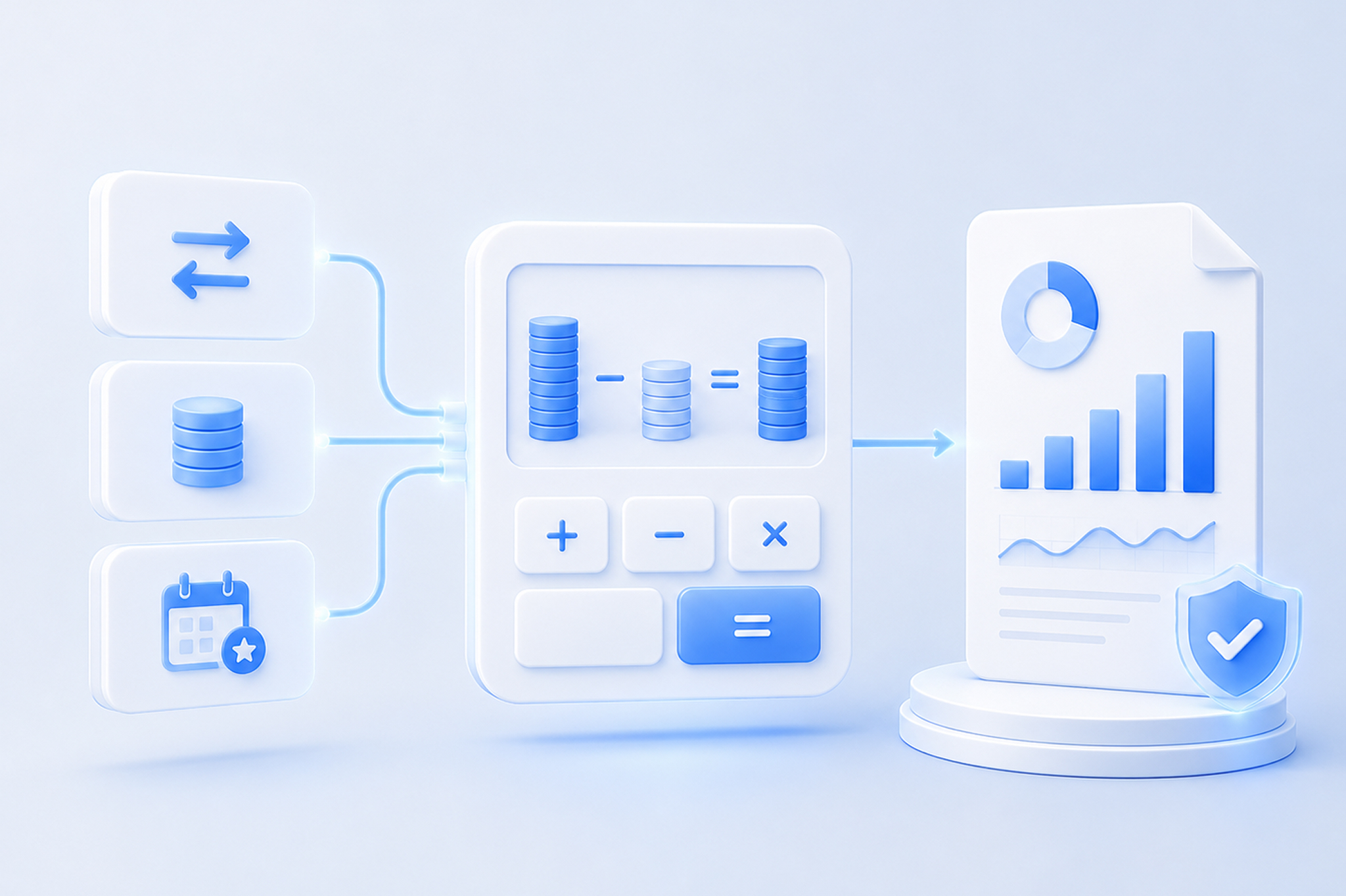
Your Bybit EU CSV export contains your raw trade history — but converting that into an accurate tax report requires calculating cost basis, holding periods and gains for every transaction.
The core calculation is straightforward: take what you received (proceeds), subtract what you paid (cost basis, calculated with FIFO), and the result is your taxable gain or loss. For German users, the 1-year holding period must also be tracked for each individual lot.
CoinTracking automates this across your full Bybit EU history and produces a report your accountant or local tax authority will accept. Import your CSV once and let CoinTracking handle the rest.
How to Import Bybit EU into CoinTracking
Three steps to upload your Bybit EU transaction history and generate your tax report.
- 1
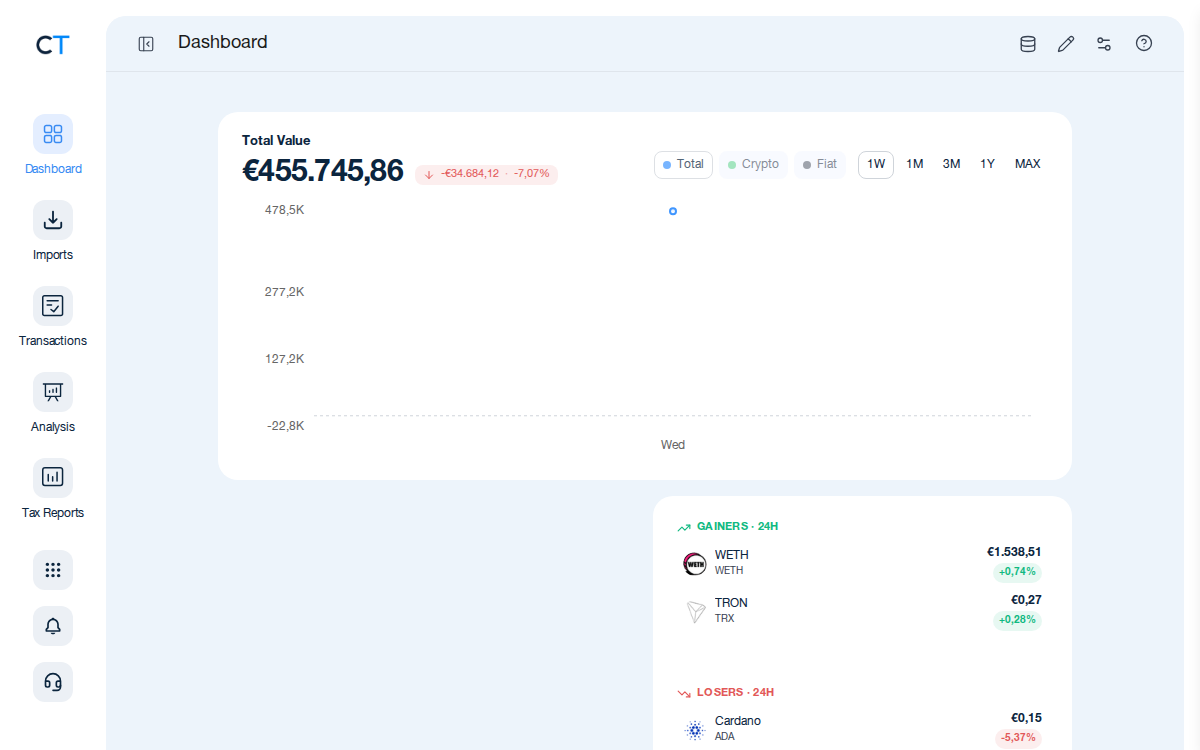
Log into CoinTracking and open Imports
After logging in, click the Import icon in the left navigation. This is where you connect all your exchanges, wallets and blockchains.
- 2
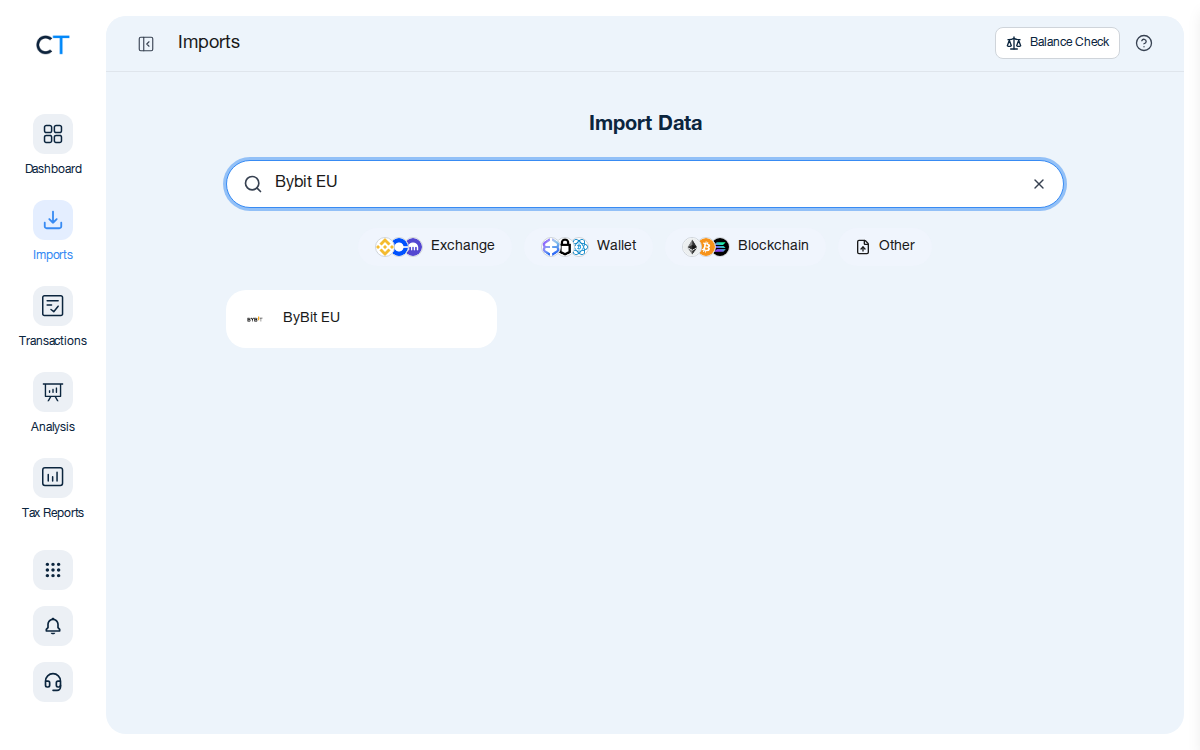
Search for Bybit EU in the import list
Type "Bybit EU" in the search field. CoinTracking will show the Bybit EU import option for CSV upload.
- 3
Upload your Bybit EU transaction history
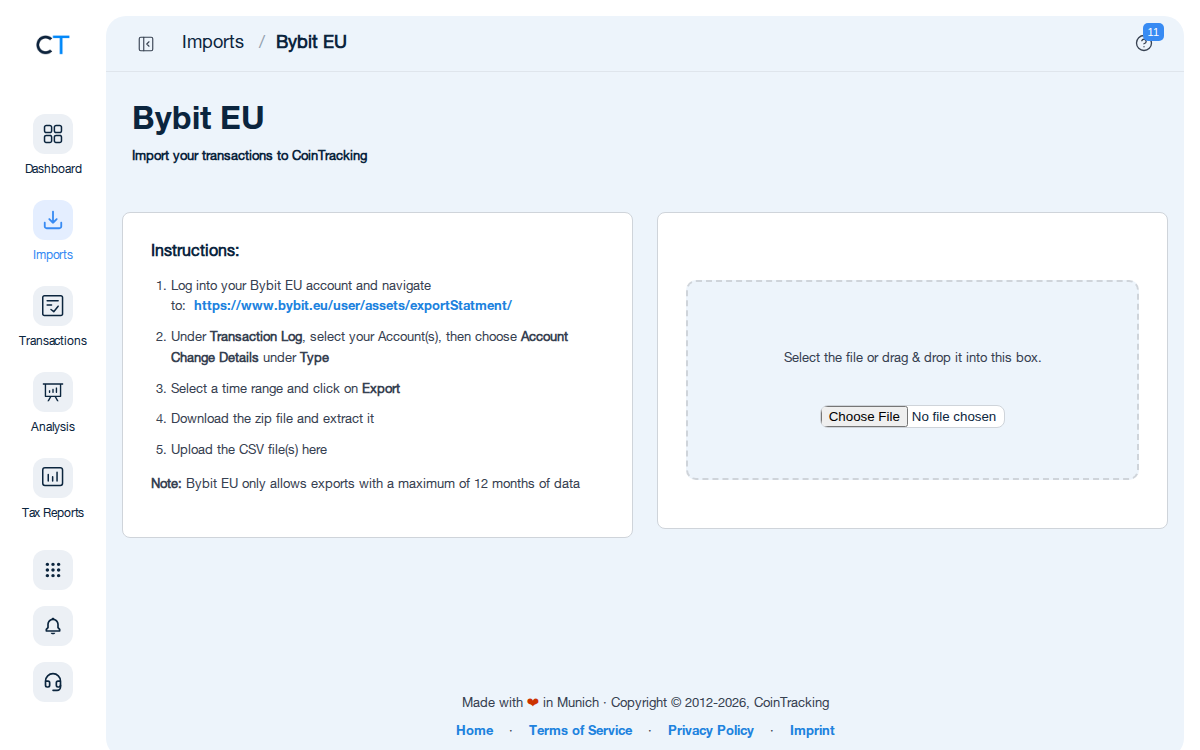
Log into Bybit EU, navigate to the transaction history export section, select your time period, download the CSV, and upload the file to CoinTracking.
"CoinTracking can handle just about any complex transaction you can throw at it and the automation is a real lifesaver. Of all the tax software tools we've reviewed, CoinTracking is the most detail-oriented and has more accuracy checks in place than the competition."

How to Create Your Bybit EU
Tax Report with CoinTracking
Three steps from CSV export to a tax report your accountant will accept.

Export your Bybit EU transaction history
Log into Bybit EU, navigate to the transaction history export section, select your time period, and download the CSV file.

Review your transactions
Open Reports → Validate Transactions. CoinTracking flags missing cost basis entries, duplicate imports and price gaps so your final report is accurate.

Generate and export your tax report
Select your country and tax year. CoinTracking generates a report formatted for your jurisdiction: PDF or Excel, ready to file or hand to your accountant.







No. Bybit EU does not generate a tax report for users. It offers a transaction history export in CSV format via the account settings. You are responsible for converting that data into a jurisdiction-specific tax report. CoinTracking imports your Bybit EU CSV and generates a complete, compliant report for your country.
Log into your Bybit EU account, navigate to the transaction history or account export section, select the time period you want to export, and download the CSV file. Then upload the CSV file directly into CoinTracking to generate your tax report.
Bybit EU is the European-regulated entity of Bybit, operating under EU MiCA (Markets in Crypto-Assets) regulation and licensed as a Crypto Asset Service Provider (CASP) in the European Union. It is subject to stricter EU compliance rules including DAC8 reporting. Global Bybit operates under different regulatory frameworks. If you trade on Bybit EU, use this guide — if you trade on global Bybit, visit Bybit Tax.
Yes. Bybit EU is a licensed Crypto Asset Service Provider (CASP) operating under EU MiCA regulation. As an EU-regulated exchange, Bybit EU is required under the DAC8 directive to report transaction data to national tax authorities from 2026. This means your Bybit EU trading history may be visible to your country's tax office.
In most EU countries, yes. Every sale, swap, or disposal of cryptocurrency is a taxable event. The gain or loss is the difference between your cost basis and the proceeds at the time of disposal. Tax-free thresholds and holding periods vary: Germany offers a 1-year exemption, Austria a flat 27.5% rate, Portugal a 1-year exemption for holdings since 2023.
Bybit EU supports CSV export for importing transaction data into tax software. Upload your Bybit EU CSV directly into CoinTracking to import your full transaction history and generate an accurate tax report. CoinTracking fully supports the Bybit EU CSV format.
Start Tracking Your Crypto Taxes Today
Experience why 2.2 million users trust CoinTracking — sign up today for a seven-day free trial!