Weex Taxes: How to Import Your Transactions & Generate Your Tax Report
Weex is a crypto exchange based in Hong Kong and Singapore offering spot and futures trading. Every trade, futures settlement and income event on Weex is a potential taxable event. CoinTracking imports your full Weex transaction history via CSV and generates a jurisdiction-specific tax report covering all spot trades, futures positions, deposits and withdrawals.

How to Import Your Weex Transactions into CoinTracking
Watch how to export your Weex transaction history as a CSV and import it into CoinTracking to generate your complete crypto tax report.
Start Your Free Weex Import- Every spot trade, futures settlement, crypto-to-crypto swap and withdrawal from Weex is a potential taxable event. Buying crypto with fiat creates cost basis but is not itself taxable. Tax compliance is your personal responsibility.
- CoinTracking supports Weex CSV import. Export your transaction history from Weex and upload it to CoinTracking. Spot trades, futures positions, deposits and withdrawals are all supported.
- Depositing fiat or crypto to Weex and holding crypto in your Weex account are generally not taxable events. Only disposals — trades, sales, futures settlements or outgoing transfers — trigger a tax obligation.
- Tax compliance is your responsibility. Weex is based in Hong Kong and Singapore and is not an EU-regulated CASP subject to DAC8. Your tax authority will not receive automatic reports from Weex via DAC8. You are required to report all taxable gains and income from your Weex activity in your annual tax return.
Weex and Your Crypto Tax Obligations
Weex is a cryptocurrency exchange headquartered in Hong Kong and Singapore, offering spot trading and futures contracts across a wide range of digital assets. The platform is designed for both retail and professional traders, providing access to perpetual and expiring futures alongside spot markets. Weex serves an international user base across Asia and beyond.
As a Hong Kong and Singapore-based exchange, Weex is not subject to EU DAC8 reporting obligations. This means your tax authority in the EU will not receive automatic reports of your Weex activity — you are responsible for declaring all taxable events in your annual tax return.
Weex users need to account for:
- Spot trades — selling crypto for fiat or swapping one crypto for another (taxable disposals)
- Futures positions — realised profit or loss on futures contracts (taxable in most jurisdictions)
- Funding fees on perpetual futures (may be deductible in some jurisdictions)
- Trading bonuses, referral rewards or airdrops received in crypto (taxable income at FMV)
Crypto Tax Basics for Weex Users
Weex is used internationally, with a strong user base in Asia, Europe and beyond. Here are the key tax rules that apply to Weex spot and futures activity.
Spot trading — each trade is a taxable disposal
When you sell cryptocurrency for fiat or swap one cryptocurrency for another on Weex, this constitutes a taxable disposal in most jurisdictions. The taxable gain or loss equals the difference between the proceeds (or fair market value of the crypto received) and your original acquisition cost. CoinTracking imports all Weex spot trade history and calculates each gain or loss using your chosen cost-basis method.
Futures trading — realised PnL is taxable
Profits and losses from Weex futures contracts are generally taxable. When a futures position is closed, the realised profit or loss must be reported. In most jurisdictions, futures profits are treated as capital gains or ordinary income. CoinTracking imports Weex futures trade data and calculates realised PnL for each closed position.
Funding fees on perpetual futures
Funding fees paid or received on perpetual futures contracts on Weex may be treated as income or deductible expenses depending on your jurisdiction. In Germany, for example, funding fees received may constitute taxable income. Consult a tax advisor for your specific situation. CoinTracking tracks funding fee flows in your imported data.
Bonuses and rewards are income
If you receive cryptocurrency as a trading bonus, referral reward or airdrop on Weex, this is generally treated as income at the fair market value of the crypto on the date it was received. The FMV at receipt becomes your cost basis for any future disposal. CoinTracking records these as income events in your tax report.
DAC8 is not applicable to Weex
The EU DAC8 directive requires EU-regulated crypto-asset service providers (CASPs) to automatically report transaction data to EU tax authorities from 1 January 2026. Weex is headquartered in Hong Kong and Singapore and is not regulated by EU authorities under MiCAR. It is not subject to DAC8. Users in the EU must self-report all Weex activity — it will not be reported on their behalf.
Weex Taxes by Country
Key crypto tax rules for countries where Weex is commonly used. Select your country for specific rates and requirements.
 Germany
- § 23 EStG: Spot trade gains taxed at personal rate (up to 45%) if disposed within 1 year; tax-free after 1 year
- Annual exemption: €1,000/year in private disposal gains
- Futures: Realised futures PnL is typically taxed as capital gains or other income — seek specific tax advice
- Cost basis: FIFO per wallet
- Forms: Anlage SO
 United Kingdom
- Capital Gains Tax: 18% (basic) / 24% (higher) from October 2024
- Annual exempt amount: £3,000 (2024/25)
- Futures: HMRC treats crypto derivatives gains as subject to CGT or income tax depending on the nature of activity
- Cost basis: Section 104 pooling (HMRC)
- Authority: HMRC
 United States
- Short-term gains: Ordinary income rates (up to 37%) for crypto held ≤1 year
- Long-term gains: 0%, 15% or 20% for crypto held >1 year
- Futures: Crypto futures may be subject to the 60/40 rule (Section 1256 contracts) depending on the contract type — consult a US tax advisor
- Cost basis: FIFO or specific identification (IRS)
- Authority: IRS
 Australia
- Capital Gains Tax: Spot disposals subject to CGT; 50% CGT discount for assets held >12 months
- Futures: Crypto futures gains may be treated as ordinary income or CGT depending on the nature of trading activity
- Cost basis: Cost base at time of acquisition; FIFO commonly applied
- Authority: ATO (Australian Taxation Office)
 Singapore
- Capital Gains Tax: Singapore does not have a capital gains tax — crypto held as a capital asset is generally not subject to CGT
- Trading activity: If crypto trading is your business or carried out in a business-like manner, gains may be taxable as income
- GST: Crypto-related services may be subject to GST — consult a local advisor
- Authority: IRAS (Inland Revenue Authority of Singapore)
Tax rules change frequently. This overview is for general information only. Consult a qualified advisor for your specific situation.
Are Weex Transactions Taxable?
In most jurisdictions, spot trades and futures settlements on Weex are taxable events. Use this as a starting reference — exact rules vary by country.
Taxable Events
- Selling crypto for fiat on Weex (spot trade disposal)
- Swapping one crypto for another (taxable disposal in most jurisdictions)
- Closing a futures position with a realised profit or loss
- Receiving trading bonuses, referral rewards or airdrops in crypto (income at FMV)
Not Taxable
- Buying crypto with fiat on Weex
- Depositing fiat or crypto to Weex
- Holding crypto or open futures positions in Weex
- Transferring crypto between your own wallets
Tax treatment varies by country. Always verify with a qualified advisor for your specific situation.
How to Calculate Your Weex Taxes
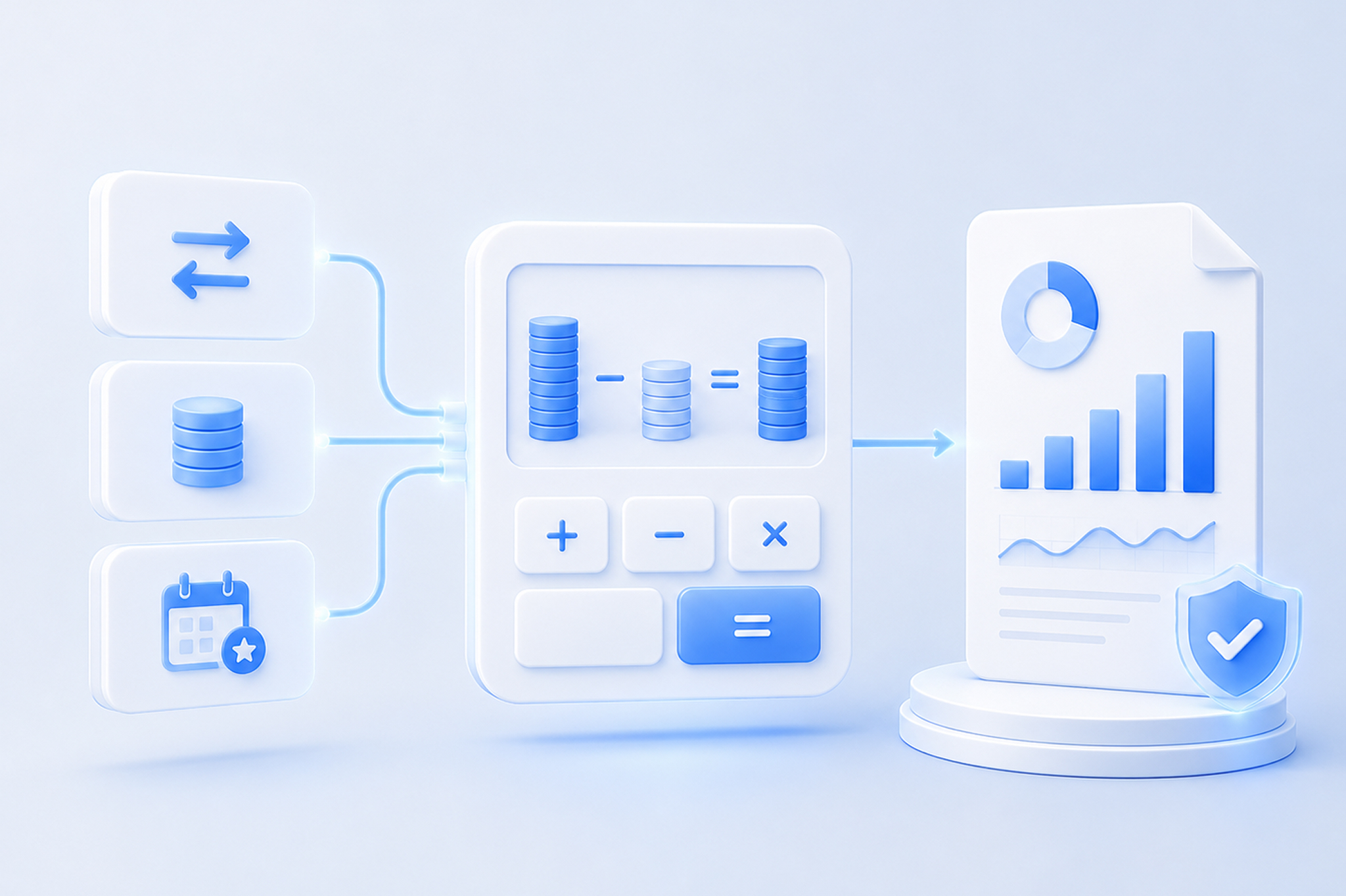
Active traders on Weex who combine spot and futures trading can accumulate hundreds or thousands of taxable events per year — each with its own entry price, exit price and cost basis. Manually tracking every trade, futures settlement and funding fee, then calculating FIFO gain/loss or realised PnL for each, is extremely time-consuming.
CoinTracking imports your full Weex transaction history from your CSV export, assigns the correct acquisition date and market price to every spot purchase, and calculates realised PnL for each futures position. It then generates a jurisdiction-specific tax report — ready for your accountant or tax authority in Germany, UK, the US, Australia and beyond.
How to Import Weex into CoinTracking
Three steps to import your Weex data and generate your tax report via CSV.
- 1
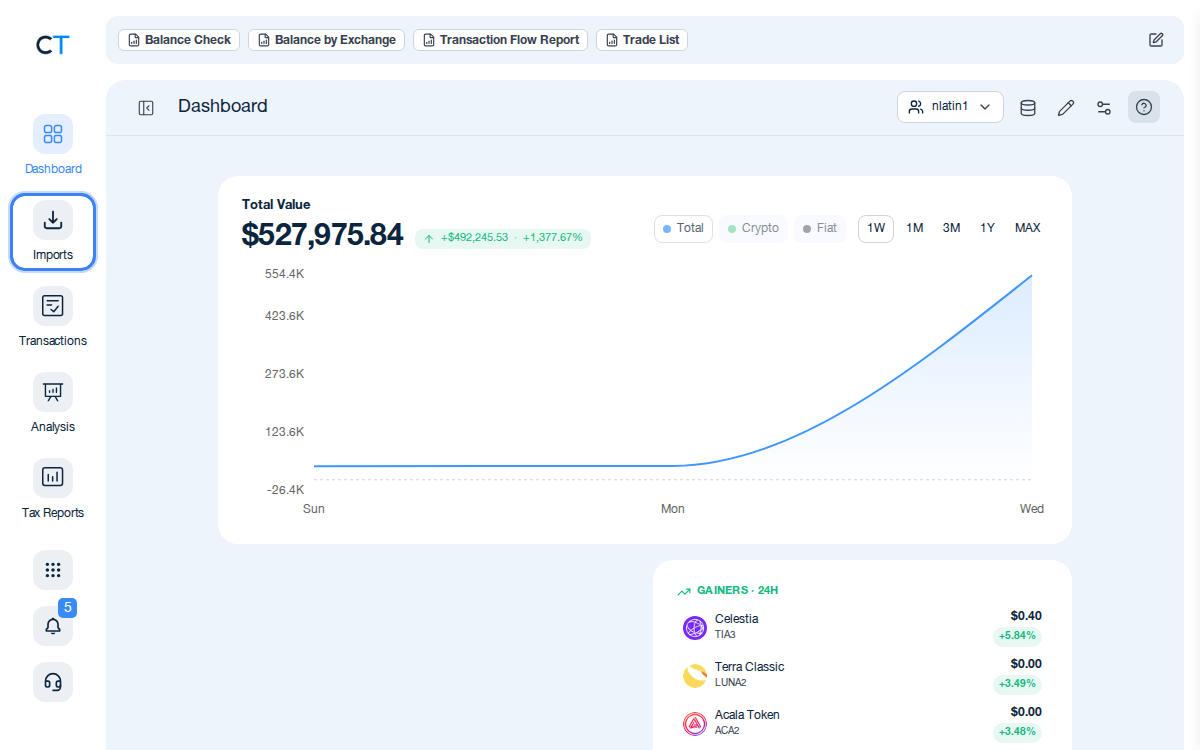
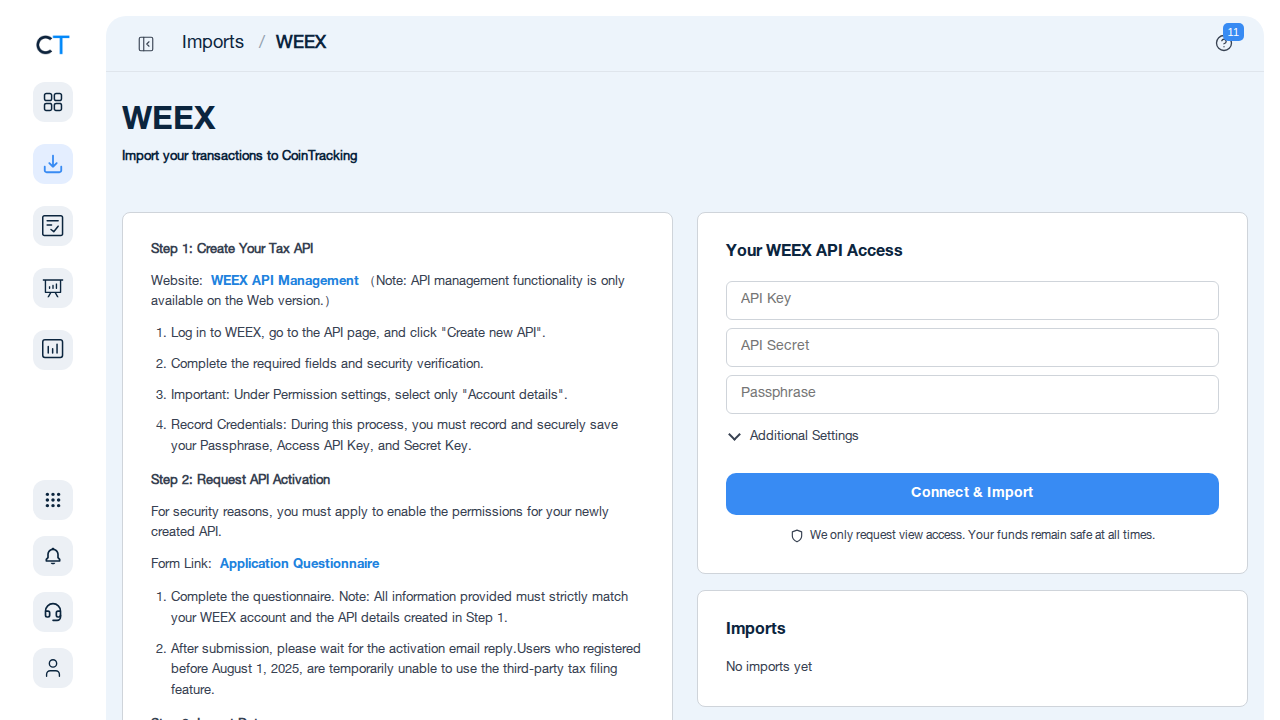
Log into CoinTracking and open Imports
After logging in, click the Import icon in the left navigation. This is where you add all your exchanges, wallets and blockchains. Search for Weex to start.
- 2
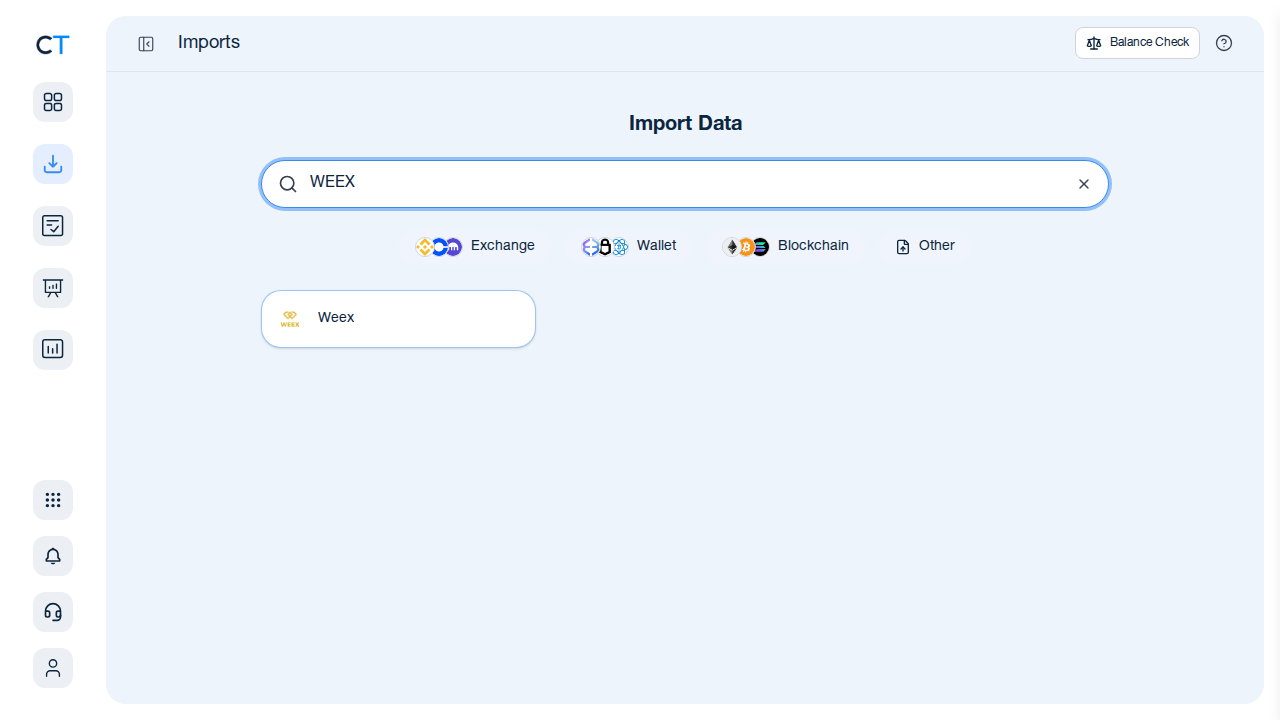
Download your Weex CSV and upload it
Log into your Weex account and navigate to the transaction history or reports section. Download your transaction history as a CSV file. In CoinTracking, search for Weex in the import search and upload the CSV. Spot trades, futures positions, deposits and withdrawals will all be imported.
- 3
Review transactions and generate your tax report
Once your Weex data is imported, validate the transactions and generate a tax report for your jurisdiction. CoinTracking calculates capital gains, income and losses — including each spot trade and futures settlement — and formats the output for your country, ready for your accountant or tax return.
"CoinTracking can handle just about any complex transaction you can throw at it and the automation is a real lifesaver. Of all the tax software tools we've reviewed, CoinTracking is the most detail-oriented and has more accuracy checks in place than the competition."

How to Create Your Weex
Tax Report with CoinTracking
Three steps from Weex CSV to a tax report your accountant will accept.

Import your Weex transactions
Download your CSV from Weex and upload it to CoinTracking. Spot trades, futures positions, deposits, withdrawals and any bonuses or rewards are all imported.

Review and validate your transactions
Open Reports → Validate Transactions. CoinTracking flags missing cost basis, missing prices and unresolved transfers so you can correct them before generating your report.

Generate your Weex tax report
Select your country and tax year. CoinTracking generates a jurisdiction-specific tax report in PDF or Excel format, covering all Weex gains, losses, futures PnL and income — ready to file or hand to your accountant.



No — Weex provides a transaction history export (CSV). CoinTracking imports this and generates your full tax report, including cost-basis tracking across all spot trades, futures positions, deposits and withdrawals.
Log into your Weex account and navigate to the transaction history or reports section. Download your transaction history as a CSV file and upload it to CoinTracking using the import search.
Yes — in most jurisdictions, profits from futures trading are taxable as capital gains or ordinary income depending on how they are classified. Each realised profit or loss from a futures position on Weex is a taxable event. CoinTracking imports Weex futures trade history and calculates gains and losses per position.
Weex is based in Hong Kong and Singapore and is not subject to EU DAC8 reporting obligations. Your tax authority will not receive automatic reports from Weex via DAC8. Tax compliance for your Weex activity is your personal responsibility in your country of residence.
Germany: FIFO per wallet (§ 23 EStG). UK: Section 104 pooling (HMRC). US: FIFO or specific identification (IRS). Australia: cost base at acquisition; FIFO commonly applied (ATO). CoinTracking supports FIFO, LIFO, HIFO and all major methods.
Yes — in most jurisdictions, receiving cryptocurrency as a trading bonus, referral reward or airdrop is taxable income at the fair market value on the date of receipt. The FMV at receipt also becomes your cost basis for any future disposal. CoinTracking records these as income events in your tax report.
Start Tracking Your Crypto Taxes Today
Experience why 2.2 million users trust CoinTracking — sign up today for a seven-day free trial!