BTC-E Taxes: How to Report Your Historical Crypto Gains
BTC-E was seized by US authorities in 2017 and is no longer operational. But if you traded on BTC-E before the closure, those transactions are still taxable events. CoinTracking lets you import your historical BTC-E trade data, calculate your gains, and generate a tax report ready for your tax authority.

How to Import Your BTC-E Transactions into CoinTracking
Watch how to use CoinTracking's offline BTC-E importer to paste your historical trade data and generate a crypto tax report for your historical BTC-E activity.
Start Your Free BTC-E Import- BTC-E was seized by the US Department of Justice in July 2017. The exchange is offline — but every crypto trade executed on BTC-E before that date remains a potential taxable event.
- Import type: offline clipboard paste. If you have a copy of your BTC-E trade history, paste it directly into CoinTracking's BTC-E importer — no API or CSV file required.
- Missing records? CoinTracking also supports manual transaction entry, so you can reconstruct your BTC-E history from blockchain explorers, bank statements, or old email confirmations.
- Tax obligations do not expire when an exchange closes. Unreported BTC-E gains from 2014–2017 may still be subject to tax, interest and penalties depending on your jurisdiction's statute of limitations.
BTC-E: A Defunct Exchange With Lasting Tax Implications
BTC-E was a major cryptocurrency exchange launched around 2011 and primarily associated with Russian operators. At its peak it handled a significant share of global Bitcoin trading volume, serving users worldwide across Bitcoin, Litecoin, Namecoin and several other cryptocurrencies.
In July 2017, US and international authorities seized the btc-e.com domain and arrested Alexander Vinnik, the alleged operator, on charges including money laundering. The exchange has been offline ever since. A successor platform briefly attempted to operate under the WEX branding but ultimately also failed.
For tax purposes, this means:
- Every sale, swap or use of crypto on BTC-E before the seizure is a taxable event in most jurisdictions
- There is no BTC-E API or live connection — import requires pasting your saved trade history into CoinTracking's offline importer
- CoinTracking calculates cost basis and capital gains from whatever historical data you can provide

Crypto Tax Basics: What BTC-E Users Need to Know
Historical crypto trades from 2014–2017 are subject to the same tax rules as trades made today. The exchange being offline does not change your obligations.
Every disposal was a taxable event
In most countries, selling or swapping crypto triggers capital gains tax at the time of the transaction. If you sold Bitcoin for Litecoin on BTC-E in 2016, that swap was a taxable disposal in many jurisdictions — even though the exchange is now gone.
Statutes of limitation still apply
Most jurisdictions have a statute of limitations on tax assessments — typically 3 to 7 years from the filing deadline. However, fraudulent or non-disclosed income often resets or removes those limits entirely. Filing a corrected or late return proactively is almost always better than risking an assessment after an audit.
Reconstructing your records
If you no longer have your BTC-E transaction data, CoinTracking supports manual trade entry so you can reconstruct your history from blockchain explorer records, bank fiat deposit confirmations, or any saved screenshots of your BTC-E account. Even a best-effort reconstruction is better than zero disclosure.
BTC-E Historical Taxes by Country
If you traded on BTC-E, you may need to file amended returns or late disclosures. These are the key rules for the countries where CoinTracking users most commonly held BTC-E accounts.
 Germany
- Disposal tax: Personal income tax rate (up to 45%); gains are tax-free if held longer than 1 year (Haltefrist)
- Annual exemption: Gains up to €600/year are tax-free (€1,000 from 2024)
- Statute of limitations: Generally 4 years; 10 years for tax evasion
- Cost basis: FIFO
- Authority: Finanzamt
- Forms: Anlage SO, Anlage KAP
 United Kingdom
- Capital Gains Tax: 18% (basic rate) or 24% (higher rate) from October 2024
- Annual exempt amount: £3,000 (2024/25 onward)
- Statute of limitations: 4 years for innocent errors; 20 years for fraud or deliberate non-disclosure
- Cost basis: Section 104 pool (HMRC rules)
- Authority: HMRC
- Forms: Self Assessment SA100, SA108
 Spain
Spain
- Savings income (IRPF): 19% up to €6,000; 21% up to €50,000; 23% up to €200,000; 27% up to €300,000; 28% above
- Statute of limitations: Generally 4 years from the filing deadline
- Authority: Agencia Tributaria (AEAT)
- Forms: Modelo 100 (IRPF), Modelo 721
 Poland
- Flat rate: 19% on all crypto gains (no holding period exemption)
- Loss carryforward: Up to 5 years
- Cost basis: FIFO
- Authority: Urząd Skarbowy
- Form: PIT-38
 Italy
Italy
- Flat rate: 26% on gains exceeding €2,000/year (from 2023)
- Statute of limitations: Generally 5 years; extended for non-disclosure
- Authority: Agenzia delle Entrate
- Forms: Quadro RT (gains), Quadro RW (foreign holdings)
 Portugal
- Disposal tax: 28% on gains from crypto held less than 1 year (from 2023)
- Long-term holding: Tax-free on disposal if held 1 year or longer
- Authority: Autoridade Tributária (AT)
- Forms: Modelo 3, Anexo G or Anexo J
 United States
- Short-term gains (held under 1 year): Ordinary income tax (10-37%)
- Long-term gains (held 1 year or longer): 0%, 15%, or 20% depending on income
- Statute of limitations: 3 years (ordinary); 6 years (substantial understatement); unlimited for fraud
- Authority: IRS
- Forms: Form 8949, Schedule D
 France
- Flat 30% tax (PFU): Gains from crypto disposals subject to prelevement forfaitaire unique — 12.8% income tax + 17.2% social charges.
- Statute of limitations: Generally 3 years from the end of the tax year
- Authority: Direction generale des Finances publiques (DGFiP). Declare via Formulaire 2086.
 Austria
- 27.5% capital gains tax: Since March 2022, crypto is taxed like shares — a flat 27.5% KESt applies to gains.
- Old coins grandfathered: Crypto acquired before 28 February 2021 is tax-free on disposal — which covers most BTC-E-era holdings.
- Authority: Finanzamt Austria. Report via Einkommensteuererklarung (E1 / E1kv).
Tax rules for historical crypto filings vary significantly. This overview is for general information only. Consult a qualified advisor for amended or late returns.
Were Your BTC-E Transactions Taxable?
BTC-E transactions from 2014–2017 follow the same tax rules as current trades. Here is a quick reference for common transaction types.
Taxable Events
- Selling crypto for fiat (USD, EUR, etc.)
- Swapping one cryptocurrency for another
- Using crypto to pay for goods or services
- Receiving crypto as income or mining reward
Not Taxable
- Buying and holding crypto (no disposal)
- Depositing fiat to BTC-E
- Transferring crypto between your own wallets
- Receiving crypto as a personal gift
Tax treatment varies by country and year. CoinTracking applies the rules for your selected jurisdiction automatically across historical data.
How to Calculate Your Historical BTC-E Taxes
Calculating gains on historical BTC-E trades is challenging without tooling. You need the acquisition date and cost, the disposal date and proceeds, and a consistent cost-basis method — typically FIFO — applied across every trade in chronological order.
BTC-E processed trades in BTC, LTC, NMC, NVC, PPC, USD and EUR pairs. CoinTracking handles all of these, applies historical price data for missing cost-basis entries, and produces a gain-and-loss report spanning the full history you can provide.
Even a partial trade history is better than none. CoinTracking flags any gaps so you know exactly what is and isn't covered in your report.

How to Import BTC-E into CoinTracking
Three steps to load your historical BTC-E trade data and generate your tax report.
- 1
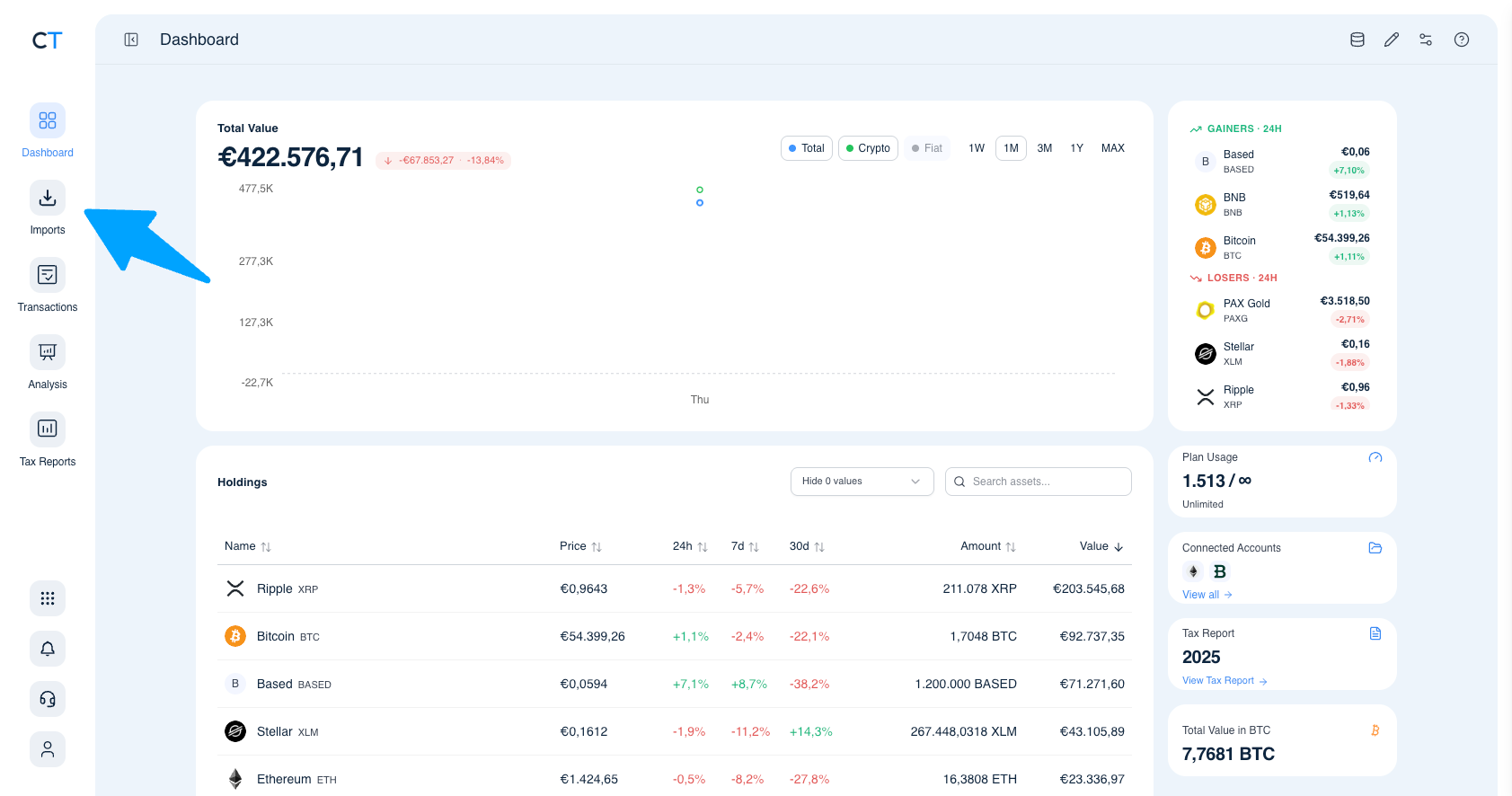
Log into CoinTracking and open Imports
After logging in, click the Import icon in the left navigation. This is where you connect all your exchanges, wallets and blockchains.
- 2
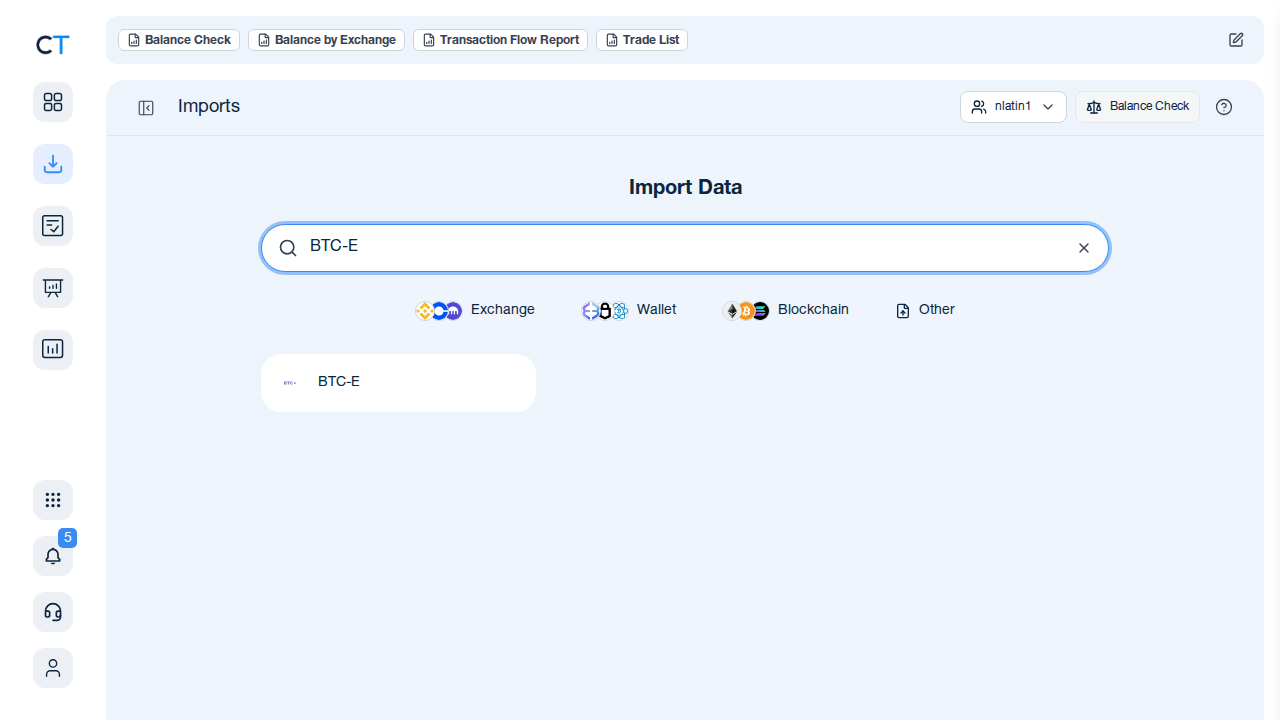
Search for BTC-E in the import list
Type "BTC-E" in the search field. CoinTracking will show the BTC-E offline import option.
- 3
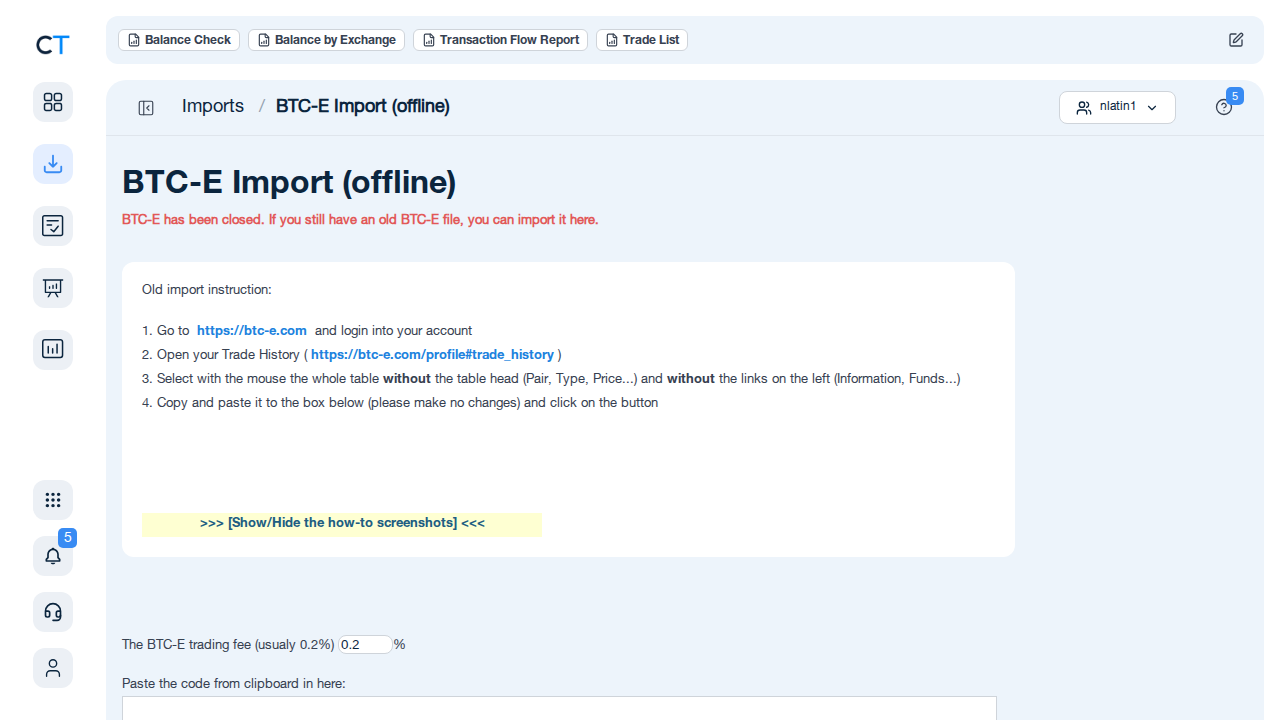
Paste your BTC-E trade history
On the BTC-E import page, paste your saved trade history table into the input box and click the import button. CoinTracking processes your historical data and adds all trades to your portfolio.
"CoinTracking can handle just about any complex transaction you can throw at it and the automation is a real lifesaver. Of all the tax software tools we've reviewed, CoinTracking is the most detail-oriented and has more accuracy checks in place than the competition."

How to Create Your BTC-E
Tax Report with CoinTracking
Three steps from raw trade history to a tax report your accountant will accept.

Gather your BTC-E trade history
Locate any saved copies of your BTC-E trade data — a saved HTML page, spreadsheet, email records, or screenshots. If you have no data, reconstruct trades from blockchain explorer records using your old BTC-E deposit addresses.

Review and validate your transactions
Open Reports → Validate Transactions. CoinTracking flags missing cost basis entries, duplicate imports and price gaps so your historical report is as accurate as possible.

Generate and export your tax report
Select your country and the relevant tax years. CoinTracking generates a gain-and-loss report formatted for your jurisdiction, covering your full BTC-E history.





BTC-E was one of the world's largest cryptocurrency exchanges until July 2017, when the US Department of Justice seized its domain and servers and arrested the alleged operator Alexander Vinnik. The exchange has not been operational since. However, if you traded on BTC-E before the seizure, every sale or swap of crypto is a potential taxable event. The closure of an exchange does not erase your tax obligations — those gains must still be declared.
Yes. In most jurisdictions, the tax obligation arises at the time of the transaction, not when you file. Cryptocurrency transactions from 2014–2017 on BTC-E are still reportable. Statutes of limitation vary by country — typically 3 to 10 years — but undeclared income can extend or remove those limits entirely. It is always better to file a correct return, even late, than to leave unreported gains on the table.
CoinTracking provides an offline import for BTC-E. If you saved your trade history before the seizure, you can paste it directly into CoinTracking's BTC-E importer. Navigate to Imports → search for "BTC-E" → click the BTC-E card. The import page accepts the raw trade table pasted from clipboard. CoinTracking then calculates your gains and generates a tax report.
BTC-E is offline, so logging into your account is no longer possible. If you have a saved copy of your trade history — a screenshot, spreadsheet, email confirmation, or locally saved HTML page — you may be able to reconstruct your transaction history. CoinTracking also supports manual entry of individual trades for cases where digital records are incomplete.
If your BTC-E records are lost, you have a few options: (1) search for blockchain-level transaction records on public explorers using your BTC or ETH addresses from that period; (2) check old email confirmations or account statements from your bank for fiat deposits and withdrawals; (3) consult a tax advisor about making reasonable best-effort estimates. Incomplete records are not a reason to skip filing — a good-faith attempt to reconstruct trades is always better than non-disclosure.
Possibly. When US authorities seized BTC-E, substantial user data and transaction records were obtained as part of the investigation. Several jurisdictions have since received or requested access to parts of that data. Additionally, if you converted BTC-E proceeds to fiat through a regulated bank or exchange, those institutions may have reported transaction data. Proactively declaring historical gains puts you in a far better position than waiting to be contacted.
Start Tracking Your Crypto Taxes Today
Experience why 2.2 million users trust CoinTracking — sign up today for a seven-day free trial!