STEX Taxes: How to Import Historical Data & Generate Your Tax Report
STEX was an Estonian cryptocurrency exchange that ceased operations in 2023. Despite the platform's closure, tax obligations for all trades executed during its active period remain fully in force. CoinTracking imports your historical STEX data and generates a tax report covering any outstanding prior-year liability.

How to Import Your STEX Transactions into CoinTracking
Watch how to upload your historical STEX transaction data into CoinTracking and generate your complete crypto tax report — even for a closed exchange.
Start Your Free STEX Import- Every crypto trade and disposal made on STEX was a taxable event in the year it occurred. Capital gains tax and income tax obligations remain fully in force for all prior tax years — the closure of the exchange does not change this.
- CoinTracking can import historical STEX trading data from a CSV export if you saved one before the platform became inaccessible. Manual entry is also available for trades reconstructed from emails or other records.
- Transferring crypto between your own wallets is generally not a taxable event. Only buying, selling, or trading crypto constitutes a disposal triggering tax.
- STEX ceased operations in 2023. You can still import historical data if you have a CSV export saved. Your tax obligations for trades made on STEX remain in effect — all gains and income from prior years must be declared. If you have undeclared STEX activity, consider voluntary disclosure to your tax authority.
STEX and Your Crypto Tax Obligations
STEX was founded in Estonia and offered trading across hundreds of altcoin pairs, giving retail traders access to a wide range of smaller tokens. The platform became inaccessible to users in 2023 amid financial difficulties, with funds recovery ongoing for affected users.
Estonia is an EU member state, and STEX operated under Estonian regulation. The platform's closure does not affect traders' tax obligations for historical trades. Tax authorities in most countries require crypto traders to declare all disposals in their annual returns — regardless of whether the exchange is still operating.
If you have historical STEX data:
- Upload any saved CSV export to CoinTracking using the import search
- Use CoinTracking's manual entry for trades reconstructed from emails or screenshots
- Generate back-tax reports for any prior year to catch outstanding obligations
- CoinTracking supports FIFO, LIFO, HIFO and other methods for historical trades
Crypto Tax Basics for Former STEX Traders
STEX ceased operations in 2023, but tax obligations from its active years span multiple prior tax filings. Here is what former STEX users need to understand about their ongoing crypto tax obligations.
Historical trades are still taxable regardless of closure
In most jurisdictions, a crypto disposal is taxable in the year it occurred — not when you first realise or report the gain. Trades made on STEX in any prior year are subject to the tax rules of those years. Waiting to declare does not eliminate the obligation; it can increase it through interest and late-filing penalties.
Voluntary disclosure reduces penalties
If you have undeclared STEX activity from prior years, most tax authorities offer a voluntary disclosure programme where taxpayers can self-report errors and omissions in exchange for reduced or waived penalties. In Germany this is the Selbstanzeige (§ 371 AO); in the UK it is the HMRC Voluntary Disclosure process; in Estonia it is handled through EMTA. Proactively disclosing is almost always preferable to an audit.
EU jurisdiction — but DAC8 does not apply retroactively
Although STEX was an Estonian company operating under EU jurisdiction, it ceased operations before the DAC8 framework came into force on 1 January 2026. DAC8 requires crypto-asset service providers (CASPs) to report user data to EU tax authorities, but STEX is no longer operational and will not be making these reports. Estonian tax authorities may have obtained user data through regulatory or insolvency proceedings, but self-reporting is the safest approach and remains legally required regardless.
Record reconstruction — if no CSV export was saved
Tax authorities typically require crypto traders to retain records for at least 5 to 7 years (longer in some jurisdictions). If you no longer have your STEX transaction history, try to reconstruct trades from email confirmations, blockchain records for on-chain assets, or bank statements showing fiat movements to and from STEX. CoinTracking's manual entry feature allows you to reconstruct trades from partial records, and the resulting report can serve as your best-available-information filing.
STEX Taxes by Country
Crypto tax rules vary by jurisdiction. Here are the key rates and rules for countries where STEX was commonly used.
 Germany
- § 23 EStG: Gains taxed at personal income tax rate (up to 45%) if sold within 1 year; tax-free if held over 1 year
- Freigrenze: €1,000/year in private disposal gains exempt
- Cost basis: FIFO per wallet
- Voluntary disclosure: Selbstanzeige (§ 371 AO) — possible to self-report prior-year gains
- Forms: Anlage SO
 Estonia
- Income tax rate: 20% flat rate on crypto gains; no separate capital gains tax rate
- Treatment: Crypto treated as property; disposal triggers income tax
- Cost basis: Actual cost of each asset acquired
- Authority: Tax and Customs Board (EMTA — Maksu- ja Tolliamet)
- Reporting: Annual income tax return required; all crypto disposals must be declared
 United Kingdom
- Capital Gains Tax: 18% (basic rate) / 24% (higher rate) from October 2024
- Annual exempt amount: £3,000 (2024/25 onward)
- Cost basis: Section 104 pooling (HMRC)
- Voluntary disclosure: HMRC Voluntary Disclosure process for prior-year errors
 United States
- Short-term gains: Ordinary income tax rates (up to 37%) for assets held ≤1 year
- Long-term gains: 0%, 15% or 20% for assets held >1 year
- Cost basis: FIFO or specific identification
- Voluntary disclosure: IRS Voluntary Disclosure Program (VDP) for prior-year unreported income
- Authority: IRS
 Finland
- Capital gains tax: 30% on gains up to €30,000; 34% on gains above €30,000
- Capital losses: Deductible against capital gains in the same year or carried forward for 5 years
- Cost basis: FIFO per asset type
- Authority: Finnish Tax Administration (Verohallinto)
 Netherlands
- Box 3 wealth tax: Crypto declared as assets; effective rate ~1.2–2% of year-end value
- No realised capital gains tax for private investors
- Authority: Belastingdienst
Tax rules change frequently. This overview is for general information only. Consult a qualified advisor for your specific situation.
Are STEX Transactions Taxable?
In most jurisdictions, every crypto trade on STEX was a taxable event. Use this as a starting reference — exact rules vary by country and year.
Taxable Events
- Selling crypto for fiat on STEX (historical)
- Trading one crypto for another on STEX
- Any crypto disposal on the platform
Not Taxable
- Deposits to STEX from your own wallet (historical)
- Withdrawals from STEX to your own wallet
- Holding crypto in your STEX account
Tax treatment varies by country and by the tax year in which the trade occurred.
How to Calculate Your STEX Taxes
STEX traders who made many trades across multiple altcoin pairs may have complex cost-basis chains that are difficult to unwind manually — especially years after the fact. Calculating historical gains accurately requires knowing the market price of each asset at the time of each trade.
CoinTracking imports your historical STEX data, applies your chosen cost-basis method (FIFO, LIFO, HIFO), uses its built-in historical price database to fill in any missing market prices, and generates a complete tax report for the relevant years. The result is a jurisdiction-specific report ready for your accountant, covering any historical liability from your STEX trading activity.
How to Import STEX into CoinTracking
Three steps to import your historical STEX data and generate your tax report.
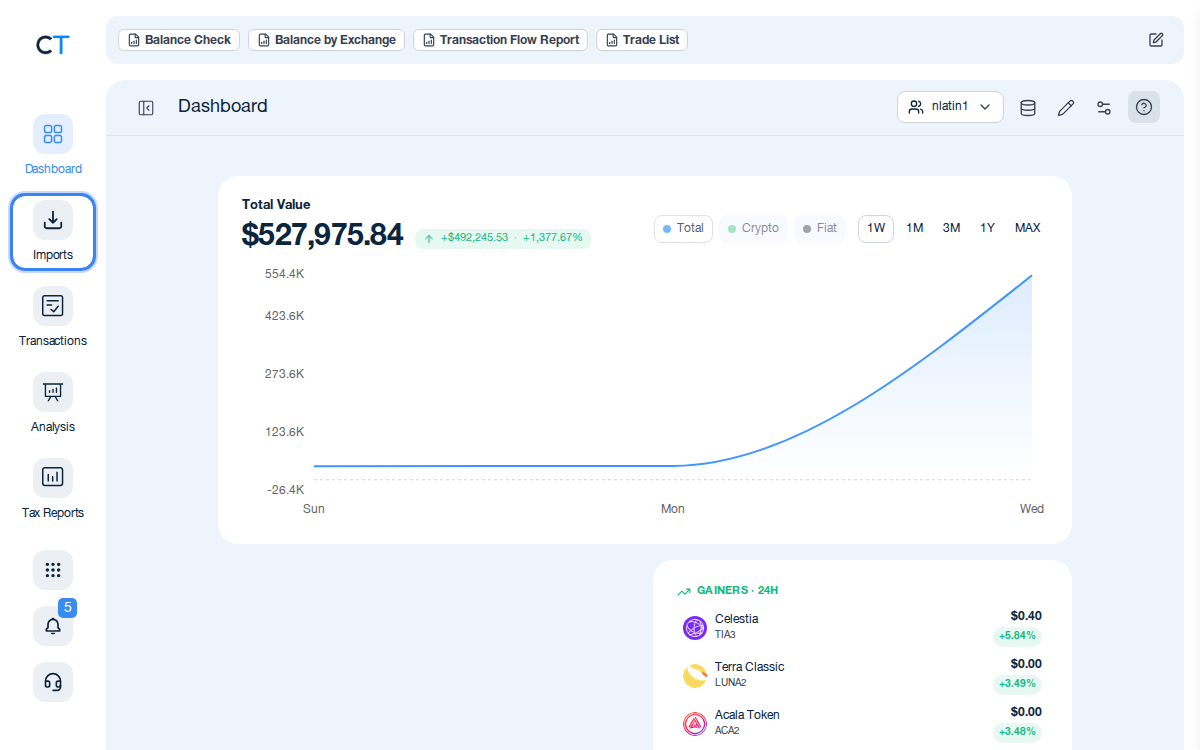
- 1
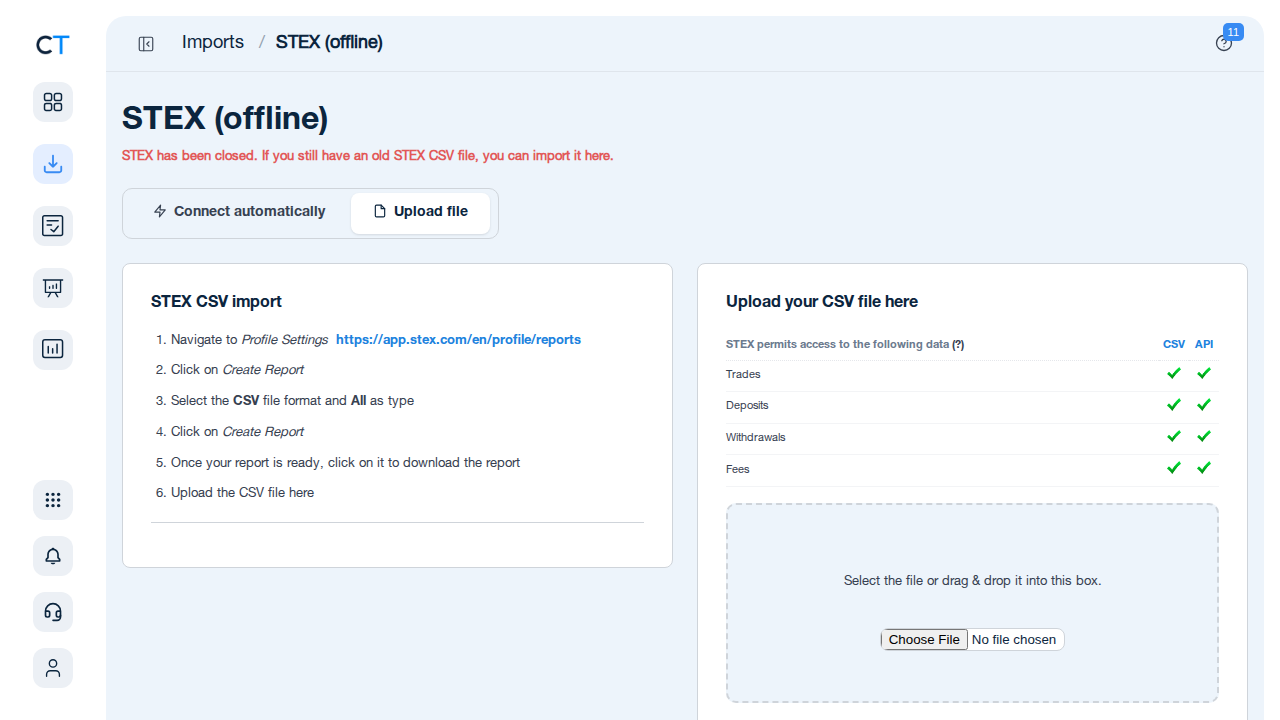
Log into CoinTracking and open Imports
After logging in, click the Import icon in the left navigation. This is where you add all your historical exchange data, wallets and blockchains.
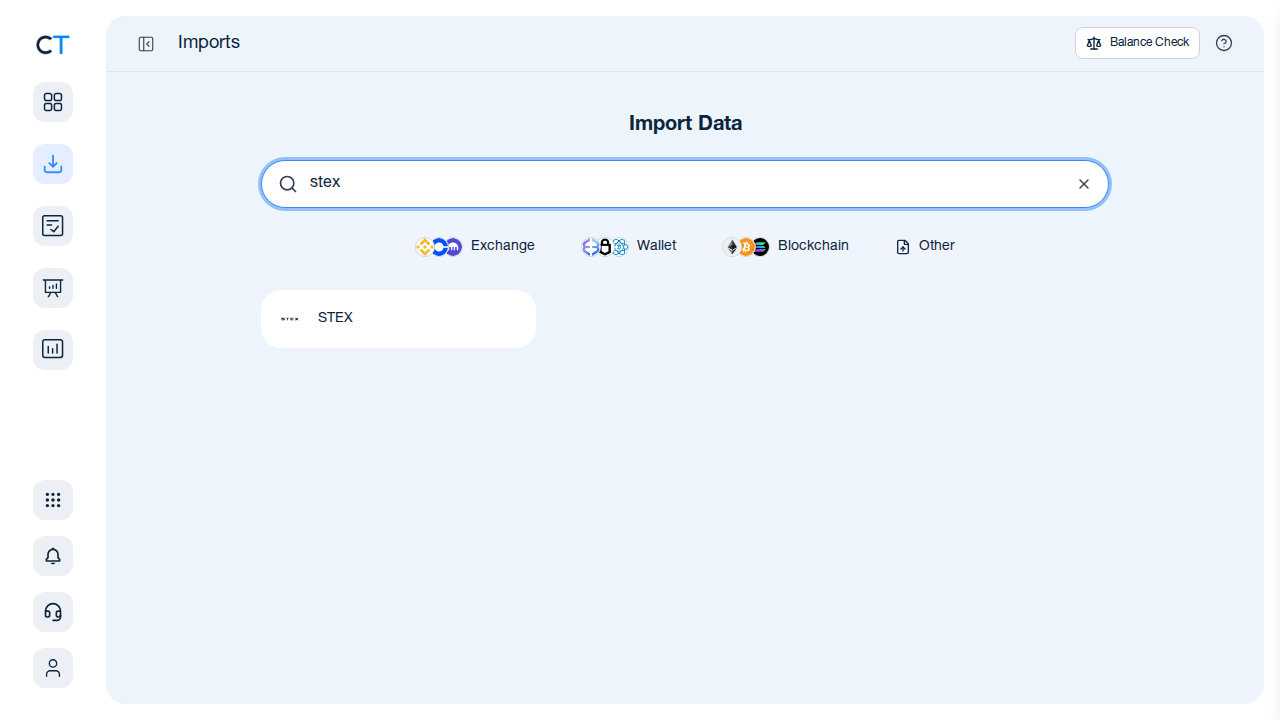
- 2
Search for STEX or use CSV import
Type "STEX" in the import search. If a direct match is not available, use the CSV import option to upload your saved STEX transaction export. CoinTracking supports a wide range of legacy and closed exchange CSV formats.
- 3
Review and generate your back-tax report
Once your historical STEX data is imported, validate the transactions and generate a tax report for the relevant prior years. CoinTracking calculates gains and losses using FIFO (or your chosen method) and formats the report for your jurisdiction.
"CoinTracking can handle just about any complex transaction you can throw at it and the automation is a real lifesaver. Of all the tax software tools we've reviewed, CoinTracking is the most detail-oriented and has more accuracy checks in place than the competition."

How to Create Your STEX
Tax Report with CoinTracking
Three steps from historical CSV to a tax report your accountant will accept.

Import your historical STEX data
Upload your saved STEX CSV to CoinTracking or use manual entry for reconstructed records. All historical altcoin trades and transfers are supported.

Review and validate your transactions
Open Reports → Validate Transactions. CoinTracking flags missing cost basis, duplicate imports and price gaps — especially important when working with historical data from a closed exchange.

Generate your back-tax report
Select your country and the relevant prior tax year. CoinTracking generates a jurisdiction-specific report in PDF or Excel format, ready to file or hand to your accountant.





No — STEX is defunct. The platform ceased operations in 2023 and no longer generates any reports. If you saved a CSV export of your transaction history before the platform became inaccessible, CoinTracking can import it and generate your complete crypto tax report, covering all gains, losses and income from your historical STEX activity.
If you exported your STEX transaction history before the platform became inaccessible, upload the CSV to CoinTracking using the import search. CoinTracking supports a wide range of CSV formats from legacy and closed exchanges. Manual entry is available for trades reconstructed from email confirmations, screenshots, or other records. Document your reconstruction methodology for tax authority records.
Yes. Tax obligations arose in the year each trade was made. The platform's closure does not extinguish these obligations. Capital gains and income from STEX activity are taxable in the year the disposal occurred — not when you first realise or report the gain. If you have undeclared activity from prior tax years, voluntary disclosure is strongly advisable.
STEX ceased operations before DAC8 reporting obligations took effect on 1 January 2026. It is unlikely to file DAC8 reports for historical data. However, Estonian tax authorities may have obtained user data through regulatory or insolvency proceedings. Self-reporting remains the safest approach and is required regardless of whether any exchange report is filed.
The correct method depends on your jurisdiction. Germany requires FIFO per wallet (§ 23 EStG). Estonia uses the actual cost of each asset. The UK applies Section 104 pooling (HMRC). The US allows FIFO or specific identification. CoinTracking supports FIFO, LIFO, HIFO and other methods and applies the correct rules for your selected country.
Try to reconstruct trades from email confirmations, blockchain records for on-chain assets, or bank statements showing fiat deposits and withdrawals to STEX. CoinTracking's manual entry feature lets you enter historical trades individually if no automated import is available. Document your reconstruction methodology for tax authority records in case of a later review.
Start Tracking Your Crypto Taxes Today
Experience why 2.2 million users trust CoinTracking — sign up today for a seven-day free trial!